
Comprehensive Guide to Sharp Cut Cyclones (SCC): Precision PM1, PM2.5, and PM10 Sampling for Air Quality Monitoring
In the field of environmental science and industrial hygiene, the ability to accurately measure and categorize particulate matter (PM) is paramount. For professionals utilizing instruments such as nephelometers, photometers, and carbon monitors, the quality of the data collected is directly dependent on the precision of the inlet system. Sharp Cut Cyclones (SCC) represent the gold standard in size-selective sampling, providing the accuracy required for high-stakes ambient and indoor air quality assessments. This article explores the technical specifications, applications, and operational advantages of the BGI Ambient Particulate Inlets Matrix provided by Mesa Labs.
What are Sharp Cut Cyclones (SCC)?
Sharp Cut Cyclones are specialized aerodynamic separators designed to remove particles larger than a specific "cut-point" from an air stream. In air sampling, the D50 cut-point refers to the particle size at which 50% of the particles are collected and 50% are passed through to the monitoring instrument.
The primary purpose of using an SCC is to isolate specific fractions of particulate matter, such as PM1, PM2.5, or PM10, which are critical for regulatory compliance and health impact studies. Unlike traditional impactors, these cyclones offer a "sharp" efficiency curve, ensuring that the transition between collected and bypassed particles is as narrow as possible, hence the name "Sharp Cut".
Key Applications for SCC Technology
The versatility of the SCC lineup makes them suitable for a wide range of scientific and industrial applications. According to the sources, these inlets are primarily utilized for:
- Ambient Sampling: Monitoring outdoor air quality in urban, industrial, or rural environments.
- Indoor Air Quality (IAQ) Sampling: Assessing the safety and cleanliness of air within office buildings, schools, and manufacturing plants.
- Speciation Sampling: Collecting specific types of particulates for chemical analysis to determine their source or toxicity.
- Health-Related Monitoring: Specifically targeting respirable and thoracic fractions of dust that can penetrate deep into the human respiratory system.
The Mesa Labs BGI SCC Matrix: Model Breakdown
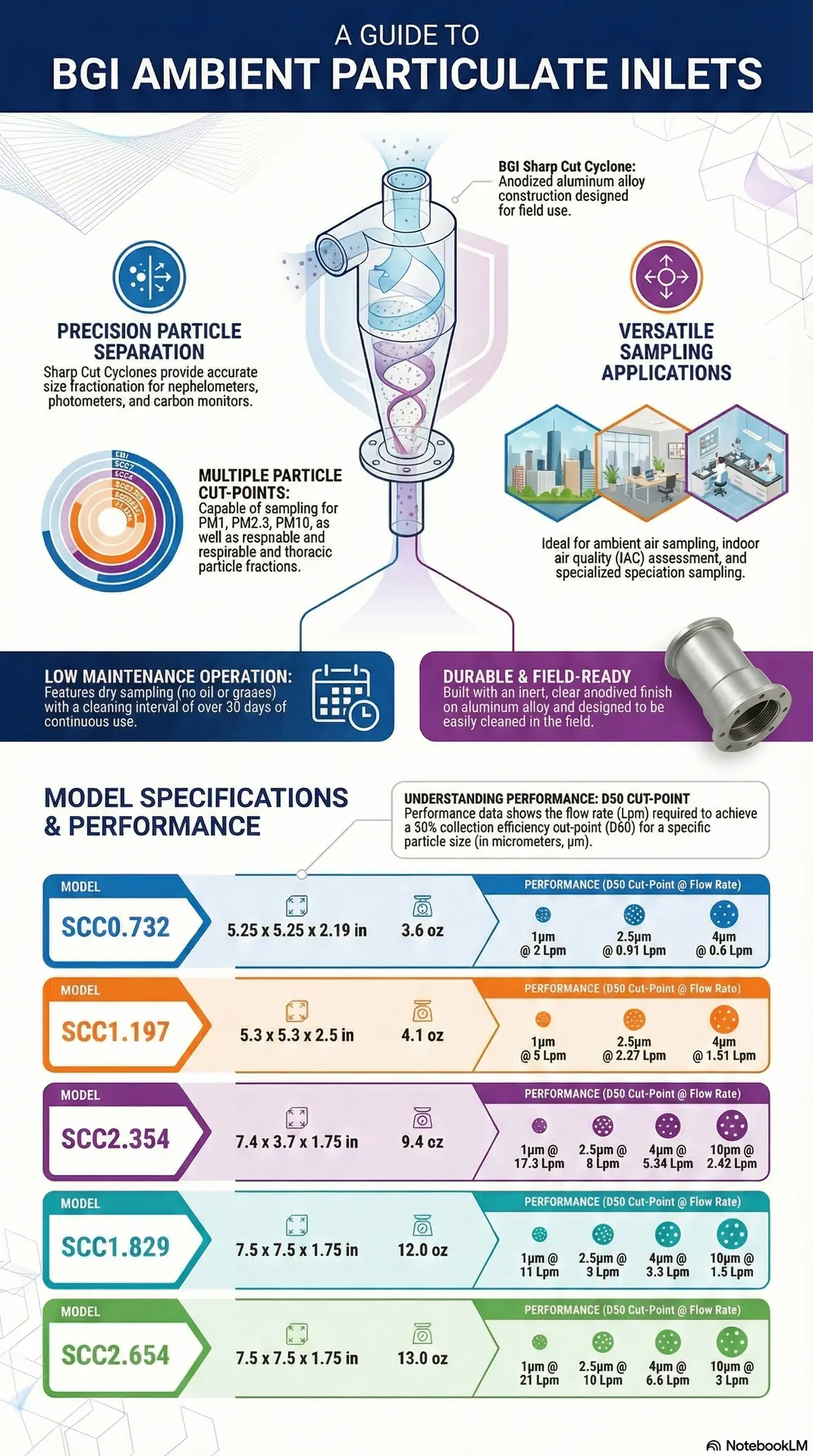
Selecting the correct Sharp Cut Cyclone requires balancing the desired particle size cut with the flow rate of your monitoring equipment. The sources identify five primary models, each optimized for specific operational parameters.
1. SCC0.732: The Ultra-Low Volume Specialist
The SCC0.732 is designed for high-precision, low-volume sampling. It is the lightest model in the series, weighing only 3.6oz, with compact dimensions of 5.25 x 5.25 x 2.19 inches.
- Primary Application: PM1 sampling at a flow rate of 2 LPM.
- Flow Rate Dynamics: At 2 LPM, the D50 is exactly 1 µm. If the flow rate is reduced to 0.91 LPM, the cut-point shifts to 2.5 µm, and at 0.6 LPM, it reaches 4 µm.
2. SCC1.197: Optimized for PM1 and PM2.5
With a weight of 4.1oz and dimensions of 5.3 x 5.3 x 2.5 inches, the SCC1.197 is a versatile mid-range cyclone.
- Primary Application: Achieving a PM1 cut-point at a flow rate of 5 LPM.
- Alternative Cut-points: By adjusting the flow to 2.27 LPM, the device provides a 2.5 µm cut, and at 1.51 LPM, it provides a 4 µm cut.
3. SCC1.829: High-Efficiency PM2.5 Monitoring
The SCC1.829 is a robust unit weighing 12oz and measuring 7.5 x 7.5 x 1.75 inches. It is a popular choice for standard PM2.5 monitoring.
- Primary Application: Delivering a 2.5 µm cut-point at a flow rate of 5 LPM.
- Operational Range: This model can achieve a 10 µm cut at 1.5 LPM, a 4 µm cut at 3.3 LPM, and even a fine 1 µm cut if the flow is increased to 11 LPM.
4. SCC2.354: The 8 LPM Powerhouse
Weighing 9.4oz and measuring 7.4 x 3.7 x 1.75 inches, the SCC2.354 is specifically calibrated for higher flow rate requirements.
- Primary Application: Optimized for PM2.5 at a flow rate of 8 LPM.
- Variable Cuts: It provides a 10 µm cut at 2.42 LPM, a 4 µm cut at 5.34 LPM, and a 1 µm cut at a high flow of 17.3 LPM.
5. SCC2.654: Maximum Throughput
The SCC2.654 is the heaviest unit in the matrix at 13oz, sharing the 7.5 x 7.5 x 1.75 inch footprint of the SCC1.829.
- Primary Application: Achieving a PM2.5 cut-point at 10 LPM.
- Performance Versatility: This model is capable of handling extreme flow ranges, offering a 10 µm cut at 3 LPM and a 1 µm cut at 21 LPM.
Critical Technical Advantages
The BGI Sharp Cut Cyclones are engineered for long-term reliability in the field. Several features distinguish them from competing inlet technologies:
Dry Sampling Technology
One of the most significant advantages of the SCC series is that they utilize dry sampling. Unlike impactors that may require oil or grease to prevent "particle bounce," these cyclones function without any messy lubricants. This ensures that the sampled air remains uncontaminated by foreign substances, which is critical for carbon monitors and chemical speciation.
Superior Material and Finish
Durability is essential for ambient sampling equipment exposed to the elements. These cyclones are constructed from a high-quality aluminum alloy and feature an inert clear anodize finish. This finish protects the device from corrosion while ensuring the interior surfaces remain chemically neutral, preventing the loss of reactive particles to the walls of the cyclone.
Low Maintenance and Field Cleanability
Maintenance intervals are a major concern for remote monitoring stations. The SCC matrix is designed for continuous operation, with a recommended cleaning interval of greater than 30 days. Furthermore, the units are field cleanable, allowing technicians to maintain the equipment on-site without the need for specialized laboratory tools or factory recalibration.
Understanding the Relationship Between Flow Rate and D50
As demonstrated in the technical data provided by the sources, the particle size cut-point (D50) is inversely proportional to the flow rate. For example, in the SCC2.654 model:
- A low flow of 3 LPM results in a large cut-point of 10 µm (PM10).
- An intermediate flow of 10 LPM results in a 2.5 µm cut (PM2.5).
- A high flow of 21 LPM results in a fine 1 µm cut (PM1).
This relationship allows a single SCC model to be adapted for different monitoring goals simply by adjusting the pump flow of the connected instrument, provided the instrument can handle the required volume.
Summary of Technical Specifications
| Model | Target Cut | Flow Rate (LPM) | Weight | Dimensions (in) |
| SCC0.732 | PM1 | 2 LPM | 3.6oz | 5.25 x 5.25 x 2.19 |
| SCC1.197 | PM1 | 5 LPM | 4.1oz | 5.3 x 5.3 x 2.5 |
| SCC1.829 | PM2.5 | 5 LPM | 12oz | 7.5 x 7.5 x 1.75 |
| SCC2.354 | PM2.5 | 8 LPM | 9.4oz | 7.4 x 3.7 x 1.75 |
| SCC2.654 | PM2.5 | 10 LPM | 13oz | 7.5 x 7.5 x 1.75 |
(Data compiled from sources and)
Conclusion: Why Choose BGI Sharp Cut Cyclones?
For professionals at aavos.be looking to provide the highest level of accuracy in air quality monitoring, the Mesa Labs BGI SCC series is an indispensable tool. Their ability to provide precise PM1, PM2.5, and PM10 cuts across various flow rates, combined with their field-cleanable design and dry sampling capabilities, makes them a superior choice for both ambient and indoor applications. Whether you are performing speciation sampling or routine air quality checks, these cyclones ensure that your data is both accurate and reproducible.
Analogy for Understanding Cut-Points: Think of a Sharp Cut Cyclone like a high-speed centrifugal sorter at a fruit packaging plant. As the air (and dust) spins rapidly inside the cyclone, the heavier "fruit" (larger particles) is flung to the outside and collected in a bin, while the smaller, lighter "fruit" (the PM fraction you want to measure) stays in the center and moves forward to the scanner. By changing the speed of the air (the flow rate), you can precisely control whether only the tiny grapes pass through, or if the larger oranges are allowed to follow as well.