High-precision instruments for air quality monitoring, particle measurement, and environmental analysis – built for reliability, accuracy, and compliance.
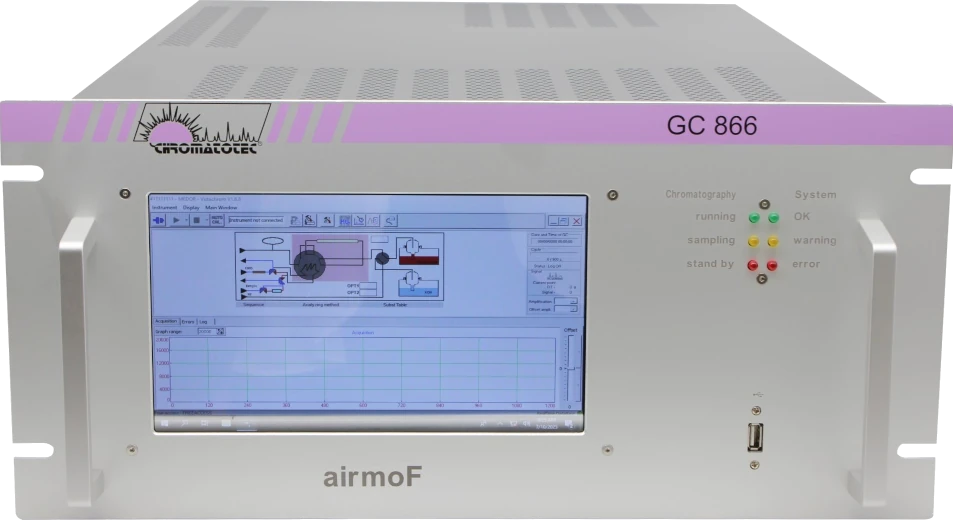
ormaldehyde monitoring usually means one of two things: sending DNPH cartridges to a laboratory and waiting days for results, or running a continuous analyser that reports concentrations as they happen. The airmoF, built by Chromatotec, belongs to the second category. It measures formaldehyde online using a microfluidic Hantzsch reaction coupled to fluorescence spectrometry, without a gas cylinder and without a filter cartridge to replace between cycles.
The airmoF draws a small air sample and reacts it with a liquid reagent inside a microfluidic circuit. The Hantzsch reaction converts formaldehyde into a fluorescent compound, which is then quantified by a photomultiplier-based fluorescence detector. Each measurement cycle takes 20 minutes, giving five results per hour — frequent enough to track short-term exposure peaks rather than only a daily average.
Calibration is carried out using either gaseous formaldehyde from a cylinder or the instrument's embedded permeation tube, which removes the need to keep calibration gas cylinders on site for routine checks.
Detection limit: < 0.1 µg/m³ (< 0.08 ppb)
Detection range: 0–737 µg/m³ (0–600 ppb)
Precision (RSD): Better than 3% over 48 hours
Detector: Fluorescence spectrometry (photomultiplier)
Cycle time / resolution: 20 minutes per cycle, 5 measurements per hour
Gas operating conditions: 5–40 °C, 20–80% RH, atmospheric pressure
Sample flow: 250 ml/min
Zero gas: Zero air or nitrogen, 250 ml/min
Liquid reagent consumption: 30 ml/day
Gas connection: 1/8″
Power supply: Input 100–240 V AC ±10%, 47–63 Hz, 1.5 A max; output 15 V / 6.67 A (100 W)
Power consumption: Max 75 W
Dimensions (19″ rack): H 222 mm (355 mm with bottle) × W 482 mm × D 600 mm (859 mm with bottle)
Weight: 15 kg
Operating conditions: 0–40 °C, 20–80% RH
Storage conditions: 0–40 °C, 0–85% RH
Outputs: 4 or 8 × 4-20 mA or 0/10 V (optional); Modbus RTU/JBUS or Bayern-Hessen protocol
Data interfaces: USB (data transfer), Ethernet (communication and remote control)
The 20-minute cycle time and low reagent consumption make the airmoF suited to situations where formaldehyde needs to be tracked continuously rather than sampled once and sent away for analysis:
Material-emissions testing labs will find the FLEC® and canister compatibility relevant where formaldehyde off-gassing from building products needs to be quantified under controlled conditions rather than in occupied space.
Standard accessories supplied with the airmoF include DNPH tubes and rings, a particle filter and filter strainer, and the liquid handling set: a 1 L reagent bottle, 1 L waste bottle, and 500 mL water bottle with storage and analysis caps.
Optional items depend on the installation:
Because the reagent is consumed continuously (30 ml/day), sites running the airmoF unattended for extended periods should plan reagent bottle replacement into their maintenance schedule — this is a supply consideration rather than a fault condition.
The instrument runs in standard or expert mode from a colour touchscreen, covering analysis setup, sequence launching, monitoring, and maintenance alerts. Data can be pulled off via USB or accessed remotely over Ethernet. For sites integrating into a wider monitoring network, the Modbus RTU/JBUS and Bayern-Hessen protocol options allow the airmoF to report into existing SCADA or air-quality network software rather than operating as a standalone unit.
The manufacturer's documentation does not list a specific standard, approval, or certification for the airmoF. Where formal compliance with a reference method is a tender requirement, this should be confirmed directly with Chromatotec before specification.
AAVOS supports formaldehyde monitoring projects from product selection through to day-to-day operation: sizing the sampling configuration for the site, arranging installation and commissioning, and providing calibration and maintenance support once the analyser is running. For continuous installations, reagent supply planning and periodic service visits are typically arranged as part of a service agreement rather than left to ad hoc ordering.
What does the airmoF measure?
Formaldehyde (HCHO) concentration in air, expressed in µg/m³ or ppb.
What is the measurement principle?
A microfluidic Hantzsch reaction converts formaldehyde into a fluorescent compound, quantified by a photomultiplier-based fluorescence detector.
Does it need a gas cylinder to operate?
No gas cylinder is required for routine sampling. Calibration can use either a gas cylinder or the instrument's embedded permeation tube.
How often does it produce a result?
Every 20 minutes, giving five measurements per hour.
Is the airmoF certified to a specific standard?
The manufacturer's documentation does not specify a certification. This should be confirmed for tender or regulatory applications.
What consumables does it need?
Liquid reagent (approximately 30 ml/day), plus periodic replacement of the reagent, waste and water bottles.
Can it be integrated into an existing monitoring network?
Yes — via Modbus RTU/JBUS, Bayern-Hessen protocol, or 4-20 mA / 0-10 V analogue outputs, alongside Ethernet for remote access.
Is it suitable for material emissions testing?
Yes — it is compatible with canisters and the FLEC® emission-testing system.
Contact AAVOS for technical advice, configuration support or a quotation.
Nous utilisons des cookies pour vous offrir une meilleure expérience utilisateur sur ce site web. Politique de cookies