High-precision instruments for air quality monitoring, particle measurement, and environmental analysis – built for reliability, accuracy, and compliance.
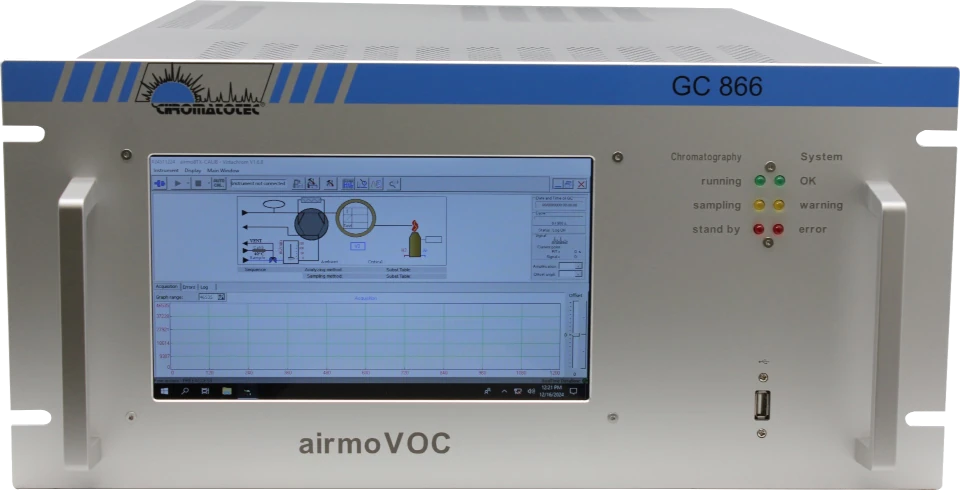
Methanol, ethanol, acetone and acetaldehyde are awkward compounds to track with a standard VOC analyser. They elute early on a gas chromatography column, they are highly polar, and they tend to pass straight through sorbent traps designed for heavier hydrocarbons. Chromatotec built the airmoOVOC C1C3, part of the Auto-GC 866 analyser range, specifically to handle this group of light oxygenated VOCs, with a dedicated preconcentration stage and flame ionisation detection capable of resolving concentrations down to 0.1 ppb.
The airmoOVOC C1C3 is an online gas chromatograph that runs unattended, cycle after cycle, drawing an air sample, preconcentrating it, separating the target compounds on a metallic capillary column and quantifying them by FID. A full analysis cycle takes 30 minutes in the standard configuration, which is enough for continuous, near-real-time tracking of methanol, ethanol, ethylene oxide, acetone, IPA and acetaldehyde at ambient or process-level concentrations.
Because the instrument is built around Chromatotec’s modular Auto-GC platform, it shares its architecture – and much of its serviceability – with the rest of the 866 range. That matters for anyone already operating other Chromatotec analysers on the same site or monitoring network: consumables, calibration logic and the Vistachrom software environment stay consistent across instruments.
Sample air passes through a 6-port valve onto a single sorbent trap built as a 3-phase bed, a configuration chosen because light oxygenated compounds do not retain well on a single sorbent material across the whole C1–C3 range. The trap is thermally desorbed onto a metallic capillary column rather than a fused-silica column; metallic columns tolerate the repeated thermal cycling and the polarity of alcohols and aldehydes better over the long analyser lifetimes expected in continuous monitoring.
Separation is followed by flame ionisation detection. FID is the appropriate choice here rather than PID or PID-hybrid detection, because it responds reliably to the full carbon range of these compounds, including partially oxidised species such as acetaldehyde, without the calibration drift that photoionisation detectors can show on polar VOCs. Carrier gas is hydrogen, which also fuels the flame, so the gas supply for the instrument is simpler than analysers that need a separate carrier and FID fuel gas.
The compound list – methanol, ethanol, ethylene oxide, acetone, IPA and acetaldehyde – points the airmoOVOC C1C3 towards a specific set of monitoring problems rather than general-purpose VOC screening:
Environmental agencies and monitoring network operators running fixed ambient stations; industrial hygienists and EHS teams tracking solvent exposure; process engineers at sites using methanol, ethanol, IPA or ethylene oxide; environmental consultants carrying out fence line or compliance studies; and quality and environmental teams in food and beverage production where ethanol or acetaldehyde levels need continuous tracking.
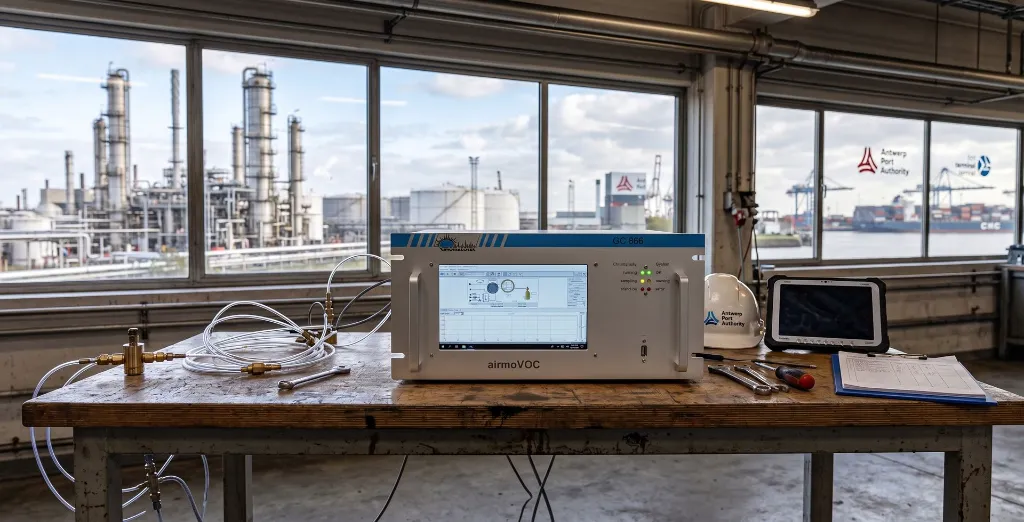
Environmental monitoring networks, chemical and solvent-handling industries, food and beverage manufacturing, ports and industrial estates with fence line monitoring obligations, and research institutes studying urban or indoor VOC chemistry.
Technical specification sheet (TSP) for the airmoOVOC C1C3. Additional documentation, including application notes for specific monitoring scenarios, is available from AAVOS on request.
AAVOS supplies and supports the airmoOVOC C1C3 across Belgium, the Netherlands and Luxembourg, including installation, commissioning and calibration on site. Because the instrument sits within a wider Chromatotec Auto-GC range, choosing the right trap configuration, detection range and stream selector setup for a given monitoring point benefits from someone who has specified these systems before. AAVOS also provides ongoing calibration and maintenance contracts, which matters for an analyser expected to run continuously for months between service visits.
What does the airmoOVOC C1C3 measure?
Methanol, ethanol, ethylene oxide, acetone, IPA (isopropanol) and acetaldehyde, using gas chromatography with flame ionisation detection.
What is the detection limit?
Below 0.1 ppb, which is suitable for ambient background concentrations of light oxygenated VOCs, not only elevated process or fence line levels.
How long does one measurement cycle take?
30 minutes in the standard configuration.
Can the analyser monitor more than one sampling point?
Yes, with the optional multiple stream selector, which supports between 2 and 6 sampling streams from a single analyser.
Why does it use FID rather than PID?
Flame ionisation detection responds consistently across the carbon range of these compounds, including partially oxidised species such as acetaldehyde, without the drift on polar VOCs that photoionisation detectors can show.
Is the airmoOVOC C1C3 suitable for unattended, continuous operation?
Yes. It is designed to run cycle after cycle with automatic data storage, and automatic validation and calibration are available as an option to reduce manual intervention.
Which standards or certifications does it hold?
Not specified by the manufacturer on the source documentation reviewed. AAVOS can request certification and standards-compliance documentation directly from Chromatotec where a project has a specific regulatory requirement.
Can it be integrated into an existing monitoring network?
Yes, through the optional MODBUS/JBUS or MGS1 communication protocol, or via the 4–20 mA analogue output.
Other analysers in the Chromatotec Auto-GC 866 range covering wider VOC, BTEX and hydrocarbon speciation; ambient air monitoring stations; and calibration and gas generation accessories (hydrogen and zero-air generators) for existing GC-FID installations.
Speak to AAVOS about specifying the airmoOVOC C1C3 for your monitoring point, including trap configuration, detection range and stream selector layout. Contact AAVOS International bv for a quotation, technical documentation, or a site assessment.
Nous utilisons des cookies pour vous offrir une meilleure expérience utilisateur sur ce site web. Politique de cookies