High-precision instruments for air quality monitoring, particle measurement, and environmental analysis – built for reliability, accuracy, and compliance.
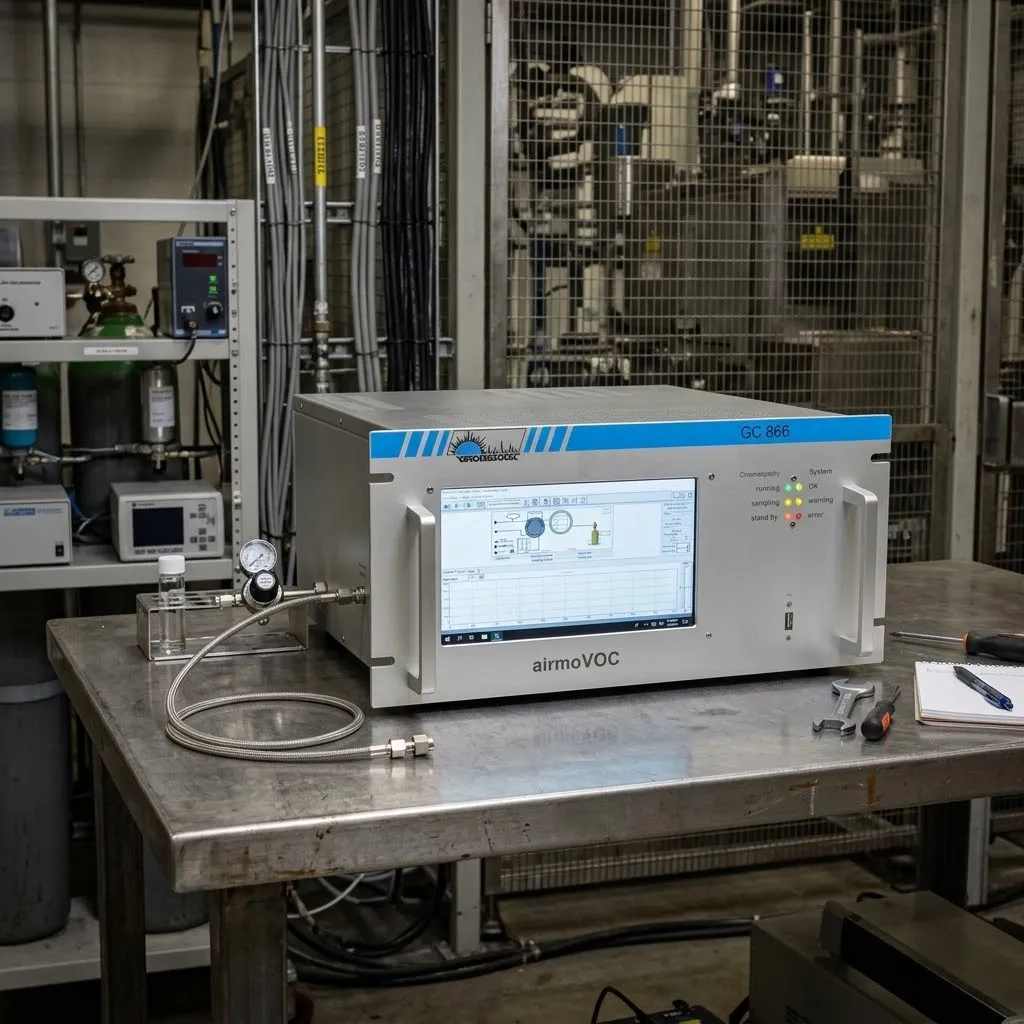
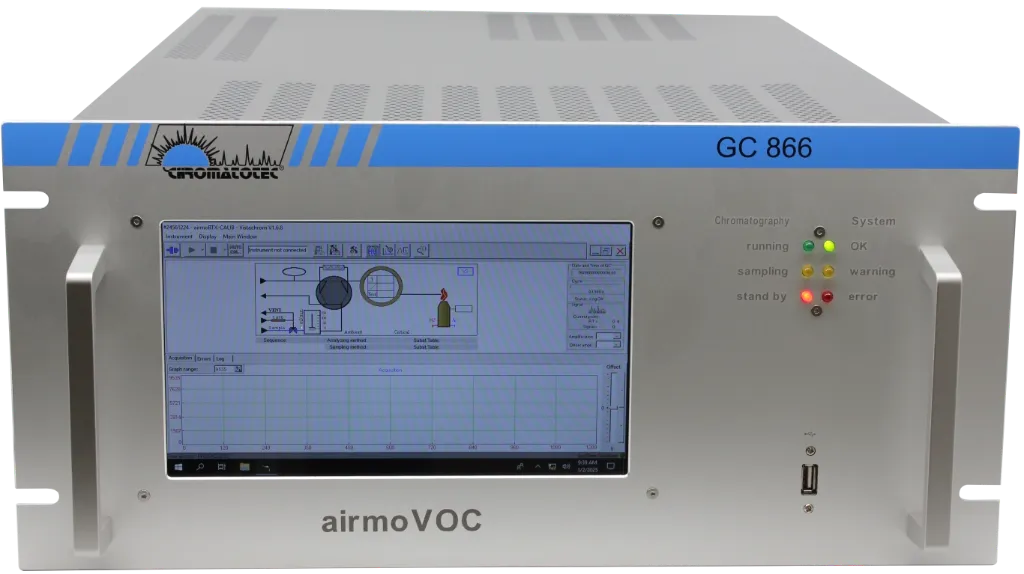
Benzene is the compound regulators watch most closely in ambient air networks, and it is also the hardest to measure reliably at trace level. The airmoVOC BTX, built by Chromatotec, is a gas chromatograph with FID detection developed specifically for continuous, unattended monitoring of benzene, toluene, ethylbenzene and xylenes (BTEX) in outdoor air. AAVOS supplies, commissions and services the instrument across Belgium, the Netherlands and Luxembourg.
The airmoVOC BTX combines automatic sample pre-concentration with capillary gas chromatography and flame ionisation detection. Ambient air is drawn through an adsorbent trap, where the target compounds are collected before being thermally desorbed and injected onto a metallic capillary column under a controlled temperature gradient. The FID detector then quantifies each compound as it elutes.
This design is what allows the instrument to reach sub-ppt detection limits for benzene while running as an unattended, cyclical monitor rather than a laboratory instrument requiring an operator for every sample.
The airmoVOC BTX pre-concentrates ambient air on an adsorbent trap, then thermally desorbs the trapped compounds into a metallic capillary column. Hydrogen pressure at the column head is regulated by a piezo valve, which keeps retention times stable from one cycle to the next — an important factor for an instrument expected to run unattended for weeks between service visits. Flame ionisation detection responds to all eluting hydrocarbons, giving the instrument the sensitivity FID is known for, provided the chromatographic separation upstream is well controlled.
In the standard configuration, the analyser resolves eight compounds across seven peaks: benzene, toluene, ethylbenzene, m+p-xylene, o-xylene, and, as optional additions to the standard set, cyclohexane and styrene. Naphthalene, phenol and 1,3-butadiene can be added as further optional targets where the monitoring programme requires them.
Ambient air quality monitoring networks. Continuous BTEX measurement is a core requirement of most national and regional air quality directives, and benzene in particular is subject to strict annual limit values. The MCERTS/EN 14662-3 certification is directly relevant here.
Fenceline and industrial perimeter monitoring. Refineries, chemical plants and tank farms use BTEX analysers to demonstrate that fugitive emissions at the site boundary remain within permitted levels.
Urban and roadside monitoring. Traffic is a significant benzene source in cities, and roadside stations use instruments of this type to track exposure trends over time.
Research and source-apportionment studies. Universities and research institutes use trace-level VOC data to study photochemical ozone formation and urban air chemistry, where BTEX ratios are a common diagnostic tool.
Environmental agencies operating national or regional air quality networks, industrial operators with fenceline compliance obligations (refineries, petrochemical sites, tank storage terminals), environmental consulting firms running short-term or campaign-based monitoring, and universities or research institutes studying urban air chemistry.
Vistachrom is Chromatotec's own software platform for the airmoVOC range. It handles remote monitoring, full traceability through archived results and QC data, configuration and control of threshold alarms, and export of data over MODBUS, MGS1, 4–20 mA or 0–10 V — which is what allows the analyser to report into an existing monitoring network rather than operating as an isolated device.
Buying the analyser is only the starting point of a monitoring programme. AAVOS supports the airmoVOC BTX with site-specific product selection, installation and commissioning, calibration against certified reference standards, and preventive and corrective maintenance throughout Belgium, the Netherlands and Luxembourg. For network operators working to MCERTS or EN 14662-3, that includes helping keep the QA/QC documentation in order — not just delivering a working instrument on day one.
What does the airmoVOC BTX measure?
Benzene, toluene, ethylbenzene, m+p-xylene and o-xylene as standard, with cyclohexane and styrene available as additional standard targets, and naphthalene, phenol and 1,3-butadiene as further options.
How sensitive is it to benzene?
The detection limit is below 20 ppt, equivalent to 0.064 µg/m³, with a working range from 0.1 to 380 µg/m³ (0–50 µg/m³ for standard ambient monitoring).
Is the airmoVOC BTX certified for regulatory compliance monitoring?
Yes. It holds MCERTS certification for benzene measurement to EN 14662-3, together with an EN 14662 QAL1 certificate.
How long does one measurement cycle take?
Depending on configuration, 15, 20 or 30 minutes (MCERTS-certified variants), or 20 minutes on the A26022 configuration.
How is the instrument calibrated?
Internal calibration runs automatically against a certified benzene permeation tube (±10% traceability), reducing the manual calibration workload for the operator.
Can the analyser be integrated into an existing monitoring network?
Yes. Vistachrom exports data via MODBUS RTU/JBUS, MGS1, 4–20 mA or 0–10 V, and the instrument provides two RS-232 ports and four USB ports for local connectivity.
What gases does the instrument require to operate?
Hydrogen (used as both FID fuel and carrier gas, at 30 ml/min) and air for the FID (180 ml/min), plus a sample pump for ambient air intake.
Is the airmoVOC BTX suitable for unattended, remote monitoring stations?
Yes. Continuous automatic operation, onboard data storage, remote monitoring through Vistachrom and automatic internal calibration are all aimed at reducing the frequency of on-site visits required.
For a site assessment, a quotation, or advice on which airmoVOC configuration (A21022, A21022-B or A26022) fits your monitoring programme, contact AAVOS' technical team.
Nous utilisons des cookies pour vous offrir une meilleure expérience utilisateur sur ce site web. Politique de cookies