High-precision instruments for air quality monitoring, particle measurement, and environmental analysis – built for reliability, accuracy, and compliance.
Benzene and naphthalene are regulated at concentrations low enough that most gas analysers simply cannot see them. Ambient air limit values sit in the low µg/m³ range, and source-apportionment or fenceline studies often need to resolve changes well below that. The airmoVOC C6-C20 from Chromatotec is built around that problem: a gas chromatograph with flame ionisation detection (GC/FID), automated for continuous, unattended operation at monitoring stations.
The analyser separates and quantifies volatile and semi-volatile hydrocarbons in the C6 to C20 range, including benzene, naphthalene and other gaseous polycyclic aromatic hydrocarbons (PAHs). When coupled to a mass spectrometer (autoGC-MS configuration), it extends to linear alkanes up to n-hexadecane. Sampling is internal to the system — there is no separate external sampling train to configure or maintain in the field.
Each analysis cycle draws a programmable sample volume of up to 2,200 mL, then runs it through the GC column for separation before FID detection. A standard cycle takes 30 to 60 minutes depending on the application; an extended 90 to 120 minute cycle is available as an option, typically chosen when lower detection limits or a wider compound list justify the longer run time.
Flame ionisation detection responds to organic carbon content, which makes it well suited to hydrocarbon speciation across a broad molecular weight range. Combined with gas chromatography, it separates individual VOCs and semi-VOCs that would otherwise overlap in a bulk measurement — this is what allows the airmoVOC to report benzene and naphthalene as distinct values rather than a lumped "total hydrocarbon" figure. It is also the reason the technique underpins EN14662, the European reference method for ambient benzene measurement.
The instrument is built for trace-level work. Reported detection limits and measurement ranges from the manufacturer are:
Benzene — detection limit 5 ppt (0.0164 µg/m³) — measurement range 0.1 to 380 µg/m³
Naphthalene — detection limit 10 ppt (0.05 µg/m³) — measurement range 0.05 to 400 µg/m³
Repeatability is stated as a relative standard deviation below 0.3% over 48 hours for retention time, and below 3% over 48 hours for concentration — a useful indicator of how stable the chromatography stays between calibrations, which matters more for unattended network stations than a single-point accuracy figure.
Chromatotec positions the airmoVOC C6-C20 across several monitoring contexts:
Ambient air monitoring networks, where continuous benzene and naphthalene data support compliance reporting against EN14662 and comparable air quality legislation.
Industrial site VOC assessment, for operators or consultants characterising fugitive or fenceline emissions around refineries, petrochemical sites and chemical plants.
Industrial emissions and environmental monitoring more broadly, where speciated hydrocarbon data is needed rather than a single non-specific VOC total.
Research applications, including tropical forest monitoring campaigns studying biogenic and anthropogenic VOC exchange, and decontamination site assessment following remediation work.
Typical users include environmental agencies and monitoring network operators running fixed stations, research institutes running campaign or long-term studies, and industrial operators or their environmental consultants assessing site-level hydrocarbon exposure.
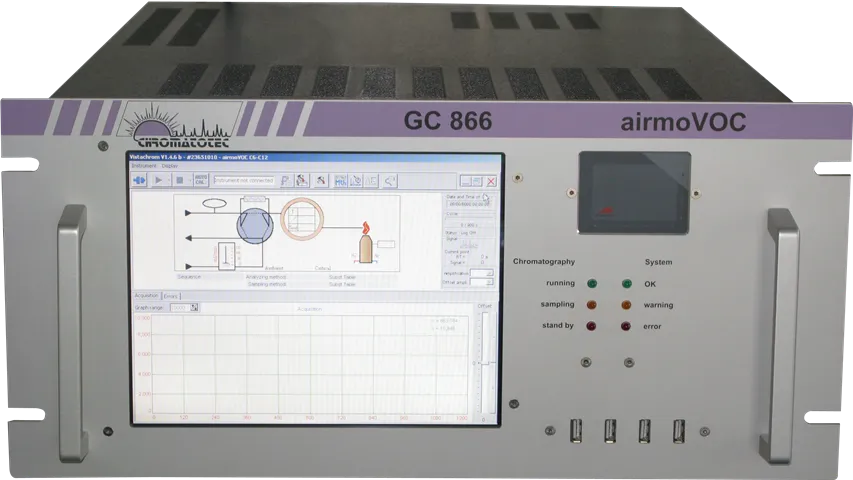
The airmoVOC C6-C20 runs on an embedded Windows-based computer with a 10-inch TFT colour LCD display, storing full results — data and chromatograms — on 128 GB of onboard SSD storage. Four USB ports and two RS-232 ports are provided for data transfer and peripheral connection. Instrument control and management of associated peripherals, such as gas generators, run through Chromatotec's Vistachrom software.
Gas supply requirements are fixed by the FID and carrier gas system: hydrogen at 30 mL/min with 4 bar inlet pressure (1/16" double ferrule fitting), and air at 180 mL/min with 4 bar inlet pressure (1/8" double ferrule fitting). Sample is drawn via a vacuum pump through a 1/4" double ferrule connection, with the pneumatic sampling valve rated at 90 mL per actuation.
The airmoVOC C6-C20 holds EN14662 QAL1 certification and MCERTS approval, granted in 2023. EN14662 is the European standard governing ambient air measurement of benzene, and QAL1 certification under that standard confirms the analyser's suitability for regulatory use before it is even installed on site — a distinction from QAL2/QAL3, which apply to on-site validation and ongoing quality assurance once installed. MCERTS approval adds a UK-recognised layer of performance verification, relevant for any monitoring programme that references it.
The manufacturer's published page does not state dimensions, weight, power consumption, operating temperature range, warranty terms, country of manufacture, or a list of standard accessories and consumables. Analogue or digital process outputs beyond the USB and RS-232 ports are also not specified. If any of these determine whether the airmoVOC C6-C20 fits a specific installation — a cabinet with limited depth, a site with a defined power budget, or a network requiring Modbus or 4-20 mA outputs — get in touch with AAVOS and we will confirm the figures with Chromatotec before you order.
AAVOS supports environmental agencies, laboratories and industrial operators across Belgium, the Netherlands and Luxembourg with instrument selection, installation, commissioning, calibration and ongoing technical support. For a GC/FID analyser running continuously at a monitoring station, that support matters after delivery as much as before it: getting the gas supply, sampling line and software configuration right at commissioning, and keeping calibration and maintenance on schedule once the instrument is in service. We can advise on how the airmoVOC C6-C20 fits into an existing monitoring network and coordinate service locally rather than through the manufacturer directly.
It uses gas chromatography with flame ionisation detection (GC/FID) to separate and quantify volatile and semi-volatile hydrocarbons between C6 and C20, including benzene and naphthalene.
5 ppt (0.0164 µg/m³) for benzene and 10 ppt (0.05 µg/m³) for naphthalene, as stated by Chromatotec.
Yes. In the autoGC-MS configuration, the system extends detection to linear alkanes up to n-hexadecane.
A standard cycle runs 30 to 60 minutes, depending on the application. A 90 to 120 minute cycle is available as an option.
EN14662 QAL1 certification and MCERTS approval, both dated 2023.
Vistachrom, which handles instrument control and manages connected peripherals such as gas generators.
It is designed as a fully automatic system with an internal sampling line and onboard data storage, which is consistent with unattended station operation, though the manufacturer does not explicitly state an unattended-operation duration or maintenance interval.
For a quotation, technical clarification on the specifications above, or advice on integrating the airmoVOC C6-C20 into an existing air quality network, contact AAVOS International bv. We can also confirm the outstanding specification points directly with Chromatotec before you commit to an order.
Customers evaluating the airmoVOC C6-C20 typically also look at other Chromatotec AutoGC 866 range analysers, general ambient air VOC monitoring instrumentation, and gas calibration systems used to maintain GC/FID analysers in the field.
Nous utilisons des cookies pour vous offrir une meilleure expérience utilisateur sur ce site web. Politique de cookies