High-precision instruments for air quality monitoring, particle measurement, and environmental analysis – built for reliability, accuracy, and compliance.
A single split bag or a failing filter cage can send dust past a baghouse long before anyone notices a visible plume. The Auburn PM 100 is built to catch that moment. It monitors particulate loading and filter leaks on baghouse and dust collector systems, and it does so continuously, across as many as eight points on the same unit.
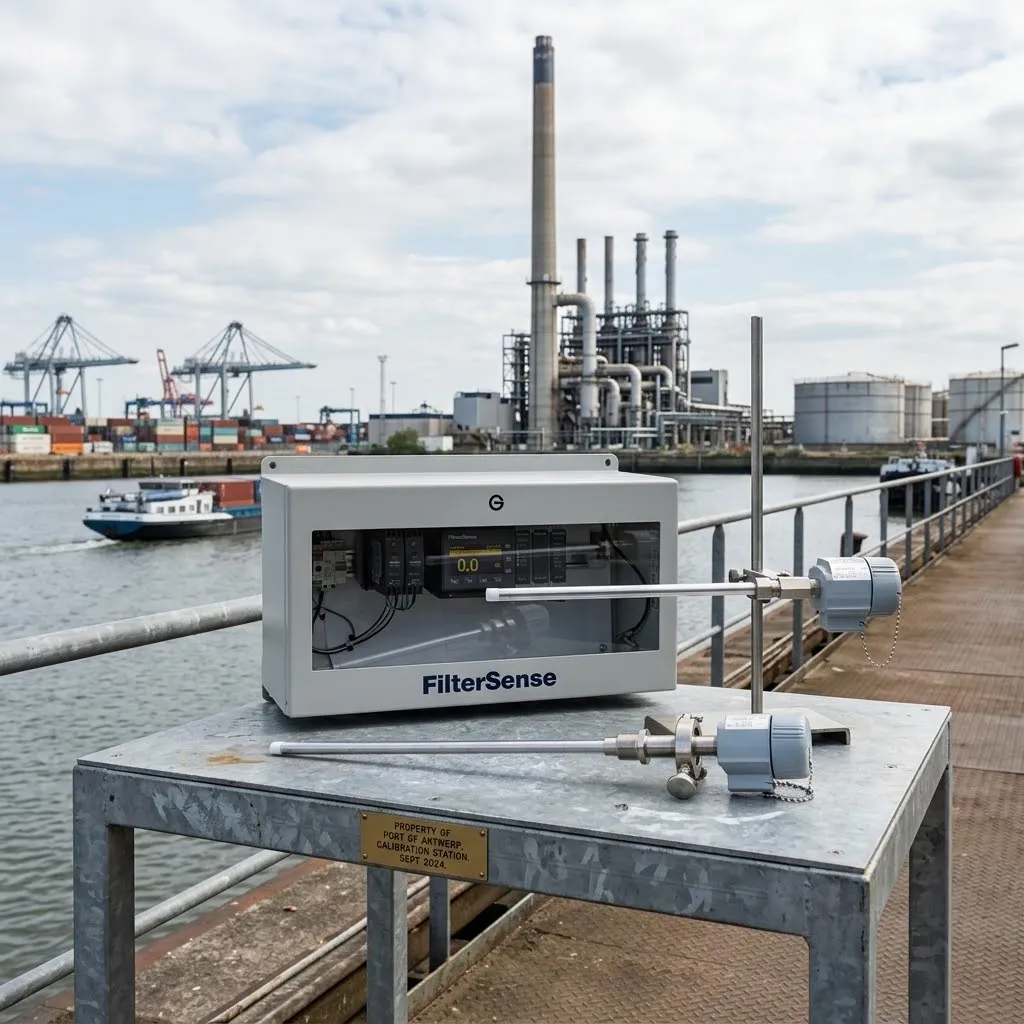
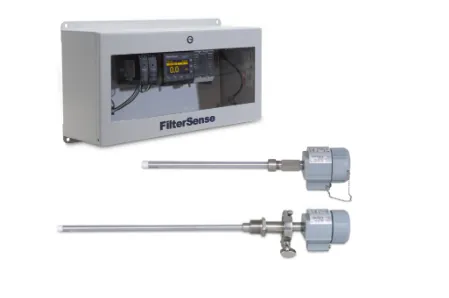
The PM 100 is a controller-based particulate monitor from Auburn FilterSense, part of the DynaCHARGE™ product line and built on Auburn's MICS™ platform. The unit itself does not sense dust directly — it requires one or more PS 10-S particulate sensors, mounted in the stack or ductwork downstream of the filter, which feed signal back to the PM 100 for processing, alarming and output.
Auburn positions DynaCHARGE™ sensing as an alternative to traditional triboelectric particulate monitors, claiming better tolerance of dust, moisture and heat in the process stream. The manufacturer's published material does not go into the underlying charge-sensing principle in detail; anyone specifying the instrument for a compliance-critical application should request the full technical datasheet before finalising a design.
Reduced manual maintenance Auburn describes the sensing element as requiring no routine performance inspection, which lowers the maintenance burden compared with instruments that need periodic manual verification.
Supports MACT compliance The PM 100 is built to help operators demonstrate compliance with US EPA MACT bag-leak-detection requirements for baghouse systems.
Multi-point coverage from one controller Up to eight sensor points can be monitored from a single PM 100, which suits multi-compartment baghouses where isolating a leaking compartment quickly matters.
Modular I/O Analog, digital and mixed expansion modules let the I/O configuration be matched to the control system already in place, rather than forcing a fixed layout.
The PM 100 uses Auburn's DynaCHARGE™ sensing technology through an external PS 10-S particulate sensor. Not specified by the manufacturer: the exact physical detection mechanism, response time, and cross-sensitivity to particle size or composition. Where these details affect a specific application — fine powders, high moisture loads, corrosive dust — AAVOS can request the relevant application note from Auburn before an order is placed.
The PM 100 is intended for continuous filter-integrity monitoring on baghouses and dust collectors, rather than for regulatory stack emissions measurement in the way a certified CEMS analyser would be used. Typical deployments include:
EHS and compliance engineers responsible for demonstrating MACT bag-leak-detection compliance are the most direct users, alongside process and maintenance engineers who need an early warning before a filter failure causes downstream contamination or unplanned downtime.
Auburn lists the PM 100 across a broad set of process industries that rely on baghouse dust collection: aluminium, battery manufacturing, carbon black, cement, chemical processing, food and dairy, foundries, incineration, minerals processing, pharmaceuticals, power generation, steel, and wood processing.
The controller accepts analog and discrete signals in both directions, with up to eight channels each, and the sensor's operating window — from -40 °C process temperature up to 232 °C, and ambient conditions down to -25 °C — covers most industrial baghouse locations without additional conditioning. Power can be supplied as either AC (110–220 VAC) or 24 VDC, which simplifies integration into both new installations and existing control cabinets.
The PM 100 requires at least one PS 10-S particulate sensor, which is not included with the controller and must be specified separately for each monitoring point. Auburn's published material does not list routine consumables for this instrument.
AAVOS supplies and supports the Auburn PM 100 across Belgium, the Netherlands and Luxembourg, including sensor selection for the specific compartment layout, installation, commissioning and ongoing technical support. For plants already running a baghouse close to a MACT deadline or a routine environmental audit, having a local point of contact for spares, sensor replacement and configuration questions tends to matter more than the datasheet itself.
Does the PM 100 measure absolute particulate concentration? Not in the way a calibrated stack analyser does. It reports a relative particulate/leak signal from the PS 10-S sensor, intended for leak detection and trending rather than certified mass-concentration reporting.
Can one PM 100 cover a multi-compartment baghouse? Yes, up to eight sensor points can be connected to a single controller, which allows individual compartments to be monitored and isolated separately.
Does the PM 100 need a separate sensor? Yes. The PM 100 is a controller unit; it requires one or more PS 10-S particulate sensors, ordered separately, to actually detect dust in the gas stream.
Is the PM 100 suitable for high-temperature ducts? The sensor is rated for process temperatures up to 232 °C (450 °F), which covers most baghouse applications, though the controller's own ambient rating is lower, at 60 °C (140 °F).
Does the PM 100 support US EPA MACT compliance? Auburn states the PM 100 is designed to support MACT bag-leak-detection guidelines. It is not, however, presented as a certified reference-method instrument.
What power supply does the PM 100 need? Either 110–220 VAC or 24 VDC, which covers most industrial control cabinet configurations without a dedicated transformer.
Can AAVOS help size the sensor configuration? Yes — AAVOS reviews the compartment layout and process conditions before recommending sensor placement and I/O configuration.
Contact AAVOS to review your baghouse configuration and get a sensor and I/O recommendation for the PM 100.
Nous utilisons des cookies pour vous offrir une meilleure expérience utilisateur sur ce site web. Politique de cookies