High-precision instruments for air quality monitoring, particle measurement, and environmental analysis – built for reliability, accuracy, and compliance.
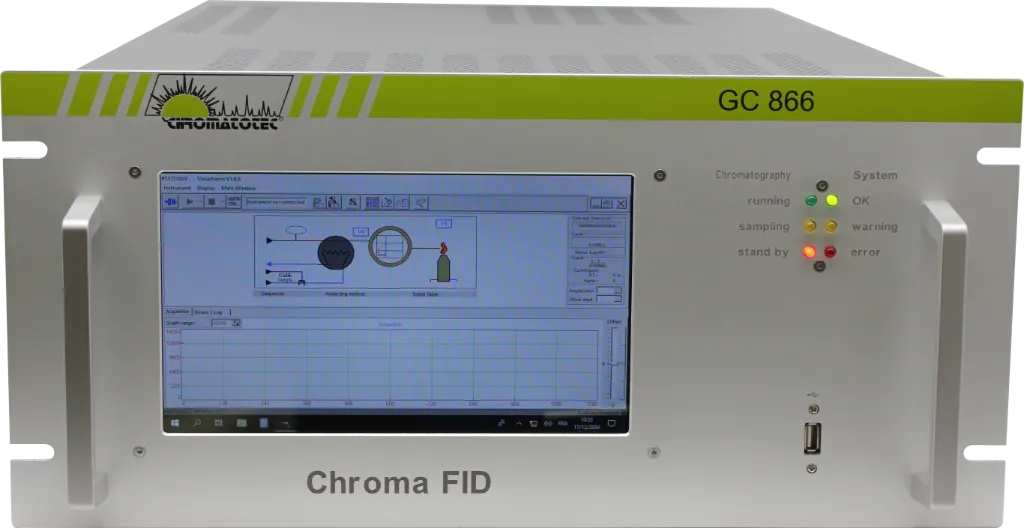
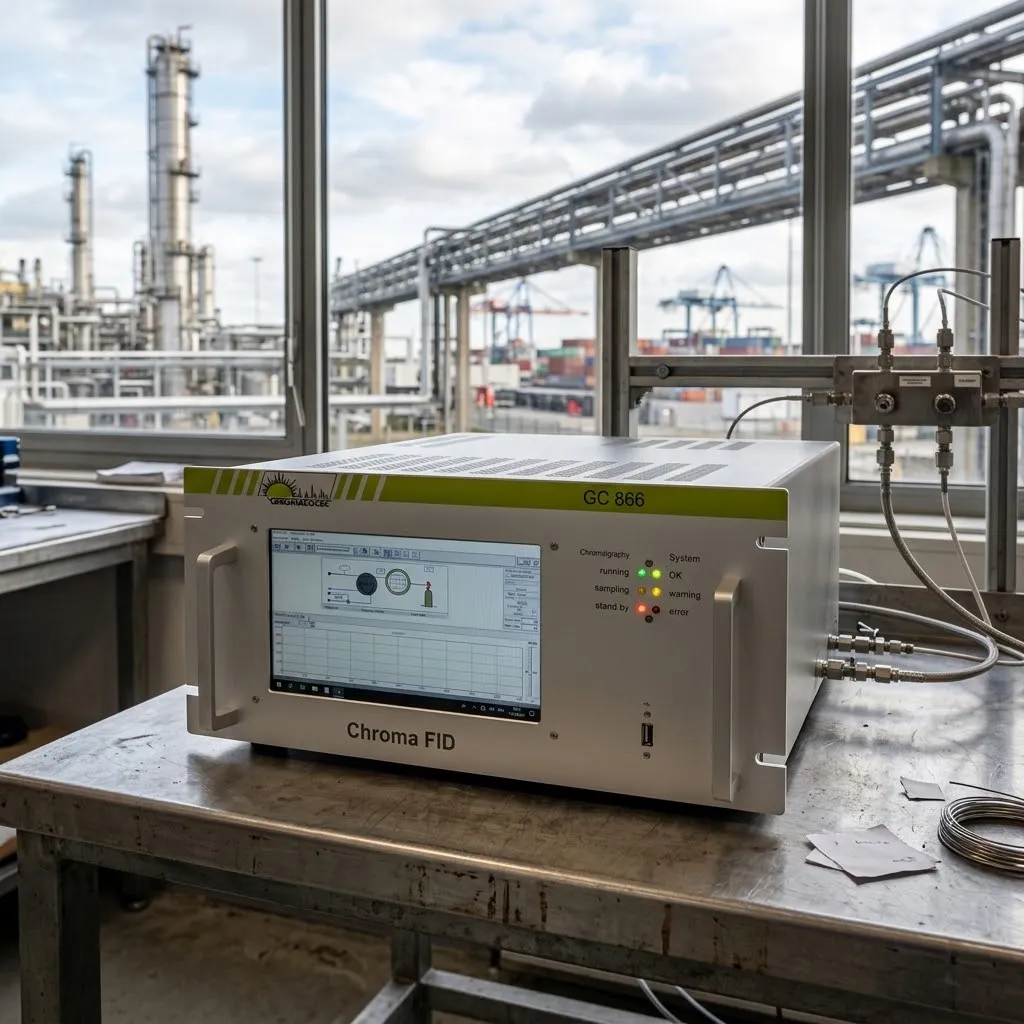
Petrochemical sites, refineries and ambient air networks all share the same problem: volatile organic compounds need to be tracked at trace concentrations, around the clock, without waiting for a laboratory to process a batch of samples. The ChromaFID, built by the French manufacturer Chromatotec as part of its Auto GC-866 range, is designed for exactly that task — automatic, continuous gas chromatography with on-site results, cycle after cycle, without an operator present.
The ChromaFID is a gas chromatograph fitted with a flame ionisation detector (FID), built for the automatic and continuous analysis of volatile organic compounds between 20 ppb and ppm levels. In its standard configuration it covers hydrocarbon chains from C1 to C12. An extended-range variant, the chromaFID-300, pushes this up to C6–C40, at the cost of the fast 3-minute benzene-only cycle available on the standard instrument.
Depending on the application selected, the instrument analyses BTEX compounds, chlorinated solvents (dichloromethane, 1,2-dichloroethane), vinyl chlorides, aldehydes, MEG/TEG and amines, in addition to the general C1–C12 hydrocarbon range. It is not a single-purpose benzene monitor: the application is defined by the column and method configuration chosen for the installation.
Sampling is automatic and continuous, drawn through a sample loop rather than a manual injection. The loop content is transferred into a temperature-regulated metallic capillary column, where the individual VOC compounds separate according to their volatility and interaction with the column phase. Column temperature and pressure are managed by the instrument's own operating software throughout the run.
Detection is handled by a flame ionisation detector. As compounds elute from the column, they pass through a hydrogen flame, where organic carbon is ionised and produces a current proportional to the amount of carbon present. FID has been the standard detection method for hydrocarbon and VOC analysis for decades, largely because of its wide linear response and its sensitivity down to trace levels — which is what allows the ChromaFID to report a benzene detection limit of 20 ppb.
Chromatotec states a relative standard deviation of under 0.3% over 48 hours for retention time, and under 3% over 48 hours for concentration. In practice, that means the instrument holds its calibration and peak identification steady across unattended, multi-day operation — a relevant figure for anyone comparing this analyser against a manual GC method that needs re-calibrating every shift.
A single analysis cycle takes between 3 and 30 minutes, depending on the application and the compound range configured. Sample volume is programmable between 50 and 500 µl, which gives some flexibility to trade sensitivity against cycle time when setting up a method.
A GC-FID analyser in this detection range is generally installed where BTEX and general hydrocarbon monitoring is a recurring operational or regulatory need, rather than a one-off measurement. In practice, AAVOS sees this type of instrument specified for:
Typical users include environmental consultants running fenceline campaigns, HSE and process engineers on industrial sites, environmental agencies operating monitoring networks, and research institutes studying VOC behaviour in ambient or industrial air. Chromatotec's own page does not name these sectors explicitly — this is AAVOS's assessment of where a GC-FID instrument in this configuration is normally deployed, based on the compound list and detection range published by the manufacturer.
The ChromaFID runs on an integrated PC with Chromatotec's Vistachrom® software. It handles remote monitoring, full traceability through archiving of results and quality control data, and the configuration of threshold alarms. Results — both data and chromatograms — are stored in full. For integration into an existing monitoring network or SCADA system, data can be exported over MODBUS, MGS1, a 4–20 mA signal, or 0–10 V.
Every value above is taken directly from Chromatotec's published specification and has not been converted or rounded. Where Chromatotec has not published a figure, that is stated rather than estimated.
The two instruments share the same GC-FID principle and the same automatic sampling method, but the range they cover is different. The standard ChromaFID includes a fast 3-minute benzene-only cycle and covers C1 to C12. The chromaFID-300 extends the hydrocarbon range to C6–C40 for applications that need visibility further up the carbon chain, but does not offer the 3-minute benzene cycle. Which one is the right fit depends on whether the priority is fast benzene turnaround or a wider compound range.
Chromatotec states that every instrument is tested and validated by its QC department for a minimum of one week before it leaves the factory — worth knowing if you are building a commissioning schedule around delivery.
A Technical Specification Sheet (TSP) for the ChromaFID is published by Chromatotec. Contact AAVOS to request the current version, or for the underlying application note for your specific compound configuration.
AAVOS supplies the ChromaFID across Belgium, the Netherlands and Luxembourg, and the relationship does not end at delivery. Our team can advise on which application configuration (BTEX, chlorinated solvents, extended hydrocarbon range) fits your monitoring objective, handle installation and commissioning on site, and support calibration with the correct reference gas standards once the instrument is running. For sites integrating the ChromaFID into an existing SCADA or monitoring network, we can also help configure the MODBUS or 4–20 mA output to match your system. Ongoing service contracts, preventive maintenance and technical support are available locally, without routing every question back to the manufacturer.
It is a gas chromatograph with flame ionisation detection (GC-FID). Sample is drawn automatically and continuously through a sample loop, injected onto a temperature-regulated capillary column for separation, and the eluting compounds are detected by an FID system.
Depending on the application configured, it covers BTEX, chlorinated solvents (dichloromethane, 1,2-dichloroethane), vinyl chlorides, aldehydes, MEG/TEG, amines, and general hydrocarbon ranges from C1 to C12 (C6 to C40 on the chromaFID-300).
20 ppb, equivalent to 64 µg/m³, as published by Chromatotec.
Between 3 and 30 minutes, depending on the application. The standard ChromaFID also offers a dedicated 3-minute benzene-only cycle, which is not available on the chromaFID-300.
Yes. Results can be exported via MODBUS/JBUS, MGS1, a 4–20 mA signal, or 0–10 V, in addition to the full data and chromatogram storage handled by the Vistachrom software.
The chromaFID-300 extends the measurable hydrocarbon range from C1–C12 up to C6–C40, but does not include the standard instrument's fast 3-minute benzene cycle.
Chromatotec's published specification lists this as "N/A." No formal standards or regulatory certifications are stated for this instrument on the manufacturer's official page — confirm current certification status directly with Chromatotec or AAVOS if your project requires a specific approval.
Hydrogen as carrier and FID gas (30 mL/min at 2 bar) and air for the FID (180 mL/min at 3 bar), both supplied continuously during operation.
For pricing, lead times, or advice on configuring the ChromaFID for your specific VOC monitoring application, contact the AAVOS technical team.
chromaFID-300 (extended C6–C40 range) and other instruments in Chromatotec's Auto GC-866 VOC analyser range are available through AAVOS.
Nous utilisons des cookies pour vous offrir une meilleure expérience utilisateur sur ce site web. Politique de cookies