High-precision instruments for air quality monitoring, particle measurement, and environmental analysis – built for reliability, accuracy, and compliance.
Benzene, toluene and the other light hydrocarbons that make up the C3-C10 range are among the more difficult pollutants to monitor continuously, precisely because the concentrations that matter for health and regulatory assessment sit at the ppb and ppt level. The airmoVOC C3-C10, built by the French analyser specialist Chromatotec as part of the AutoGC 866 range, is designed around that challenge: an automatic gas chromatograph with flame ionization detection (GC-FID) that runs unattended, cycle after cycle, at a monitoring station, a fence line or inside a process plant.
What the airmoVOC C3-C10 measures
The analyser separates and quantifies light volatile hydrocarbons across the C3-C10 carbon range, including the BTEX group (benzene, toluene, ethylbenzene, xylenes). Depending on configuration, it can resolve up to 49 individual compounds drawn from the US EPA TO-14 or PAMS (Photochemical Assessment Monitoring Stations) target lists — the same compound sets referenced in ambient air quality and ozone-precursor monitoring programmes. An optional thermoelectric cooling stage extends the working range down to ethyne (acetylene), a compound that is otherwise difficult to trap and desorb reliably at ambient temperature.
Because every compound is chromatographically separated rather than measured as a lumped total, the airmoVOC C3-C10 reports individual species concentrations instead of a single non-methane hydrocarbon figure. That distinction matters for anyone building an ozone-precursor inventory or trying to trace a specific fence-line odour or leak back to its source compound.
Measuring principle
Sample air is drawn onto a single sorbent trap, where the target hydrocarbons are pre-concentrated while lighter, non-retained gases pass through. A valve system then redirects carrier gas across the trap, and thermal desorption releases the collected compounds onto a metallic capillary column housed in a programmable temperature-gradient oven. As the oven ramps, the separated compounds elute in sequence and reach the flame ionization detector, which responds to essentially any carbon-hydrogen bond and is therefore well suited to hydrocarbon analysis. Thermoelectric cooling of the sorbent trap keeps the pre-concentration step reproducible, which is one of the reasons GC-FID analysers of this type can be left running for weeks between manual interventions.
FID is not a new principle — it has been the reference detection technology for hydrocarbon analysis for decades — but the way Chromatotec has packaged the trap, valve and oven into a compact online instrument is what allows this to run as a field or station-based automatic GC rather than a laboratory bench instrument.
Performance and sensitivity
Figures below are unchanged from official manufacturer documentation:
Detection limit (benzene): 10 ppt (standard configuration); 1 ppt with airmoVOC Expert option Measuring range (example: tri-methylbenzene): 0.05 to 400 µg/m³ Repeatability – concentration (RSD): < 3% over 48 hours Repeatability – retention time (RSD): < 0.3% over 48 hours Repeatability – water analysis (RSD): < 10% Cycle time: 15 to 60 minutes, application-dependent and programmable Sample volume: 30 to 700 ml, programmable Compounds resolved: up to 49, from TO-14 or PAMS lists
A 10 ppt detection limit for benzene is low enough to support ambient air quality assessments against the EU limit value, where annual average concentrations are typically well under 5 µg/m³. The programmable cycle time and sample volume give some flexibility to trade off temporal resolution against sensitivity, depending on whether the application calls for hourly PAMS-style data or faster fence-line screening.
Gas supply and installation requirements
The airmoVOC C3-C10 needs a small number of carrier and support gases, all at modest flow rates:
Carrier gas (H₂): 2 bar inlet; 4 ml/min column flow + 26 ml/min FID makeup Calibration gas: 50 ml/min continuous; approximately 450 ml/min during validation FID combustion air: 180 ml/min at 3 bar inlet Pneumatic valve actuation: 90 ml per commutation
Hydrogen as carrier gas means the site needs a compliant gas store or generator and the corresponding safety provisions; this is standard practice for FID-based analysers but worth planning into a station design or cabinet layout from the outset.
Data handling and communication
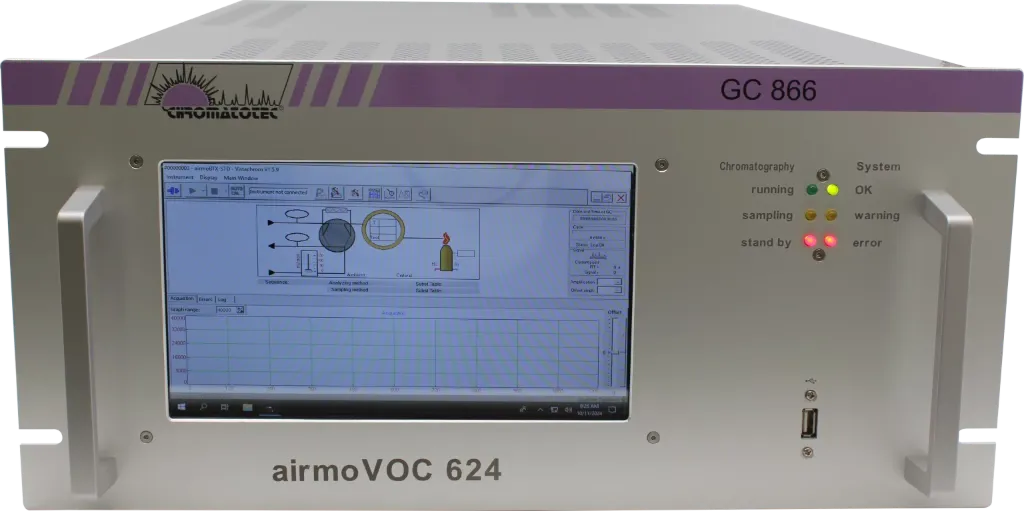
The analyser runs on an embedded Windows-based computer with its own LCD display and 128 GB of SSD storage, so chromatograms and calculated concentrations are stored locally rather than depending solely on a network connection. Vistachrom, Chromatotec's own software, handles acquisition, data storage, peak recalculation and calibration. For integration into a wider monitoring network or SCADA system, MODBUS/JBUS or the MGS1 protocol are available as options. The complete instrument is built into a 19-inch, 5U rack chassis, which keeps it compatible with standard station cabinets and rack enclosures already in use across most ambient and industrial monitoring networks.
Typical applications
Chromatotec positions the airmoVOC C3-C10 across several monitoring contexts, each with a slightly different reason for choosing continuous GC-FID over grab sampling or PID-based screening:
Ambient air quality monitoring — PAMS and TO-14 protocol measurements at fixed stations, where ozone-precursor hydrocarbons and BTEX need to be resolved individually rather than as a lumped VOC signal.
Industrial process and plant emissions monitoring — tracking hydrocarbon emissions from process units, storage or loading operations where specific compounds, not just a total, are relevant to permit conditions.
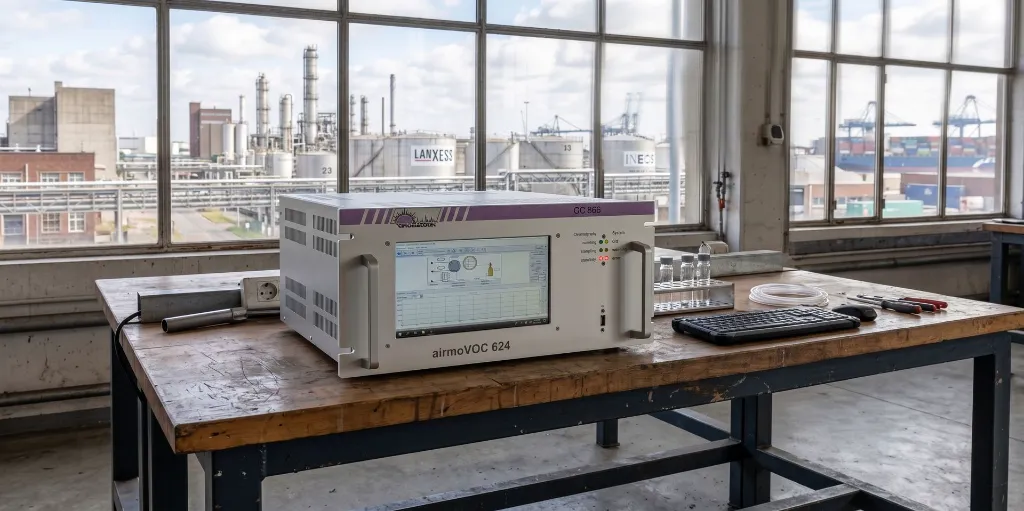
Fence-line monitoring — continuous perimeter measurement around refineries, chemical plants or terminals, where early detection of a benzene or BTEX excursion can flag a leak before it becomes a community complaint.
Occupational and indoor air quality — hydrocarbon exposure monitoring in occupational hygiene contexts and indoor air investigations, where ppt-level sensitivity picks up sources well below what portable PID instruments can resolve.
Wastewater treatment plant monitoring — hydrocarbon analysis referencing EPA Methods 502.2 and 524, relevant where volatile organics in influent or process water need tracking.
Who specifies this analyser
In practice, the airmoVOC C3-C10 tends to end up in the hands of environmental agencies running PAMS or ozone-precursor networks, industrial process engineers responsible for fence-line or emissions compliance at refineries and chemical sites, environmental consultants carrying out indoor air or occupational exposure studies, and research institutes studying atmospheric hydrocarbon chemistry. What these users have in common is a need for compound-specific data at trace levels, generated automatically and without daily operator intervention.
Standards and certifications
The airmoVOC C3-C10 is EN14662 QAL1 certified and holds MCERTS approval. EN14662 is the European standard governing ambient air measurement of benzene; QAL1 certification under that framework confirms the analyser has been type-tested and is suitable for use in EU regulatory ambient air networks. MCERTS, the UK Environment Agency's certification scheme, provides an equivalent assurance for monitoring equipment used in UK regulatory contexts. Each unit is also tested for a minimum of one week under quality control before leaving the factory, which is worth knowing if a project timeline depends on lead time and commissioning readiness.
Technical specifications
Measurement principle: gas chromatography with flame ionization detection (GC-FID) Sample pre-concentration: single sorbent trap, valve system, thermoelectric cooling Column: metallic capillary, programmable temperature-gradient oven Detection limit (benzene): 10 ppt standard; 1 ppt with airmoVOC Expert Measuring range (example): 0.05–400 µg/m³ (tri-methylbenzene) Cycle time: 15–60 minutes Sample volume: 30–700 ml, programmable Data storage: 128 GB SSD Communication: MODBUS/JBUS or MGS1 (optional) Software: Vistachrom Form factor: 19″ rack, 5U Standards / certification: EN14662 QAL1, MCERTS Factory testing: minimum one week quality control prior to delivery
Dimensions, weight, power consumption and operating temperature range are not specified in the manufacturer's published material reviewed for this page. AAVOS can request the current datasheet from Chromatotec directly if these figures are needed for a station design or cabinet specification.
Why choose AAVOS
AAVOS supplies and supports the Chromatotec airmoVOC C3-C10 across Belgium, the Netherlands and Luxembourg, including technical advice during specification, installation and commissioning on site, calibration using certified gas standards, and preventive and corrective maintenance once the analyser is in service. For a GC-FID instrument like this one, that support matters in practice: sorbent traps, carrier gas supply and column condition all affect long-term data quality, and having a regional technical partner who can service the instrument without a factory return keeps monitoring stations running. AAVOS also provides training on Vistachrom for site operators and can advise on integrating the analyser's MODBUS/JBUS output into an existing monitoring network.
Frequently asked questions
What is the measuring principle of the airmoVOC C3-C10? It uses gas chromatography with flame ionization detection (GC-FID): sample air is pre-concentrated on a sorbent trap, thermally desorbed onto a capillary column in a temperature-programmed oven, and the separated compounds are quantified by the FID as they elute.
Which compounds can the airmoVOC C3-C10 measure? Light volatile hydrocarbons across the C3-C10 range, including the BTEX group, with the ability to resolve up to 49 compounds from the TO-14 or PAMS target lists. An optional thermoelectric cooling stage extends coverage to ethyne.
What is the detection limit for benzene? 10 ppt in the standard configuration, improving to 1 ppt with the airmoVOC Expert option.
How long does one measurement cycle take? Between 15 and 60 minutes, depending on the application and the programmed sample volume and method.
Which standards and certifications apply to this analyser? The airmoVOC C3-C10 is EN14662 QAL1 certified and holds MCERTS approval, covering both EU and UK regulatory ambient air monitoring contexts.
Can the airmoVOC C3-C10 be integrated into an existing monitoring network? Yes. It supports MODBUS/JBUS or the MGS1 protocol as optional communication interfaces, and data is also stored locally via Vistachrom on the analyser's embedded computer.
Which gases does the analyser require to operate? Hydrogen as carrier gas (2 bar inlet, low flow rates for column and FID makeup) and compressed air for FID combustion at 180 ml/min. A calibration gas supply is also required for routine validation.
Is the airmoVOC C3-C10 suitable for unattended, continuous operation? Yes — it is designed as an automatic, continuous online analyser for fixed installation, running repeated cycles without daily operator intervention, which is the basis of its use in ambient air and fence-line monitoring networks.
Get in touch
For a technical consultation on the airmoVOC C3-C10, a quotation including installation and commissioning, or advice on calibration gas and consumables, contact the AAVOS technical team. We support ambient air, fence-line and industrial VOC monitoring projects throughout Belgium, the Netherlands and Luxembourg.
Nous utilisons des cookies pour vous offrir une meilleure expérience utilisateur sur ce site web. Politique de cookies