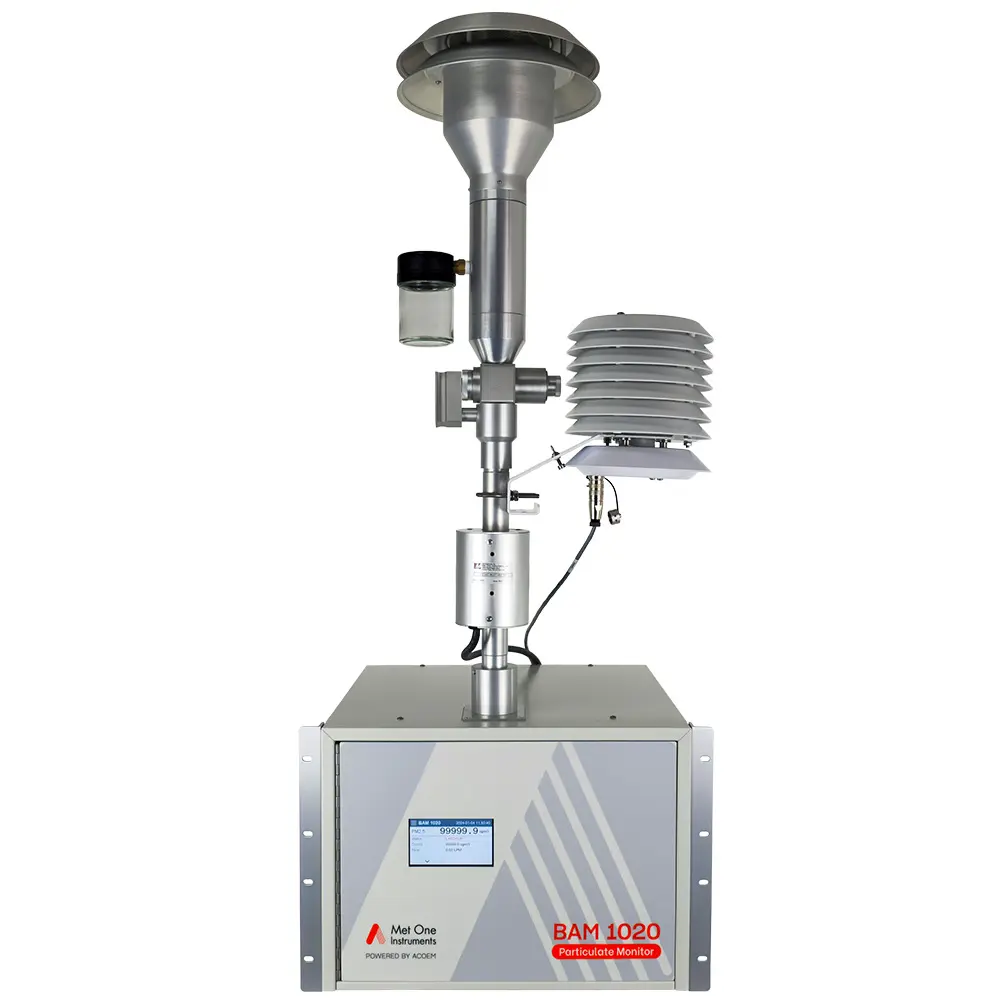
High-precision instruments for air quality monitoring, particle measurement, and environmental analysis – built for reliability, accuracy, and compliance.
The Met One BAM 1020 is a proven continuous particulate monitor that automatically measures and records airborne dust concentrations with exceptional accuracy. Utilizing the industry-standard principle of Beta Ray Attenuation, the BAM 1020 provides precise mass concentration data (PM10, PM2.5, or PM-Coarse) without the need for labor-intensive manual filter weighing.
Designed for long-term, unattended operation, this analyzer is the world’s most widely deployed regulatory compliance monitor. It is the first instrument to achieve U.S. EPA Federal Equivalent Method (FEM) designation for continuous PM2.5 monitoring and holds corresponding European Union (TÜV) certifications, making it the preferred choice for environmental agencies, industrial facilities, and research institutes globally.
Regulatory Reliability: With U.S. EPA and EU certifications for PM10 and PM2.5, the BAM 1020 ensures your data stands up to the strictest regulatory audits and legal scrutiny.
Autonomous Operation: Engineered for remote sites, the system supports 60+ days of unattended monitoring with a high-capacity filter tape, significantly reducing operational costs and site visits.
Data Integrity: Features automatic hourly zero and span calibration checks to validate measurement stability. The advanced Smart Heater technology actively controls sample relative humidity to eliminate moisture artifacts without losing volatile compounds.
Versatile Connectivity: Seamlessly integrates into modern data networks via Ethernet, USB, and RS-232/485 interfaces. It supports direct connection to meteorological sensors (wind, temperature, humidity), serving as a central station logger.
The BAM 1020 employs the physics of beta attenuation to measure particle mass density. At the start of each cycle, a carbon-14 (14C) source emits high-energy electrons (beta rays) through a clean spot on the glass fiber filter tape. A scintillation detector counts these beta rays to establish a precise "zero" baseline.
The system then advances the tape to the sampling nozzle, where a vacuum pump draws a controlled volume of ambient air through the spot, depositing particulate matter. Finally, the spot returns to the measuring position. The attenuation (reduction) in beta rays passing through the dust-laden spot is directly proportional to the mass of the particulate matter, allowing the system to calculate volumetric concentration in mg/m³ or µg/m³.
System Capabilities:
Target Fractions: PM10, PM2.5, PM1 (non-regulatory), and PM-Coarse (PM10-2.5) using dual-unit configuration.
Flow Control: Active volumetric flow control ensures precise sampling rates despite changes in temperature or pressure.
Interference Rejection: Integrated "Smart Heater" technology prevents water vapor condensation while minimizing the loss of semi-volatile aerosols, a critical advantage over heated-inlet TEOMs.
National Air Quality Networks: The backbone of ambient air monitoring stations (AQMS) for compliance with EPA NAAQS and EU Directives.
Industrial Fenceline Monitoring: Ensuring compliance with fugitive dust regulations at mines, construction sites, and processing plants.
Environmental Impact Assessments: Providing baseline data for new infrastructure projects, power plants, and urban developments.
Emergency Response: Rapid deployment for monitoring smoke from wildfires or industrial accidents.
The Met One BAM 1020 offers a balance of scientific rigor and operational practicality that few instruments can match. While newer optical methods exist, beta attenuation remains the "reference standard" for mass measurement because it measures mass directly rather than inferring it from light scatter. This makes the BAM 1020 immune to changes in particle color, shape, or refractive index. For agencies and industries where data validity is non-negotiable, the BAM 1020 is the safest and most reliable investment.
Applications:
Regulatory compliance monitoring (AQMS), fenceline monitoring, construction dust control, research and background stations.
Certifications:
U.S. EPA FEM: PM2.5 (EQPM-0308-170), PM10 (EQPM-0798-122), PM10-2.5 (EQPM-0709-185).
TÜV Rheinland: EN 12341, EN 14907, EN 16450 (PM10 and PM2.5).
China: CPA and CCEP designated.
Korea: NIER designated.
Measurement Principle:
Beta Ray Attenuation (Beta Gauge) using C-14 source and glass fiber filter tape.
Nous utilisons des cookies pour vous offrir une meilleure expérience utilisateur sur ce site web. Politique de cookies