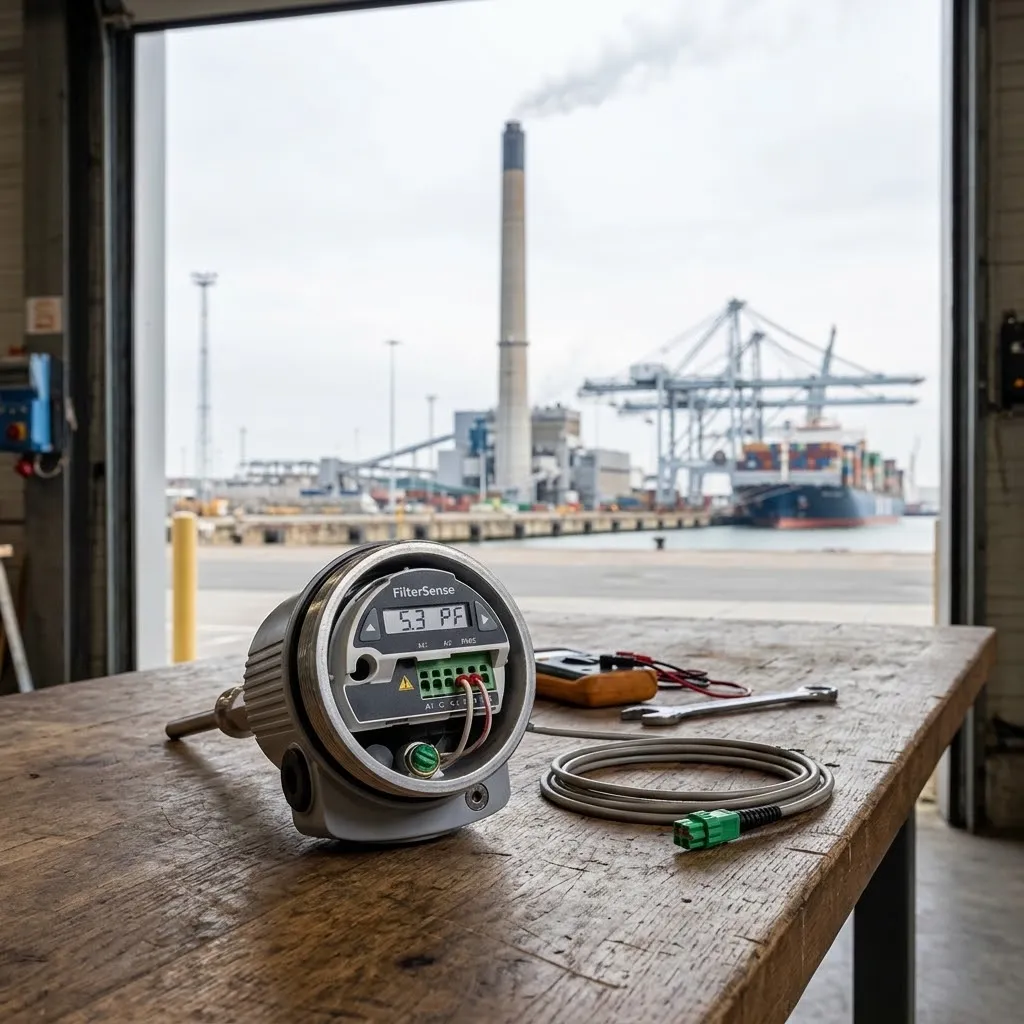
High-precision instruments for air quality monitoring, particle measurement, and environmental analysis – built for reliability, accuracy, and compliance.
Bag failures in a dust collector rarely announce themselves. A stitched seam lets go, a hole opens in the filter media, and by the time the difference is visible at the stack, an operator has already been out of compliance for hours or days. The DynaCHARGE™ PM 1 from Auburn (a Nederman company) is built to catch that moment early: a continuous particulate monitor for baghouse and dust collector outlets that gives plant staff a running picture of filter condition rather than a single point-in-time reading.
The PM 1 measures particulate loading using Auburn's DynaCHARGE™ charge-based detection principle. A probe mounted in the duct or stack picks up the electrical charge transferred by dust particles passing near it; the instrument converts that signal into a picoamp (pA) reading that scales with particulate concentration. Because the output is continuous, an unexpected rise in pA — a torn bag, a failed seal, a collapsed cage — shows up as an immediate change rather than something discovered during the next manual stack test.
Auburn positions the PM 1 as the entry point in its PM range, aimed specifically at smaller baghouses and dust collectors where a full-featured monitoring platform would be disproportionate to the risk being managed. Two configurations cover the two things most operators actually need: an alarm-only version for straightforward bag-leak detection, and a transmitter version for sites that want the reading integrated into a control system or historian.
Auburn sells the PM 1 in three variants, and the right one depends on what happens after the sensor detects a problem rather than on the sensor itself.
A bag leak that goes unnoticed does two things: it lets particulate through to atmosphere, and it keeps doing so until someone happens to inspect the collector or a stack test flags it. Continuous monitoring closes that gap. The real-time pA display and simple interface mean an operator does not need specialist training to read a trend or recognise an alarm condition — the unit is meant to sit on a control panel and be understood at a glance, including in multi-lingual configurations for sites with mixed-language operating teams.
Installation cost is often the deciding factor for smaller collectors, which is part of why the PM 1 is built around an integral, single-probe configuration rather than a separated sensor-and-electronics arrangement. NPT and quick-clamp fittings are available for both new installations and retrofits onto existing duct penetrations, and the choice between 2-wire loop power and universal line power with relays lets it fit into whatever power infrastructure is already at the collector.
On the maintenance side, the PM 1 runs a sensor health check on every power-up, which gives an early indication of probe fouling or a failed sensor rather than waiting for an operator to notice a flat or implausible reading. For duct conditions where moisture or sticky dust would otherwise build up on the probe and skew the signal, Auburn offers coated probe options.
Auburn's PM range is used across dust-and-fume-intensive process industries, including aluminium, battery manufacturing, carbon black, cement, chemical processing, food and dairy, foundries, incineration, minerals processing, pharmaceuticals, power generation, steel and wood processing. Within these industries, the PM 1 is typically specified by process and environmental engineers responsible for baghouse performance, and used day to day by plant maintenance and operations staff who need a quick, unambiguous read on filter condition.
Enclosure ingress protection rating, exact response time, communication protocols beyond 4–20 mA, dimensions, weight, certifications (e.g. ATEX/IECEx equivalents for the stated hazardous-area rating) and country of manufacture are not specified in the manufacturer's published product data. These should be confirmed from the datasheet or manufacturer directly before being quoted to a customer.
AAVOS International bv supplies and supports particulate and process monitoring instrumentation across Belgium, the Netherlands and Luxembourg. For a monitor like the PM 1, that support typically covers probe sizing and fitting selection for the specific duct or collector, installation guidance for retrofit situations, and commissioning once the unit is in place. Where a site later needs to move up to a transmitter-based or multi-point configuration, AAVOS can advise on how that fits with the existing PM 1 installation rather than requiring it to be replaced outright.
What does the PM 1 actually measure?
It measures relative particulate loading in a duct or stack, expressed as a picoamp (pA) signal from the DynaCHARGE™ probe. It is a relative, continuous indicator of particulate presence rather than a gravimetric measurement in mg/m³, though the manufacturer states an approximate minimum detection level in those units.
What is the difference between the PM 1-A and PM 1-T?
The PM 1-A is a self-contained alarm unit with relay outputs for local warning; the PM 1-T outputs a 4–20 mA loop signal for continuous trending in a PLC, DCS or SCADA system. The PM 1-AD is the same alarm function as the PM 1-A, on 24 VDC power only.
Can the PM 1 be retrofitted to an existing dust collector?
Yes. The probe is designed for both new and retrofit installation, using NPT or quick-clamp fittings, which generally allows it to be mounted through an existing duct penetration without major mechanical modification.
Is the PM 1 suitable for hot or humid process conditions?
It is rated for process temperatures up to 232 °C, and coated probe options are available for damp or sticky dust conditions that would otherwise foul an uncoated sensor.
Does the PM 1 require regular calibration?
Auburn specifies a sensor health check on every power-up rather than a fixed calibration interval in the published data; the exact maintenance and verification schedule should be confirmed against the instrument manual for the intended application.
Is the PM 1 suitable for hazardous area installation?
The manufacturer states a Class II Div. II (Zone 22) rating, which covers combustible dust atmospheres of that classification. Confirm the specific zone and gas/dust group requirements of the installation before specifying.
Can AAVOS support installation and commissioning in the Benelux?
Yes, AAVOS provides installation guidance, fitting and probe selection, and commissioning support for the PM 1 within Belgium, the Netherlands and Luxembourg.
For help selecting between the PM 1-A, PM 1-AD and PM 1-T for a specific baghouse or dust collector, contact AAVOS International bv for technical advice and a quotation.
Nous utilisons des cookies pour vous offrir une meilleure expérience utilisateur sur ce site web. Politique de cookies