High-precision instruments for air quality monitoring, particle measurement, and environmental analysis – built for reliability, accuracy, and compliance.
Automatic GC-PID analyser for trace BTEX and 1,3-butadiene in ambient, industrial and environmental air
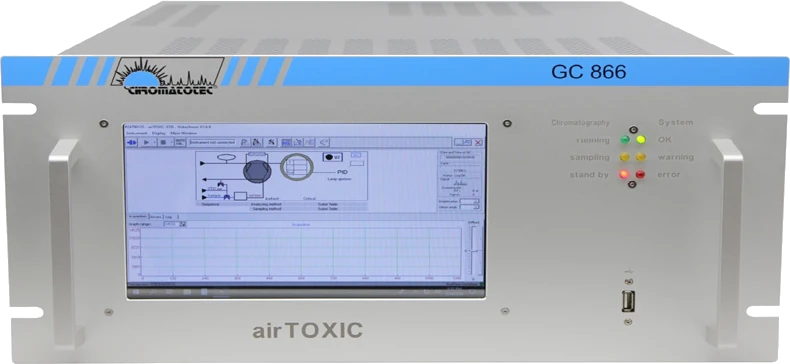
The airTOXIC BTX PID is a gas chromatograph fitted with a photo-ionisation detector, built by Chromatotec for continuous, unattended monitoring of aromatic hydrocarbons at trace concentration. It resolves up to eight compounds in a single analysis cycle: benzene, toluene, ethylbenzene, the three xylene isomers (ortho, meta, para), cyclohexane and styrene. 1,3-butadiene and IAA can be added as options. Sample matrices include air, water and soil, though the ambient-air configuration is the one most Benelux regulatory and industrial customers will specify.
Benzene is the compound that drives most specification decisions on this instrument, because it is the one with a European limit value and a reference method attached to it. The analyser is built around that requirement: the detection limit, the certified measurement range and the QAL1 certification all centre on benzene in ambient air.
Sample air is drawn through a single absorbent trap and injected via a port valve onto a 30 metre metallic capillary column (0.28 mm internal diameter). The column oven runs a programmed temperature gradient up to 202°C with pressure and flow control on the carrier gas, separating the target compounds before they reach the detector. Detection is by PID with a 10.6 eV lamp; a self-cleaning function for the lamp is built in to maintain stability between services. Reported linearity on peak area is R² > 0.995.
Cycle time is user-selectable at 15, 20 or 30 minutes, which lets an operator trade off temporal resolution against column life and helium consumption depending on the monitoring objective.
In automatic mode, the lower detection limit is ≤ 0.01 ppb (0.0325 µg/m³), which the manufacturer also expresses as 10 ppt for benzene or 1,3-butadiene in ambient air — the two figures are the same value in different units, not two separate specifications.
The certified regulatory range sits inside the instrument's wider 0–100 ppb detection range rather than matching it directly — the source material doesn't explain the relationship between the two explicitly, and this is worth confirming with Chromatotec before quoting it in a tender response.
This is an instrument for sites where trace benzene has to be tracked reliably over long unattended periods: ambient air quality monitoring networks, industrial fenceline monitoring around refineries and chemical plants, and environmental studies covering BTEX and 1,3-butadiene. The MCERTS certification for benzene under EN 14662-3 makes it a candidate specifically for compliance-grade ambient monitoring rather than only screening or research use.
The analyser holds MCERTS certification for benzene measurement, following EN 14662-3. Manufacturer documentation labels the certificate "EN14662 QAL1", which corresponds to a Quality Assurance Level 1 type-approval under the EN 14662-3 reference method for benzene in ambient air. That's the basis on which the instrument can be specified for regulatory ambient monitoring in jurisdictions that recognise MCERTS or EN 14662-3 type approval. It should not be assumed the same certification extends to the other compounds the analyser measures (toluene, ethylbenzene, xylenes, cyclohexane, styrene) — the source documents only reference benzene.
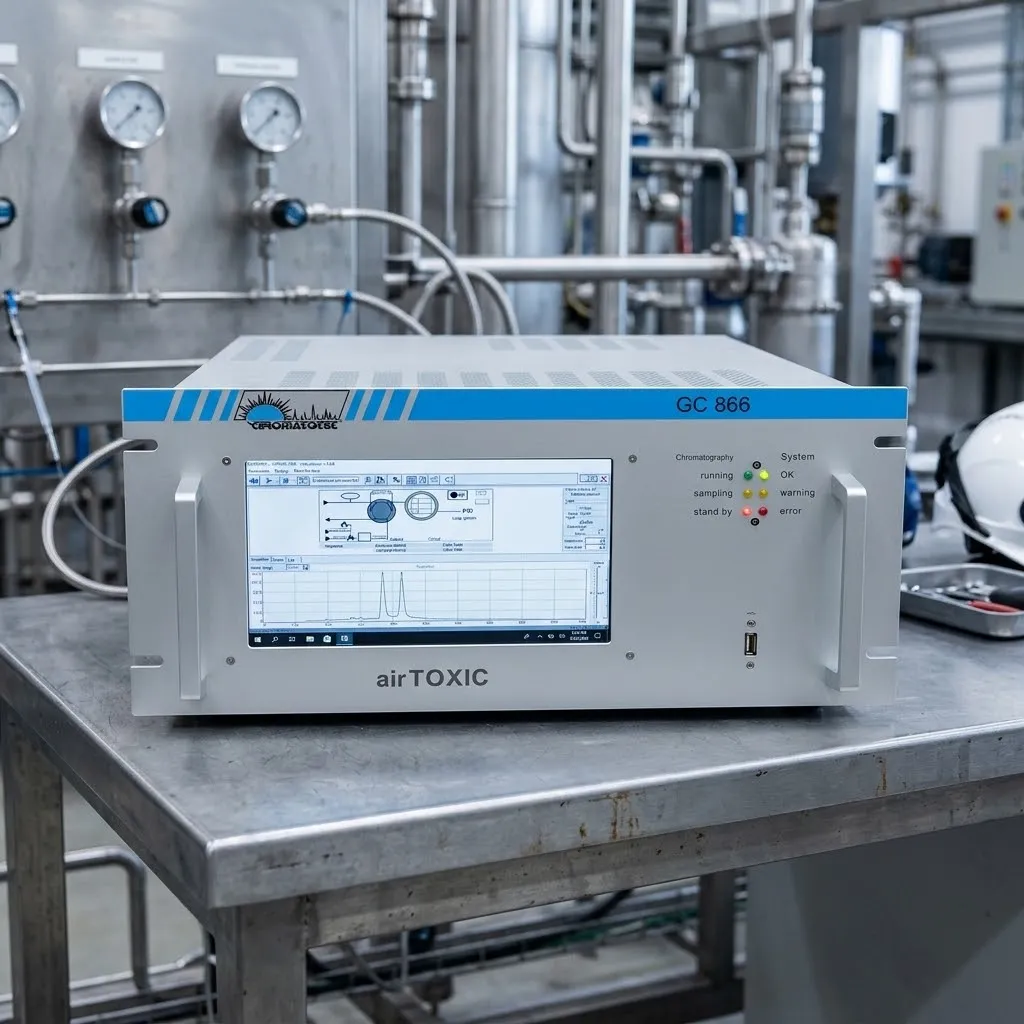
The unit is supplied as a complete 19″ rack, 5U system — sample port, GC module and PID detector are integrated in one enclosure. Data handling runs through Vistachrom software on an industrial computer connected via RS-232C, with an LCD display on the unit itself. The manufacturer states that "different communication protocols" are available for results output beyond RS-232C, without listing which ones — worth clarifying at quotation stage if the customer needs a specific fieldbus or network protocol.
Carrier gas and sample-flow requirements, power supply, dimensions, weight, operating temperature and humidity range, and consumables (column, trap, PID lamp replacement) are not stated on the manufacturer's product page and should be requested from the datasheet or Chromatotec directly before finalising a system specification.
Available on request from AAVOS.
AAVOS supplies and supports the airTOXIC BTX PID for customers in Belgium, the Netherlands and Luxembourg, and can advise on matching the cycle time and detection range to the monitoring objective, on the sampling and calibration infrastructure the installation will need, and on positioning the instrument correctly against EN 14662-3 requirements. Installation, commissioning, calibration and service contracts can be arranged locally rather than through the manufacturer directly.
What does the airTOXIC BTX PID measure?
Up to eight aromatic hydrocarbons, principally benzene, toluene, ethylbenzene and the xylene isomers, plus cyclohexane and styrene. 1,3-butadiene and IAA are available as options.
What is the measurement principle?
Gas chromatography with photo-ionisation detection (GC-PID), using a single absorbent trap and a 30 m metallic capillary column.
Is the analyser certified?
Yes, for benzene measurement, under MCERTS / EN 14662-3 (QAL1).
How sensitive is it?
The lower detection limit in automatic mode is ≤ 0.01 ppb (0.0325 µg/m³, or 10 ppt) for benzene.
What cycle time can it run?
15, 20 or 30 minutes, selectable by the operator.
What software does it use?
Vistachrom, for calibration, data storage, recalculation and export from an industrial computer connected over RS-232C.
Can it be used outside ambient air monitoring?
The manufacturer references air, water and soil applications, though the certified regulatory range and QAL1 approval are specific to benzene in ambient air.
What isn't specified on the product page?
Dimensions, weight, power consumption, operating temperature/humidity range, carrier gas requirements, calibration interval, maintenance interval, warranty terms and consumables list are not published — AAVOS can request these from Chromatotec.
Contact AAVOS for technical advice, system configuration or a quotation on the airTOXIC BTX PID.
Nous utilisons des cookies pour vous offrir une meilleure expérience utilisateur sur ce site web. Politique de cookies