High-precision instruments for air quality monitoring, particle measurement, and environmental analysis – built for reliability, accuracy, and compliance.
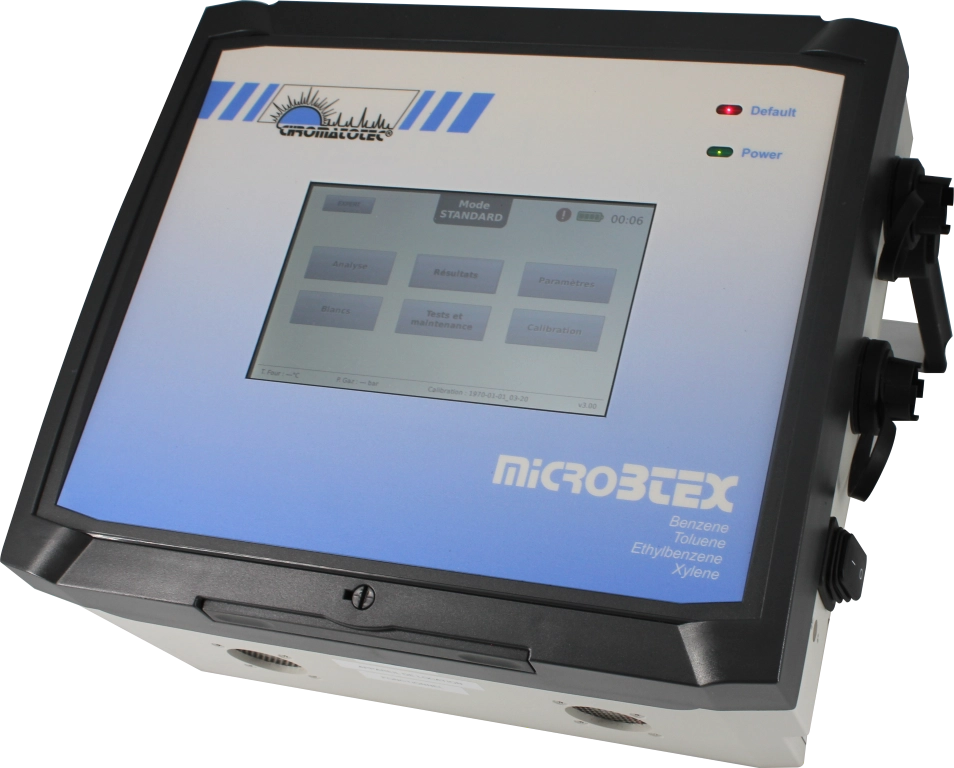
The microVOC/microBTEX is a portable gas chromatograph built around a patented microfluidic separation module and a photoionisation detector (PID). It measures benzene, toluene, ethylbenzene and the xylenes directly in the field, without the delay of sending canisters or sorbent tubes to a laboratory. The device grew out of research at the CNRS and the University of Strasbourg, and is now manufactured and supported by Chromatotec from its facility near Bordeaux, France.
In its default BTEX configuration, the analyser resolves benzene and toluene down to roughly 1 ppb, and ethylbenzene together with the meta/para-xylene pair to around 2 ppb, with ortho-xylene at approximately 4 ppb under default settings. A full BTEX cycle takes 10 minutes; a benzene-only run can be shortened to 5 minutes, or 3 minutes as an option. A benzene plus 1,3-butadiene configuration runs at 10 to 15 minutes per cycle. Chromatotec states that other target compounds can be configured on request, though no specification is published for those beyond BTEX and the butadiene variant.
Two detection ranges are available depending on configuration: 0–1000 ppb, or 0–10/0–100/0–1000 ppm for higher-concentration applications.
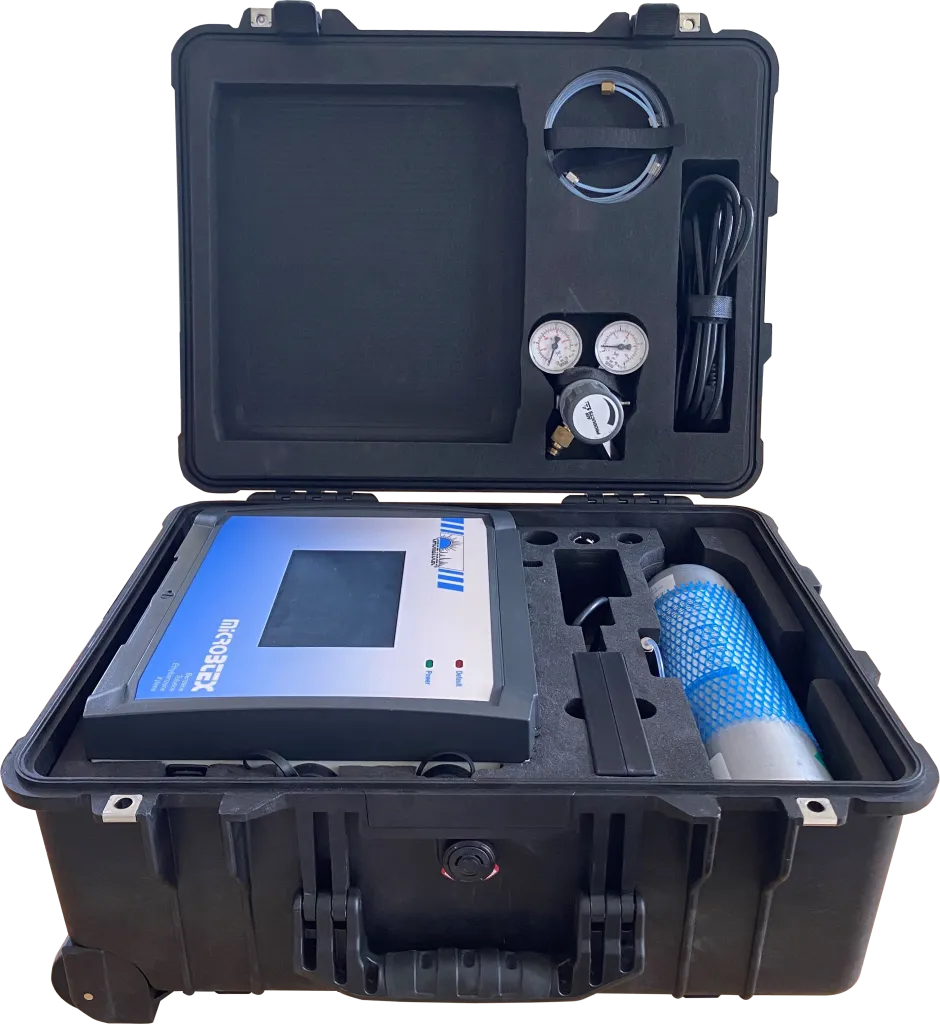
Analysis relies on gas chromatography: a small gas sample, injected through a loop of 200 µL or less, is separated on an internal column and detected by PID at a temporal resolution of 0.1 seconds. Nitrogen serves as carrier gas, fed at 2.5 mL/min from a 4 bar inlet supply through a 1/8″ connection, with a total sample gas flow between 16 and 20 mL/min. Because separation happens on a microfluidic chip rather than a full-size column oven, the instrument fits in a 32 × 28 × 15 cm housing weighing 6 kg — light enough to carry between sampling points in a single day.
Chromatotec quotes a deployment time of under 5 minutes from case to first analysis. The instrument runs from mains power (100–240 V, 1.5 A max, 47–63 Hz, drawing up to 75 W) or from its internal battery, rated for up to 4 hours of autonomy — useful for locations without a mains connection, or for moving between multiple monitoring points on battery power alone. A 58 L nitrogen bottle with its own manometer ships as a standard accessory and, in the BTEX configuration, is rated for 21 days of continuous gas supply.
Sample introduction is compatible with canisters and with FLEC® (Field and Laboratory Emission Cell) systems, which extends the instrument's use beyond ambient air to surface emission testing.
A 7″ colour touchscreen (800 × 480) runs the embedded software in either standard or expert mode, covering sequence programming, live monitoring, and defect/maintenance management. Results are logged continuously to a 32 GB microSD card, with capacity for more than 13 months of uninterrupted data. Area, retention time and concentration values can be exported over USB, and the analyser can be monitored and controlled remotely over Ethernet — relevant where the instrument is left running unattended at a fixed point for part of a campaign.
Required: nitrogen carrier gas supply, analysis column, particle filter — all included as standard.
Application-dependent: canister or FLEC® sampling adapters, where the campaign requires surface-emission or pre-collected sample analysis rather than direct air sampling.
Not specified: the manufacturer does not publish a defined list of additional sample-conditioning components (e.g. dryers) for humid or particulate-heavy environments; this should be discussed against the specific site conditions.
The instrument targets BTEX and closely related compounds by default; broader VOC speciation requires a different configuration or a different instrument in the Chromatotec range. Detection limits and cycle times are quoted for default settings — actual performance in a specific application should be confirmed against the manufacturer's technical specification sheet before it is written into a tender. No standard or certification is published for this analyser, so it should not be specified where a certified reference method is a contractual requirement.
AAVOS can support selection of the right configuration (BTEX, benzene-only, or benzene plus 1,3-butadiene), advise on carrier gas logistics for extended field campaigns, and provide calibration gas supply, commissioning and after-sales technical support for this instrument in Belgium, the Netherlands and Luxembourg.
Contact AAVOS for technical advice, configuration support or a quotation.
What compounds does the microVOC/microBTEX measure by default? Benzene, toluene, ethylbenzene and the xylene isomers (BTEX). A benzene plus 1,3-butadiene configuration is also available, and other targets can be discussed with the manufacturer.
How sensitive is it? Under default settings, benzene and toluene are detected down to roughly 1 ppb, with ethylbenzene and the xylenes between 2 and 4 ppb.
How long does one measurement take? A full BTEX cycle runs in 10 minutes. A benzene-only measurement can be run in 5 minutes, or 3 minutes as an option.
Can it run without mains power? Yes — the internal battery provides up to 4 hours of autonomy, which supports moving between sampling points during a field campaign.
What carrier gas does it need, and how much? Nitrogen at a 4 bar inlet pressure, consumed at 2.5 mL/min. The included 58 L bottle is rated for 21 days of continuous BTEX monitoring.
Can it work with canister or FLEC® samples? Yes, the instrument is compatible with canister sampling and with FLEC® (Field and Laboratory Emission Cell) systems for surface emission testing.
Is it certified to a specific air quality standard? No standard or certification is published by the manufacturer for this analyser.
How is data retrieved from the instrument? Results (area, retention time, concentration) are logged to an internal 32 GB microSD card and can be exported via USB, or the instrument can be monitored and controlled remotely over Ethernet.
Nous utilisons des cookies pour vous offrir une meilleure expérience utilisateur sur ce site web. Politique de cookies