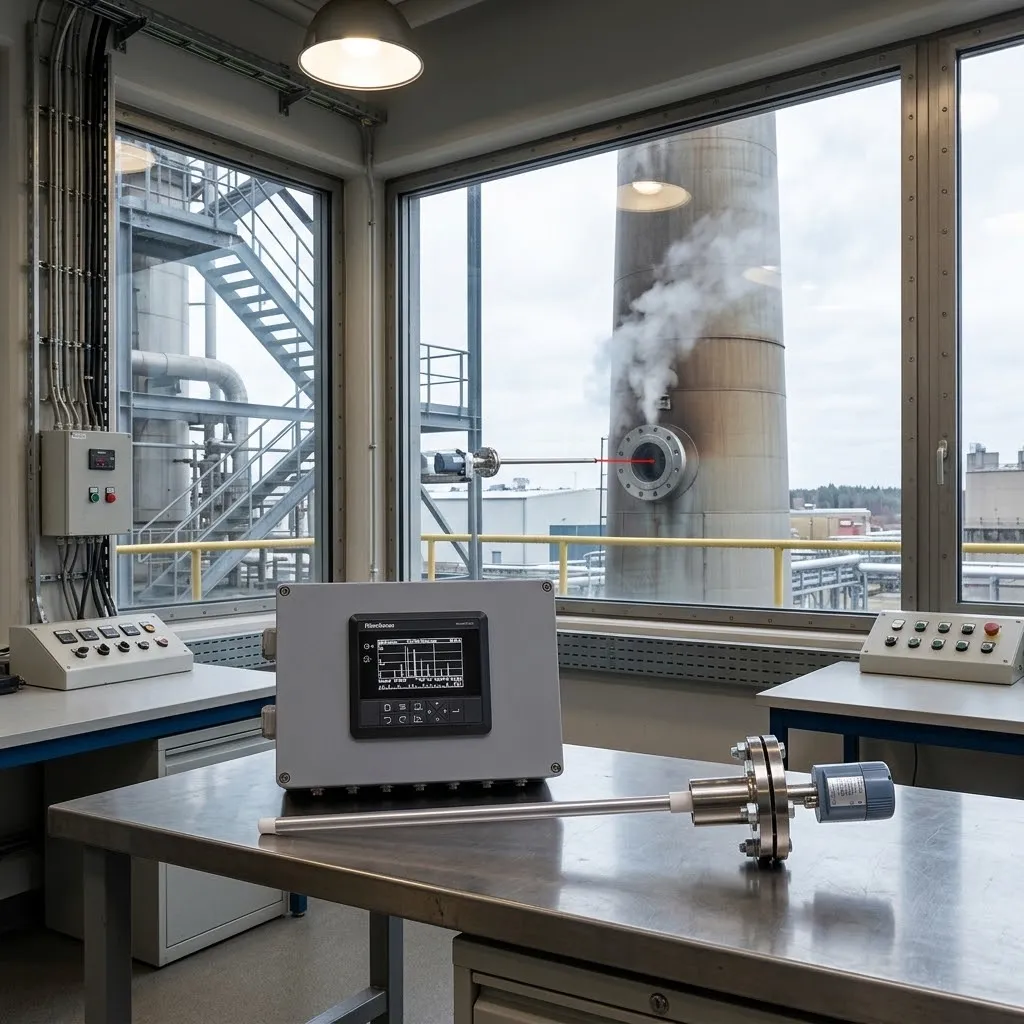
High-precision instruments for air quality monitoring, particle measurement, and environmental analysis – built for reliability, accuracy, and compliance.
Broken bag filters are one of the most common causes of undetected particulate emissions from baghouses and dust collectors, and by the time a visible plume appears, an operator is usually already out of compliance. The DynaCHARGE™ PM 100 PRO, manufactured by Auburn FilterSense (a Nederman company), is built to catch that failure earlier. It is a continuous, electrodynamic particulate monitoring transmitter designed to sit permanently in a stack or baghouse compartment outlet and signal a filter leak long before it becomes an emissions event.
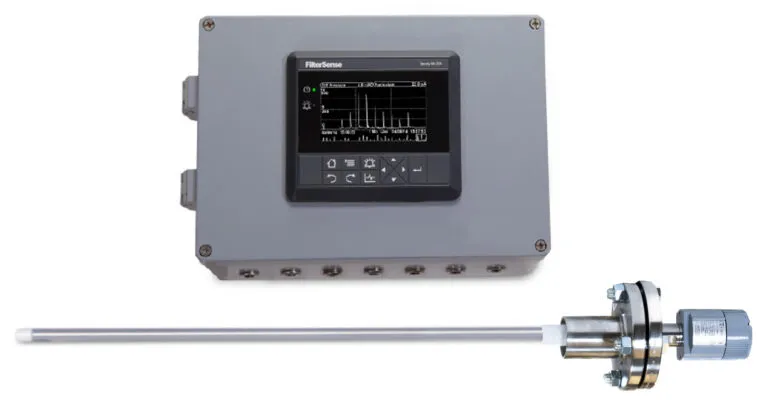
The PM 100 PRO is the processor and display unit at the centre of Auburn's DynaCHARGE particulate monitoring platform. On its own it does not measure anything — it requires one or more PS 10-HP or PS 10-XD particulate sensors, sold separately, mounted in the ductwork. Through Auburn's MICS™ multi-point interface, a single PM 100 PRO can bring in signals from up to 32 sensor points, which makes it a practical choice for baghouses with several compartments or for plants that want one control room view across multiple stacks.
It is worth being precise about what this instrument does and does not do. The PM 100 PRO reports a relative particulate signal, expressed in picoamps, rather than a calibrated mass concentration in µg/m³ or mg/m³. That makes it a parametric monitor and bag-leak detection system in the sense used by US EPA MACT standards, not a Federal Equivalent Method mass analyser such as a beta-attenuation or optical PM10/PM2.5 monitor. For sites that need both — early leak warning on individual compartments and a certified mass reading at the stack outlet — the two technologies are usually run side by side rather than one replacing the other.
The system uses an electrodynamic sensing probe: dry particulate passing the probe tip induces a small electrical signal, which the PM 100 PRO processes into three output resolutions depending on the operating mode selected — 0.1 pA in Measure mode, 0.5 pA in Monitor mode and 5.0 pA in Detect mode. Auburn states a minimum detectable concentration of at least 1.0 mg/m³, though the exact figure will depend on duct velocity, particle characteristics and sensor placement. Not specified by the manufacturer: the precise underlying measurement circuit and calibration methodology are not detailed in the publicly available product literature — AAVOS can request the full technical brochure from Auburn if a project requires it.
Because the sensing element has no moving parts and is described by Auburn as unaffected by dust, moisture or heat build-up, routine sensor cleaning is largely eliminated. The transmitter runs continuous filter leak diagnostics in the background, which is what allows it to operate for extended periods without a manual instrument performance check.
The PM 100 PRO performs automatic EPA self-checks and is built to support compliance with US EPA MACT requirements for continuous particulate monitoring on baghouse-controlled processes. Device and process diagnostics follow the NAMUR NE107 convention, so status signals (fault, function check, out of specification, maintenance required) integrate cleanly with a DCS or SCADA layer instead of requiring a technician to interpret proprietary codes. Not specified by the manufacturer: no EN, MCERTS, QAL1 or ATEX-style third-party certification is stated in the source documentation for this unit — AAVOS has not tagged any formal certification on this product until Auburn confirms one in writing.
Readings are logged on board, with a mirrored SD card acting as a second copy of the data history. If one card is lost or corrupted, the second preserves the record — a detail that matters more than it sounds during an environmental audit, when a gap in the compliance record can be as costly as an actual exceedance.
Auburn positions this platform for aluminium, battery, carbon black, cement, chemical, food & dairy, foundry, incineration, minerals, pharmaceutical, power, steel and wood processing operations — in short, any site running baghouses or dust collectors under an emissions permit. On the user side, it is typically specified by environmental and process engineers responsible for MACT compliance, plant reliability teams who want early warning of a torn bag before it causes downstream fouling, and environmental consultants building a monitoring plan for a permit renewal.
The PM 100 PRO is a transmitter and processing unit only. Each monitoring point needs a PS 10-HP or PS 10-XD particulate sensor mounted in the duct or baghouse outlet; the PRO unit cannot report a reading without at least one sensor connected. Mounting hardware is available in several configurations and sizes depending on duct diameter and access — AAVOS can confirm the correct mounting kit once duct dimensions are known.
Buying the transmitter alone rarely solves a compliance problem — getting the sensor count, mounting position and I/O configuration right the first time is what determines whether a bag leak detection system actually catches a failure before it shows up in a stack test. AAVOS specifies, installs and commissions DynaCHARGE systems across Belgium, the Netherlands and Luxembourg, and supports the completed system with calibration checks, preventive maintenance and technical assistance for the lifetime of the installation.
Does the PM 100 PRO give a certified PM2.5 or PM10 mass reading?
No. It reports a relative electrodynamic signal in picoamps for leak detection purposes, not a Federal Equivalent Method mass concentration. Where a certified mass reading is required at the stack outlet, it is normally paired with a beta-attenuation or optical PM analyser.
Can one PM 100 PRO monitor several baghouse compartments?
Yes, up to 32 monitoring points through the MICS™ platform, so a multi-compartment baghouse can be covered from a single transmitter.
Which sensors work with the PM 100 PRO?
PS 10-HP and PS 10-XD sensors, sold separately. The correct type depends on duct temperature, pressure and access.
How often does the sensor need cleaning?
Auburn states the sensing element is unaffected by dust, moisture and heat build-up, and reports installations running 1.5 years without cleaning or maintenance in one published case. Actual intervals depend on the process.
What diagnostics does it provide?
Automatic EPA self-checks and NAMUR NE107-compliant device and process diagnostics, so fault and maintenance status can be read directly by a DCS or SCADA system.
Is the PM 100 PRO suitable for high-temperature stacks?
The sensor is rated for a process temperature range of −40°C to 898°C, which covers most kiln, incinerator and high-temperature process stacks. The transmitter electronics themselves operate within a −40°C to 70°C ambient range.
What power supply does it need?
The base transmitter version runs as a 4–20 mA, two-wire loop-powered device. The processor/display version accepts 110–220 VAC or 24 VDC.
For sizing, sensor selection or a quotation for a DynaCHARGE PM 100 PRO installation, contact AAVOS or request the Application Review Form so our engineers can specify the correct configuration for your baghouse or stack.
Nous utilisons des cookies pour vous offrir une meilleure expérience utilisateur sur ce site web. Politique de cookies