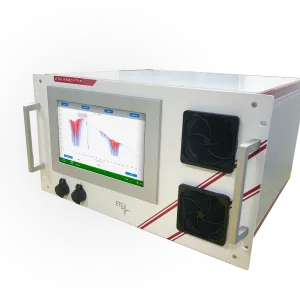
High-precision instruments for air quality monitoring, particle measurement, and environmental analysis – built for reliability, accuracy, and compliance.
The ETG 9500 is a multi-component gas analyser built around Fourier Transform Infrared (FTIR) spectroscopy, capable of resolving several compounds from a single sample stream instead of running parallel single-gas instruments. AAVOS supplies it to environmental compliance teams, hospital biomedical departments and process engineers across Belgium, the Netherlands and Luxembourg who need one analyser that can be reconfigured as their measurement requirements change. It is built by ETG Risorse e Tecnologia in Italy and available as a wall-mounted unit, a 19″ rack version, or a portable instrument.
Key Benefits
Applications
In industrial emissions work, the 9500 is configured to track CO₂, H₂O, NO, NO₂, SO₂, NH₃, HCl and HF from a single stack or process stream, whether it sits permanently in a fixed monitoring system or travels between sites in its portable housing. Anyone only needing to track one compound at high speed is better served by the single-gas ETG 6900; the 9500 earns its place where several regulated compounds need to be reported together.
Hospitals use a dedicated ETG 9500 configuration to monitor anaesthetic gas dispersion in operating theatres — nitrous oxide, isoflurane, sevoflurane, desflurane, enflurane and halothane among them. Response speed matters here as much as accuracy: a leak has to be caught and traced to its source before it becomes an exposure risk to theatre staff.
Research laboratories reconfigure the same platform for greenhouse gas work, resolving methane, nitrous oxide, CO₂ and water vapour at low detection limits. Because reconfiguration is software-based, a laboratory can move from one measurement campaign to another without buying a second instrument.
ETG also lists the 9500 platform against composting process control, catalyst monitoring, leak detection in chemical plants, biogas and syngas research, VOC analysis, CO₂ quality control, gas purity analysis, and toxicity assessment after fire incidents — reflecting the breadth that FTIR's compound flexibility allows, though not all of these are documented with the same level of detail as the three configurations above.
Typical Users
Environmental compliance officers responsible for stack or fence-line emissions reporting; hospital biomedical engineering and operating-theatre safety teams; process engineers in chemical, petrochemical, waste treatment and composting operations; and research laboratories running greenhouse gas or biogas/syngas studies.
How it Works
FTIR spectroscopy exploits the fact that every gas molecule absorbs infrared light at frequencies specific to its own structure. The 9500 passes a sample through an infrared beam, records the resulting absorption spectrum, and applies algorithms to convert that spectrum back into individual compound concentrations. Because each compound has its own spectral signature, one measurement pass can in principle separate out several gases at once — that is the mechanism behind the instrument's multi-compound claim, and it is what distinguishes FTIR from single-wavelength techniques such as NDIR.
Technical Highlights
ETG built the 9500 around a 5-metre optical path folded into a low-volume cell, a design choice aimed at extending sensitivity without the slower response times a long path length would normally introduce. Background referencing — the step where the instrument establishes its zero point before analysing a sample — runs automatically rather than as a manual calibration step, which matters for anyone running the analyser unattended for stretches of time. Where two target compounds share overlapping absorption bands, the software can exclude the interfering one from the calculation rather than let it bias the reading.
Reconfiguration is handled entirely in software. Adding a compound to an existing 9500 does not require new hardware; ETG supplies updated calibration files, which can be loaded over a LAN or WLAN connection, including remotely. That matters for sites that expect their monitoring scope to change over the life of the instrument rather than staying fixed at commissioning.
Technical Specifications
Measurement principle: FTIR (Fourier Transform Infrared Spectroscopy)
Optical path length: 5 metres, low-volume cell
Reconfiguration: Software-based; new compound files can be loaded remotely over LAN/WLAN without hardware modification
Background acquisition: Automatic
Available formats: Wall-mounted, 19″ rack, portable
Measuring ranges, detection limits per compound, response time in seconds, dimensions, weight and power draw are not published on the manufacturer's page — see Missing Information below. AAVOS can request these directly from ETG for a specific configuration.
Downloads
Frequently Asked Questions
How many gases can the ETG 9500 measure at the same time?
The number depends on the configuration loaded, since FTIR resolves compounds by their individual absorption spectra rather than by a fixed sensor count. Configurations documented by ETG cover eight-plus compounds for industrial emissions, six-plus anaesthetic gases, and four greenhouse gases, with more available on request.
Is the 9500 suitable for compliance-grade stack emission reporting?
ETG's own material does not list specific EN, ISO or US EPA certifications for this model. If a permit requires a certified reference or equivalent method, confirm the applicable standard with AAVOS before specifying — we can check what documentation ETG holds for the configuration in question.
Can I add a new gas to the measurement scope after the analyser is installed?
Yes. ETG supplies updated calibration files that can be loaded over LAN or WLAN, including remotely, without opening the instrument or changing hardware.
What's the difference between the industrial and anaesthetic gas configurations?
Both run on the same FTIR platform. The anaesthetic configuration is tuned for operating-theatre gases such as isoflurane, sevoflurane and nitrous oxide, prioritising fast leak detection; the industrial configuration targets stack and process gases such as CO₂, NOx, SO₂ and HCl.
Which format should I choose — wall-mounted, rack, or portable?
Wall-mounted and 19″ rack versions suit a fixed installation point, such as a plant control room or hospital plant room. The portable version is built for spot checks and leak tracing across multiple sites or rooms.
How do I get a quotation or lead time for a specific configuration?
Contact AAVOS with your target compound list and application — we'll confirm configuration, availability and pricing directly rather than quoting from a generic listing.
Why AAVOS?
AAVOS is the Benelux distributor for ETG Risorse instruments, covering Belgium, the Netherlands and Luxembourg. That means a local point of contact for advice, installation, commissioning, calibration, maintenance and technical support, rather than routing every question through an overseas manufacturer.
Get in Touch
Contact our specialists to discuss which ETG 9500 configuration fits your compound list and site: https://www.aavos.be/contactus
Related Products
We use cookies to provide you a better user experience on this website. Cookie Policy