High-precision instruments for air quality monitoring, particle measurement, and environmental analysis – built for reliability, accuracy, and compliance.
Sample Stream Dryer
Water vapour changes the physical and optical behaviour of aerosol particles, and in humid climates it does something worse: it condenses inside sampling lines and instrument housings. The Sample Stream Dryer from Aerosol Magee Scientific is built to prevent exactly that, keeping the relative humidity of an aerosol sample below the 40% threshold recommended by the World Meteorological Organization's Global Atmosphere Watch programme (WMO/GAW).
The unit is a stand-alone sample conditioning device that sits between the inlet and any aerosol instrument, most commonly an Aethalometer. It draws the sample stream across a Nafion membrane, a material that selectively transports water vapour while leaving aerosol particles unaffected. At a flow rate of 5 LPM it lowers the dew point of the incoming air by up to 14°C, which in most field installations is enough to bring relative humidity within the WMO/GAW recommended range even where air-conditioned station interiors run cooler than the outside dew point. Because it is fully self-contained, with its own display, control electronics and USB power input, it can be added to an existing monitoring setup without redesigning the sampling line. It works with every model of Aethalometer, and Aerosol Magee Scientific states it can also condition the inlet of any other aerosol instrument that needs a dry sample stream.
Aerosol stations located in hot, humid regions frequently run air conditioning to protect electronics. If that indoor temperature drops to, or below, the dew point of the outside air being sampled, water condenses inside the tubing and inside the instrument itself. The result is twofold: measurement data becomes unusable, and the condensation can cause lasting damage to optical and flow components. The WMO/GAW guidelines (2003; Wiedensohler, 2014) address this directly by recommending that aerosol measurements be carried out at a relative humidity of 40% or below. Three things follow from this. Removing excess moisture before it reaches the instrument keeps optical and mass-based aerosol readings, including black carbon and OC/EC data, free of humidity-related artefacts. Preventing condensation in the sampling line and instrument housing avoids the corrosion and component damage that moisture ingress can cause over time. And running the sample below 40% relative humidity is the documented reference practice for aerosol monitoring stations reporting to GAW networks.
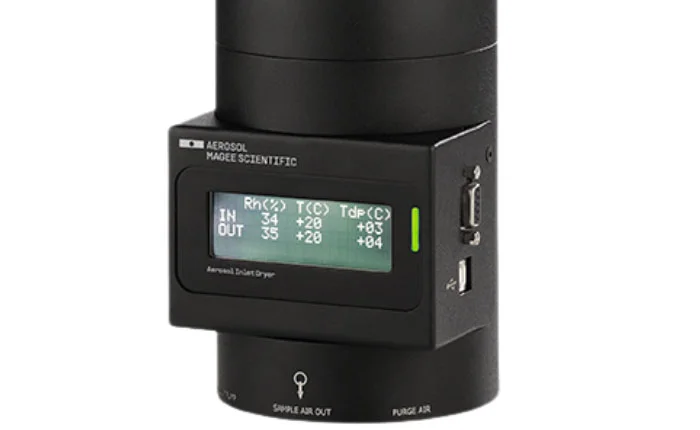
Drying itself takes place through a semi-permeable Nafion membrane. Water vapour molecules in the sample stream pass through the membrane wall into a separate chamber held at low absolute pressure by a vacuum pump; liquid water and aerosol particles cannot cross the membrane. This is a diffusion-based approach, distinct from thermal, dilution or desiccant drying methods, and it is widely used in atmospheric sampling because it removes moisture without heating the sample or introducing dilution air that would alter particle concentrations. The unit reports both inlet and outlet temperature and humidity on its own display, and, when connected to an Aethalometer via the supplied data cable, writes that hygrometric data directly into the Aethalometer's data files, so the drying performance is documented alongside the black carbon measurement itself.
Typical applications include ambient air quality monitoring in humid locations, where indoor air-conditioning temperatures can fall below the outdoor dew point and trigger condensation in unconditioned sampling lines; laboratory aerosol studies that require stable, low-humidity sample conditions to isolate the effect being studied from moisture artefacts; direct combustion emissions measurement, where flue or stack samples carry significant moisture that must be removed before reaching sensitive optical or gravimetric instruments; and low-temperature sampling, since the membrane process removes water vapour without heating the sample, avoiding loss of semi-volatile aerosol components that thermal drying methods can drive off. It is used by environmental monitoring agencies operating GAW-affiliated or national air-quality networks, university and institute research groups running black carbon or OC/EC campaigns, climate research programmes, and industrial or laboratory teams conditioning aerosol samples ahead of continuous or filter-based analysis, across environmental agencies, academic and research institutions, climate research institutions, industrial facilities and public health organisations.
On the technical side, the Sample Stream Dryer relies on Nafion membrane technology that is selective for water vapour only, handles a sample flow rate of up to 5 LPM, and reduces the dew point by up to 14°C at that flow rate when the input dew point is 22°C. Particle loss stays below 4%, so the aerosol size distribution reaching the instrument is not meaningfully altered. It is compatible with every Aethalometer model and can also be used ahead of other aerosol instruments, or run as a fully independent stand-alone unit.
In terms of specifications: the unit is USB powered at 5 V, 200 mA. The chassis is aluminium, 82 cm long and 11 cm in diameter, weighing 4.55 kg. It is designed for indoor use only, with an operating temperature range of 10–40°C (measurement accuracy 0.2°C) and a non-condensing relative humidity range (measurement accuracy 2%). Drying efficiency is 14°C at an input dew point of 22°C, with particle loss under 4%. Sampling air connects via 1/4" NPTF inlet/outlet fittings, purge air and the vacuum pump connection use 1/8" NPTF, sample airflow reaches up to 5 LPM with a purge airflow of 4 LPM, and drying pressure sits at -700 mbar. Electrically, power comes in via USB Type B, data is transmitted over an RS232 serial interface, and the chassis has functional grounding. The user interface consists of a 4 x 20 alphanumeric character display, a green/yellow/red LED status indicator, and a vacuum gauge with adjusting control. The supplied external pump is a KNF N838.1.2.KN.18, available in 230 V/50 Hz or 115 V/60 Hz versions, delivering 37 LPM free air (5 LPM at 300 mbar abs. vacuum) at 100 mbar abs., measuring 402 x 121 x 110 mm and weighing 6.8 kg.
Available downloads include the specification sheet, the installation scheme, the GAW aerosol measurement procedures guidelines and recommendations document, and the GAW–WCCAP recommendation for aerosol drying.
AAVOS supplies the Sample Stream Dryer across Belgium, the Netherlands and Luxembourg with the technical advice needed to size it correctly for an existing sampling line, whether that line already feeds an Aethalometer or another aerosol instrument. Beyond the initial order, AAVOS handles installation, commissioning and, where required, integration of the dryer's humidity output into the wider monitoring station data stream, plus ongoing technical support for stations that need to stay within WMO/GAW recommended sampling conditions year-round. Contact AAVOS for pricing, lead time and advice on integrating the Sample Stream Dryer into your current or planned aerosol sampling setup.
We use cookies to provide you a better user experience on this website. Cookie Policy