High-precision instruments for air quality monitoring, particle measurement, and environmental analysis – built for reliability, accuracy, and compliance.
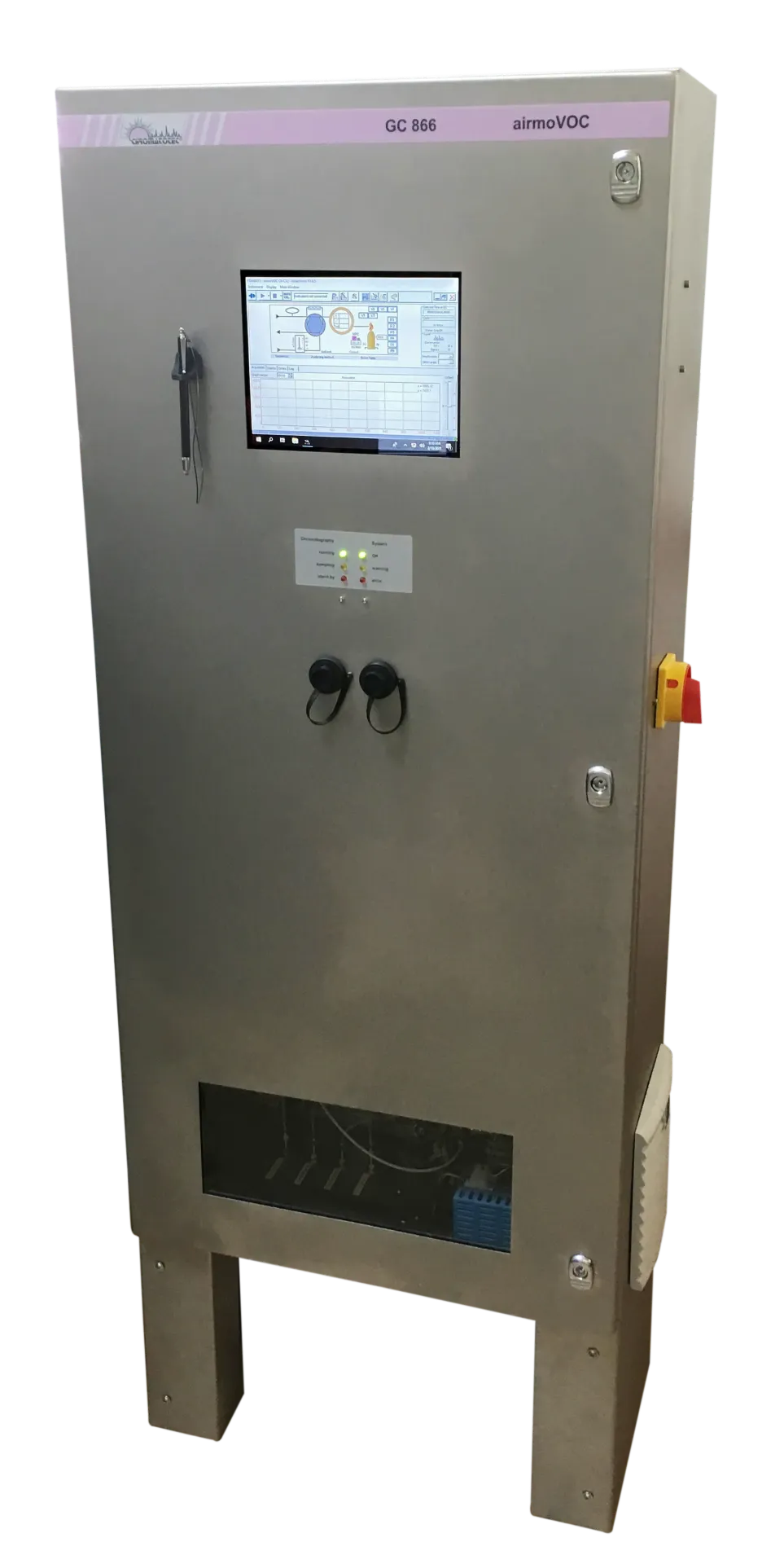
Water utilities and process operators monitoring volatile organic compounds in drinking water, surface water or effluent streams typically rely on manual sampling followed by laboratory analysis, which leaves gaps between measurements. The airmoVOC WMS from Chromatotec addresses that gap with an online, purge-and-trap gas chromatograph built into a self-contained, wall-mounted enclosure, designed to run unattended at the sampling point rather than in a laboratory.
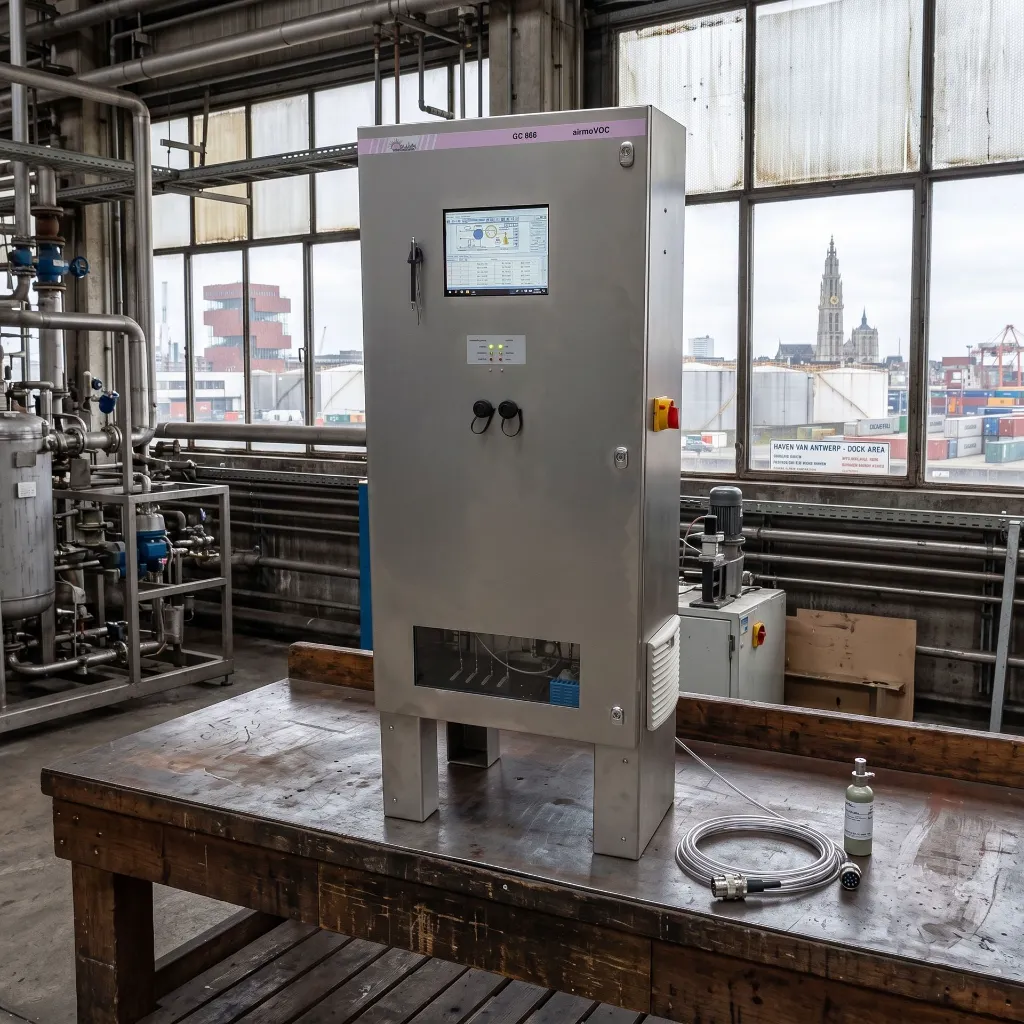
The airmoVOC WMS is a standalone process analyser for VOC monitoring in liquid matrices, based on the EPA 502.2 method for volatile organics in drinking water by purge-and-trap gas chromatography. It ships as a turn-key wall-mounted cabinet with integrated calibration and gas generation, which means no external gas cylinder is required for routine operation. Everything from the sample port through to data storage sits inside a single enclosure — a deliberate design choice for sites where space is limited and cylinder logistics are impractical.
Two model variants exist within the family: the A25022-502 (the airmoVOC-WMS configuration referenced in this datasheet, built around the EPA 502.2 method) and the A25022 (listed under the airmoVOC 624 designation). AAVOS can advise on which configuration matches your specific compound list and regulatory method.
Detection runs on flame ionisation (GC-FID) as standard, with an online GC-MS detector (DET QMS) available as an option where compound confirmation by mass spectral data is required. Sample handling follows purge-and-trap methodology: a water sample — 5 mL as standard, or an optional 25 mL sparger — is purged with ultra-pure nitrogen at 40 mL/min for an 11-minute sampling period, transferring dissolved VOCs into the gas phase. The stripped compounds pre-concentrate on an absorbent tube before being introduced into a gas chromatograph fitted with a metallic capillary column and a programmable-temperature-gradient oven. Carrier gas pressure is regulated by a piezo-valve rather than a conventional mechanical regulator, which supports the retention-time stability the analyser is specified to.
The low sample volume requirement — just 5 mL of water — keeps dead volume between the water inlet and the trap under 15 mL, which shortens the time between sample draw and result and simplifies inlet calibration. Each unit is tested for a full week after production before being released for quality control.
Vistachrom software handles visualisation and storage of chromatographic data on a connected PC, along with recalculation, calibration, data export and measurement set-up. It also derives retention time, peak area, mass and concentration profiles from the raw chromatogram.
The airmoVOC WMS platform covers up to 60 compounds depending on configuration:
Typical compounds resolved include benzene, toluene, ethylbenzene and the xylenes (BTEX), along with chlorinated aliphatics and aromatics such as 1,2-dichloroethane, trichloroethylene, tetrachloroethylene, chlorobenzene, the dichlorobenzenes, trimethylbenzenes, trichlorobenzenes and hexachloro-1,3-butadiene. The airmoVOC C6C16 option extends coverage further into additional VOCs and sulphur-containing VOCs where a broader compound list is required.
Drinking water quality monitoring — finished drinking water, raw source water and surface water, where continuous VOC tracking supports supply safety without waiting on laboratory turnaround.
Wastewater and effluent surveillance — process water and waste water/effluent streams, including refinery wastewater quality monitoring, where head-space or trace-level detection down to parts-per-trillion matters.
Rainwater monitoring — for sites tracking VOC deposition or run-off contamination.
Ambient air monitoring (optional) — with the air market option enabled, the same platform extends to ambient air control, urban and non-urban pollution monitoring, indoor air measurements, and BTEX/PAMS/CE analysis, giving a single instrument coverage across both liquid and gas matrices.
Drinking water utilities and municipal water authorities are the most direct fit, particularly where continuous compliance monitoring is preferred over periodic grab sampling. Refineries and chemical process operators use the same platform for wastewater and process water surveillance, especially where VOC breakthrough into effluent carries regulatory or environmental risk. Environmental consultancies and contract laboratories running water-quality campaigns, and research institutes studying VOC behaviour in aquatic systems, are also realistic users of this instrument class.
The analyser's purge-and-trap methodology is based on EPA 502.2, the established US EPA method for volatile organic compounds in drinking water. No formal product certifications (such as EN14662, QAL1 or MCERTS) are listed by the manufacturer for this instrument — where a project specifically requires one of these certification schemes, confirm with AAVOS before specifying the airmoVOC WMS.
A wall-mounted, gas-generator-integrated analyser still needs correct siting, commissioning and periodic calibration to deliver the detection limits it's specified for. AAVOS handles product selection against your compound list and method requirements, installation and commissioning on site, and ongoing calibration once the unit is running. For water utilities and industrial sites across Belgium, the Netherlands and Luxembourg, that means a local technical contact for maintenance rather than relying on cross-border manufacturer support for day-to-day service. Where a multiplexed, multi-point monitoring setup is being planned, AAVOS can also advise on stream configuration before the order is placed.
What is the measuring principle of the airmoVOC WMS?
Purge-and-trap sample preparation combined with gas chromatography and flame ionisation detection (GC-FID), based on the EPA 502.2 method. An online GC-MS detector is available as an option.
How much sample does the analyser need per measurement?
5 mL of water as standard, or an optional 25 mL sparger configuration, with an 11-minute sampling time per cycle.
What is the detection limit for BTEX compounds?
Below 0.001 µg/l for BTEX, with a broader detection range of 0.05 to 20 µg/l for surface and finished drinking water, extendable to 0 to 50,000 µg/l on demand for other liquids.
Does the airmoVOC WMS require a gas cylinder on site?
Not with the integrated hydrogen and zero-air generator option — the standard turn-key configuration is designed to avoid external gas cylinder dependency.
Can one unit monitor multiple sampling points?
Yes, with the multiplexer option, supporting 2 to 32 streams, including dedicated water and air stream capability.
Is the airmoVOC WMS certified to a specific standard?
The manufacturer does not list formal certifications such as EN14662, QAL1 or MCERTS for this instrument. The method basis is EPA 502.2. Contact AAVOS if your project requires a specific certification scheme.
Can this analyser also monitor ambient air, not just water?
Yes, with the air market option enabled it extends to ambient air control, urban/non-urban pollution monitoring, indoor measurements and BTEX/PAMS/CE analysis.
What control system does the analyser use?
An embedded Windows®-based computer with a 10" TFT colour LCD, 128 GB SSD storage, MODBUS RTU/JBUS communication, and both USB and RS-232 connectivity.
For a quotation, help selecting between the A25022-502 and A25022 configurations, or advice on matching the compound list to your monitoring requirement, contact the AAVOS technical team.
We use cookies to provide you a better user experience on this website. Cookie Policy