High-precision instruments for air quality monitoring, particle measurement, and environmental analysis – built for reliability, accuracy, and compliance.
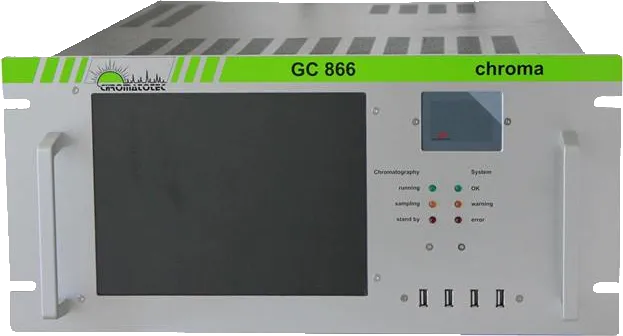
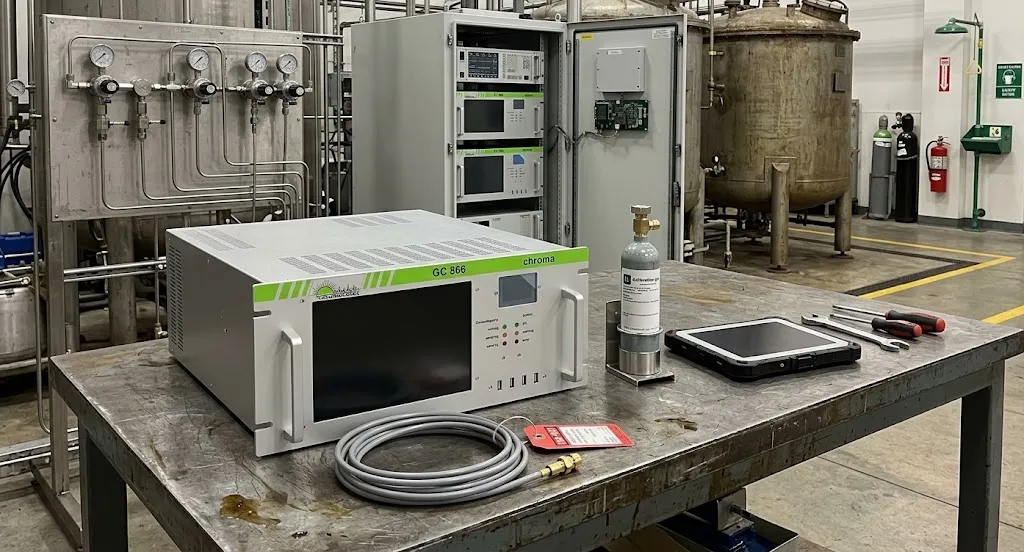
Sulfur compounds rarely announce themselves gradually. A process upsets, a seal degrades, or an odour complaint arrives before anyone has hard numbers to work with. chromaS is Chromatotec's answer to that gap: an automatic, isothermal gas chromatograph built to run continuously and report H2S, mercaptans, COS, CS2 and related sulfur species without an operator standing over it.
How it works
The instrument draws a continuous, uninterrupted sample stream and injects a defined volume into a chromatographic column at set intervals. A controlled oven holds the column at a fixed temperature chosen for the application, separating the sulfur compounds by their retention behaviour. Detection is handled by a sulfur-specific double flame photometric detector (FPD) — the double-flame design is specifically intended to avoid quenching effects that can distort readings in single-flame FPD systems. Compounds are identified by retention time as they elute from the column, and concentrations are calculated automatically once the system has been linearised.
An internal permeation tube provides automatic data validation as standard, which matters for a technique this sensitive to detector drift over unattended runs.
Detection performance
chromaS is specified with two detection limit tiers, depending on compound complexity:
The two ranges mean chromaS can be configured for trace ambient-level monitoring or for higher-concentration process streams, without changing the underlying measurement principle.
Measured compounds
The manufacturer lists the following as analysable on chromaS: H2S, methyl mercaptan, ethyl mercaptan, isopropyl mercaptan, n-propyl mercaptan, 2-butyl mercaptan, tert-butyl mercaptan, dimethyl sulphide (DMS), diethyl sulphide (DES), dimethyl disulphide (DMDS), carbonyl sulphide (COS) and carbon disulphide (CS2). Chromatotec's own product summary also references SO2 and general mercaptans (RSH); these are not broken out individually in the published specification and should be confirmed against the TSP datasheet before being stated as measured parameters.
Gas requirements
Running chromaS means planning for three gas supplies: carrier gas (air or nitrogen at 3 bar, 5 mL/min, 1/8" fitting), a sample inlet at either -1 bar or ambient pressure (the latter via an airmoPump), and detector gases — hydrogen at 2 bar (70 mL/min, 1/8") and air at 3 bar (80 mL/min, 1/8"). A pneumatic valve handles gas commutation at 90 mL/min. None of this is unusual for FPD-based GC, but it does mean gas supply and safe hydrogen handling need to be part of the installation plan from the outset.
Data handling and connectivity
chromaS runs on Chromatotec's VISTACHROM® software, which stores every chromatogram and result with individual timestamps, supports remote monitoring, keeps a full audit trail for QC purposes, and lets operators configure threshold alarms. Data can be exported over MODBUS, MGS1, 4-20 mA or 0-10 V, which covers most SCADA and DCS integration scenarios without requiring a dedicated protocol gateway.
Reference methods
Chromatotec lists ASTM (specific standard not stated on the product page), US EPA Method TO-15, and US EPA Method 16 (Total Reduced Sulfur by gas chromatograph) under standards, approvals and certifications for this product. These are reference methods the analyser draws on rather than a certification issued for the instrument itself — worth clarifying directly with Chromatotec if a formal certification statement is needed for a tender.
Configuration
Required: carrier gas supply, hydrogen and air for the detector, a sample line to the analysis point.
Application-dependent: airmoPump (needed where sample inlet pressure is at or near ambient rather than under vacuum/positive pressure), enclosure or shelter for outdoor or industrial installation, and any MODBUS/analogue integration hardware on the receiving end.
Not specified: dedicated calibration gas cylinders or a zero-air generator are not mentioned on this page but are typically part of a working GC-FPD installation — to be confirmed before quoting.
Chromatotec's sulfur compounds range
chromaS sits alongside several other Chromatotec instruments built for sulfur measurement — H2S MEDOR, H2S/TOS TS MEDOR, THT MEDOR, TRS MEDOR, energyMEDOR and airmoS. The MEDOR-branded instruments use a different detection approach to chromaS's GC-FPD method; the manufacturer's source material reviewed here doesn't detail that difference, so a meaningful side-by-side belongs on a future comparison page once the MEDOR technical documentation has been reviewed.
Why AAVOS
As the Chromatotec chromaS becomes available through AAVOS in the Benelux, our role covers the parts of the project that sit around the instrument itself: helping confirm the right detection range and cycle-time configuration for your application, planning the gas supply and sampling arrangement, handling installation and commissioning, and supporting ongoing calibration and maintenance once the system is running. (Distributor status/exclusivity language kept general — confirm exact positioning once the Chromatotec agreement terms are finalised.)
Contact AAVOS for technical advice, configuration support or a quotation.
06 — FAQ
What does chromaS measure?
It's specified for a range of sulfur compounds including H2S, several mercaptans, dimethyl sulphide, diethyl sulphide, dimethyl disulphide, carbonyl sulphide and carbon disulphide.
What is the measurement principle?
Isothermal gas chromatography with a sulfur-specific double flame photometric detector, identifying compounds by their retention time.
How sensitive is the instrument?
Detection limits are 4 ppb for double sulphur compounds such as DMDS and CS2, and 7 ppb for single sulphur compounds such as H2S and DMS.
How long does one analysis cycle take?
10 minutes as standard, though shorter cycles are possible depending on the application.
What gases does chromaS need to operate?
Carrier gas (air or nitrogen), plus hydrogen and air for the detector — see the gas supply specification above for exact pressures and flows.
Which standards does chromaS reference?
The manufacturer lists ASTM, US EPA Method TO-15, and US EPA Method 16 as applicable reference methods.
Can chromaS integrate with an existing monitoring or control system?
Yes — VISTACHROM® supports data export over MODBUS, MGS1, 4-20 mA or 0-10 V.
Is chromaS suitable for outdoor or industrial installation?
Not specified by the manufacturer on this page; this depends on enclosure and environmental protection, which should be confirmed for your specific site.
We use cookies to provide you a better user experience on this website. Cookie Policy