High-precision instruments for air quality monitoring, particle measurement, and environmental analysis – built for reliability, accuracy, and compliance.
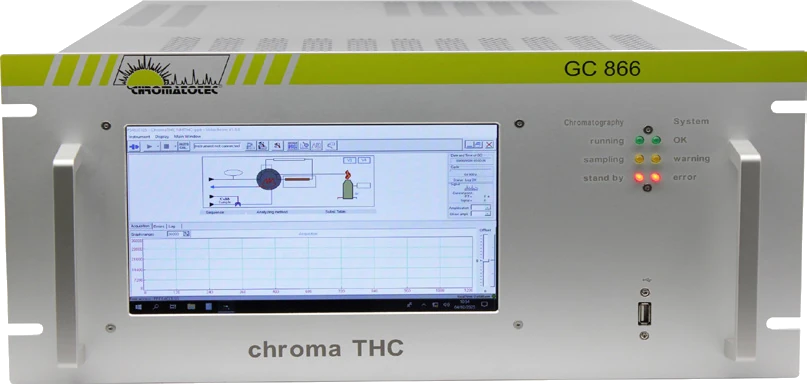
The chromaTHC is an automatic gas chromatograph built specifically for continuous measurement of methane (CH₄) and non-methane total hydrocarbons (NMTHC). Chromatotec designed it for unattended operation in process environments, ambient air networks and industrial hygiene monitoring, where an operator cannot realistically restart or babysit an instrument every few hours.
Once commissioned, the analyser runs on its own around the clock. Sample gas is injected into an isothermal oven held at 80°C as standard, and separation between the methane fraction (and C₂H₆, where UHC is measured) and the NMTHC fraction happens on a column fitted with back-flush. Detection is by flame ionisation — a heated FID at 150°C with automatic ignition, so the flame relights itself rather than requiring manual intervention after a shutdown or gas interruption.
Why GC-FID for this measurement
Flame ionisation detection is a well-established technique for hydrocarbon analysis because it responds proportionally to carbon content and gives good sensitivity at low concentrations. Chromatotec's implementation adds a valve that regulates the carrier gas (hydrogen, nitrogen or air, depending on configuration) specifically to damp flame fluctuation — a common source of drift in FID instruments. The result is a retention time drift below 0.3% and, according to the manufacturer, no interference from oxygen in the sample — a limitation that affects some competing FID designs.
Detection performance
Figures preserved exactly as published by Chromatotec — no unit conversion applied.
Gas supply and configuration
A THC analyser is never a standalone box — it's a small gas-handling system, and this is usually the part that needs the most planning before installation:
The injection loop volume is sized according to the application, and an internal loop valve (XXXVALVEHC) is available where measurement up to the percent range is required. Where sample pressure cannot be guaranteed, a vacuum pump can be added at the sample inlet.
Data, control and integration
The chromaTHC runs on an embedded Windows-based computer with an LCD display and 128 GB of onboard SSD storage. It communicates over Ethernet with remote control, and outputs data via MODBUS RTU / MGS1 or JBUS for integration into a DCS, SCADA or plant historian. Chromatotec's VistaChrom software layer adds remote monitoring, full traceability through result and QC archiving, configurable threshold alarms, and export via MODBUS, MGS1, 4-20 mA or 0-10 V — useful where the receiving system doesn't speak MODBUS natively.
Applications
Chromatotec positions the chromaTHC for VOC analysis in indoor, outdoor and combustion air, for industrial hygiene monitoring, and for pure gas impurity checks in nitrogen, CO₂ and oxygen streams. The same measurement principle is also used in process and continuous emissions monitoring contexts, where continuous, unattended THC data is needed rather than periodic sampling.
What isn't specified
The manufacturer's page does not list applicable standards, certifications, power requirements, dimensions, weight or a stated warranty for this model. Where any of this information is required for a tender or specification, it should be requested directly rather than assumed.
Configuration and related instruments
The chromaTHC sits in Chromatotec's autoGC 866 platform alongside other VOC analysers (airmoVOC FID range, ChromaFID, chromaPID) built on the same automatic GC architecture, and alongside the platform's permanent-gas analysers (Chroma CO, ChromaTCD, chromARGON, Chroma DID, ChromEnergy) where a site needs both hydrocarbon and permanent-gas measurement from a related instrument family. Where TVOC sensitivity below 1 ppb is required, the chromaTHC-1ppb (C24000) variant uses nitrogen rather than hydrogen as carrier gas and runs a longer, 10-minute cycle.
Why AAVOS
AAVOS can help translate the gas-supply and configuration requirements above into a working installation — sizing the hydrogen/air/nitrogen supply, specifying sample conditioning where needed, and handling commissioning, calibration and ongoing maintenance once the analyser is on site. Where the specification sheet doesn't answer a tender requirement (certifications, power, dimensions), AAVOS can request this directly from Chromatotec on your behalf.
Contact AAVOS for technical advice, configuration support or a quotation.
What does the chromaTHC actually measure? Methane (CH₄) and non-methane total hydrocarbons (NMTHC), separated on a single column with back-flush. A separate 1 ppb variant also reports total VOC (TVOC).
What is the measurement principle? Automatic gas chromatography with flame ionisation detection (GC-FID), using an isothermal oven held at 80°C as standard.
Does the sample gas need conditioning before it reaches the analyser? The manufacturer specifies a sample inlet flow of 80 mL/min at ambient pressure, with an optional vacuum pump where sample pressure can't be guaranteed. Beyond that, conditioning requirements depend on the sample matrix and should be assessed per application.
Which gases does the instrument require to run? Hydrogen (FID and carrier gas), compressed air (FID), and — for the chromaTHC-1ppb variant — nitrogen as carrier gas instead of hydrogen.
How long does one measurement cycle take? 2 minutes as standard for 0–3 ppm in ambient air; 3–5 minutes or longer for higher concentrations or process applications; 10 minutes for the chromaTHC-1ppb variant.
Is the chromaTHC certified to any standard? The manufacturer's product page does not list any standards, approvals or certifications for this model.
Can it be integrated into an existing monitoring network or DCS? Yes — it communicates via Ethernet, MODBUS RTU/MGS1 or JBUS, and its VistaChrom software also supports 4-20 mA and 0-10 V output.
What's the difference between the standard chromaTHC and the chromaTHC-1ppb version? The 1ppb variant reaches a lower detection limit (<1 ppb TVOC), uses nitrogen instead of hydrogen as carrier gas, and runs a longer 10-minute cycle.
We use cookies to provide you a better user experience on this website. Cookie Policy