High-precision instruments for air quality monitoring, particle measurement, and environmental analysis – built for reliability, accuracy, and compliance.
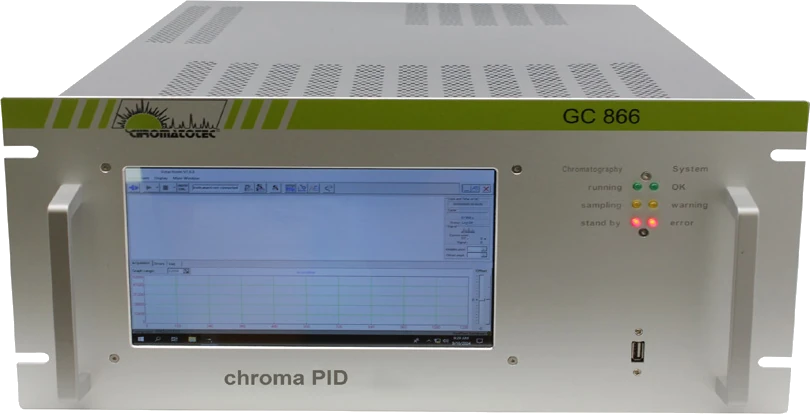
The chromaPID is an automatic gas chromatograph fitted with a photo-ionisation detector (PID), built by Chromatotec for continuous benzene and total VOC (TVOC) monitoring in air, water and soil. It is designed for applications where a conventional flame ionisation detector lacks the sensitivity required, and where trace-level benzene needs to be tracked reliably over long, unattended monitoring periods.
In its standard configuration, the chromaPID quantifies benzene, with a lower detection limit of 6 ppb on the ppb version or 0.1 ppm on the ppm version. It reports total VOC concentration down to 1 ppb. Three detection ranges are available for benzene — 0–10, 0–100 and 0–1000, expressed in ppm or ppb depending on the configuration — which allows the instrument to be matched to ambient trace-level work or to higher-concentration industrial settings from the same platform.
Sample is introduced through a port valve fitted with a sample loop and separated on a metallic column of 0.53 mm internal diameter, before detection by a 10.6 eV PID lamp (alternative lamp energies are available on request). Photo-ionisation detection responds to a broad range of aromatic and unsaturated compounds, which is why the technique suits benzene monitoring at ppb level where FID sensitivity would not be sufficient. The lamp is self-cleaning, which Chromatotec states is intended to preserve detector stability between services. The oven runs isothermally as standard; a programmed temperature gradient is available as an option for applications that need it.
A full analysis cycle takes between 3 and 15 minutes, and carrier gas pressure and flow are controlled through the valve rather than a separate flow controller.
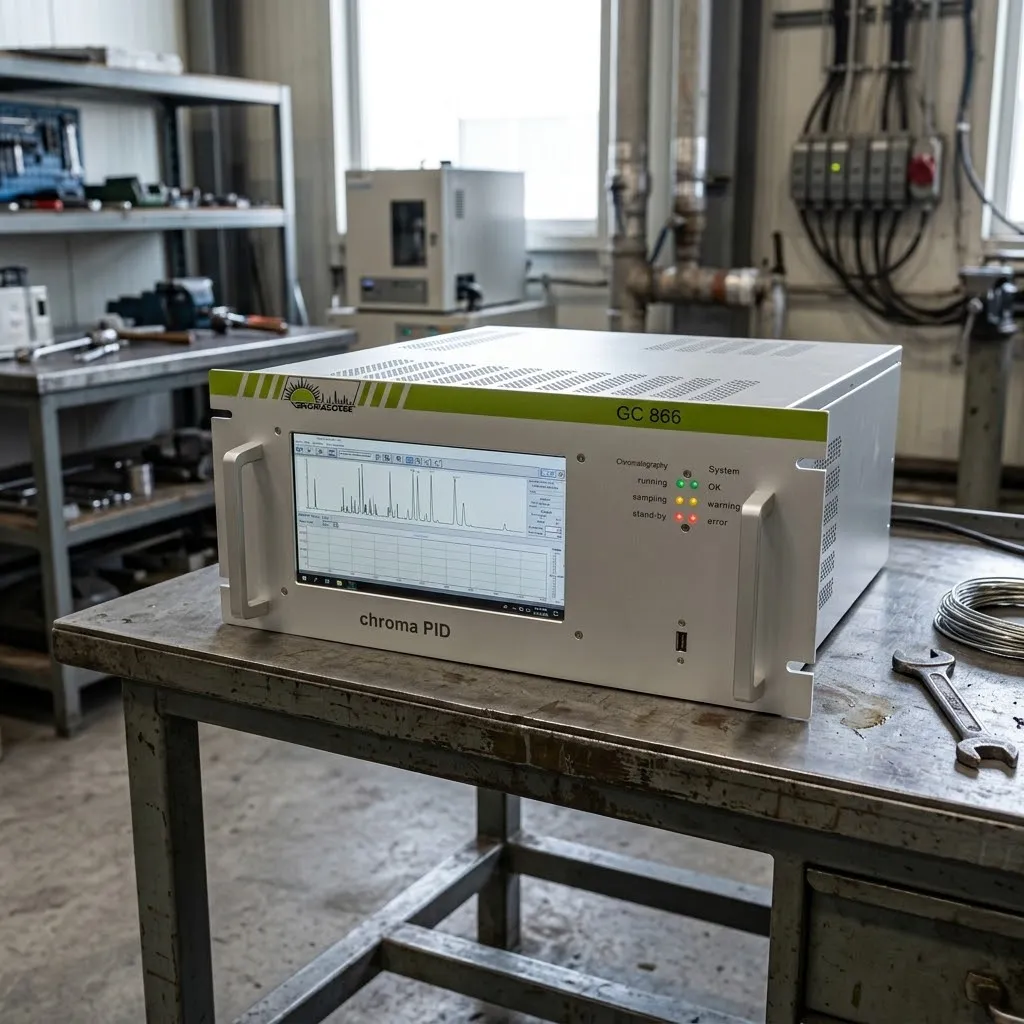
The complete analytical path — from sample inlet to data storage — is housed in a single 19″ 4U rack unit, which keeps the footprint compact for cabinet or shelter installation. Results are handled by an embedded Windows-based computer with an LED display and 128 GB of SSD storage, so the instrument can log extended monitoring campaigns without external storage. Communication runs over Ethernet with remote-control capability, and a bidirectional RS-232 link is available for transferring data and results to a separate computer. A 0…1 V analogue output is provided for high/low concentration alarms, which is the usual way to wire the chromaPID into an existing SCADA or alarm system.
Not specified by the manufacturer on this page: physical dimensions, weight, power consumption, operating temperature and humidity range, warranty terms, country of manufacture, calibration and maintenance intervals, and any reference to a specific ambient-air standard such as EN 14662. These should be confirmed from the datasheet or technical manual before being quoted to a customer or included in a tender specification.
Vistachrom is Chromatotec's data platform for the chromaPID. It lets the operator view and store chromatographic data, recalibrate the method, export results and configure the measurement remotely. Retention time, peak area, mass and concentration can all be calculated and reported in any international measurement unit, which is useful where a site needs to report in different units than the ones used for calibration.
The chromaPID is positioned for continuous benzene monitoring in air, water and soil where trace-level sensitivity and unattended operation matter more than broad multi-compound coverage. Typical settings include fenceline and perimeter monitoring around refineries and petrochemical sites, ambient air quality stations tracking benzene as a regulated pollutant, and industrial hygiene applications where benzene exposure needs to be tracked continuously rather than through periodic sampling. The ATEX/IECEx Zone 1 Group IIC T4 rating on the explosion-proof cabinet variant makes it suitable for installation inside hazardous areas, which is relevant for refinery and tank-farm perimeter applications specifically.
Because the platform reports TVOC alongside benzene, it also gives a general indication of overall VOC loading at the same measurement point, without needing a second instrument.
Required for operation: carrier/dilution gas supply (air or nitrogen) and a vacuum pump for sample introduction, as listed under gas requirements above. Application-dependent: the explosion-proof (Exp) cabinet variant, needed only where the analyser is installed in a classified hazardous area; the programmed-gradient oven option, relevant where the standard isothermal method does not adequately separate the target compounds; and the choice of ppm versus ppb detection range, which should be matched to the expected concentration levels at the installation site rather than assumed. Not specified by the manufacturer on this page: specific sampling probe, filter or sample-conditioning accessories, or a defined list of consumables and their replacement intervals.
The chromaPID (Exp cabinet variant) holds ATEX and IECEx certification for Zone 1, Group IIC, T4. Chromatotec provides the certificate and a technical specification sheet (TSP) as separate downloads. No reference method or ambient-air measurement standard (such as EN 14662) is stated on the manufacturer's page reviewed for this content; if a customer requires compliance with a specific reference method, this should be verified directly with Chromatotec before being confirmed in writing.
Chromatotec states that each unit is tested for one week by its quality control department before final delivery, which is worth mentioning to customers evaluating lead times and factory acceptance procedures.
As the Benelux distributor for Chromatotec, AAVOS can advise on whether the chromaPID's ppb or ppm configuration, and the standard or Exp-rated cabinet, matches your monitoring point — fenceline, ambient station or process area. Beyond product selection, AAVOS supports system configuration, installation, commissioning, calibration and ongoing maintenance, and can put together a service contract so the analyser stays within specification over its operating life.
Contact AAVOS for technical advice, configuration support or a quotation on the chromaPID.
We use cookies to provide you a better user experience on this website. Cookie Policy