High-precision instruments for air quality monitoring, particle measurement, and environmental analysis – built for reliability, accuracy, and compliance.
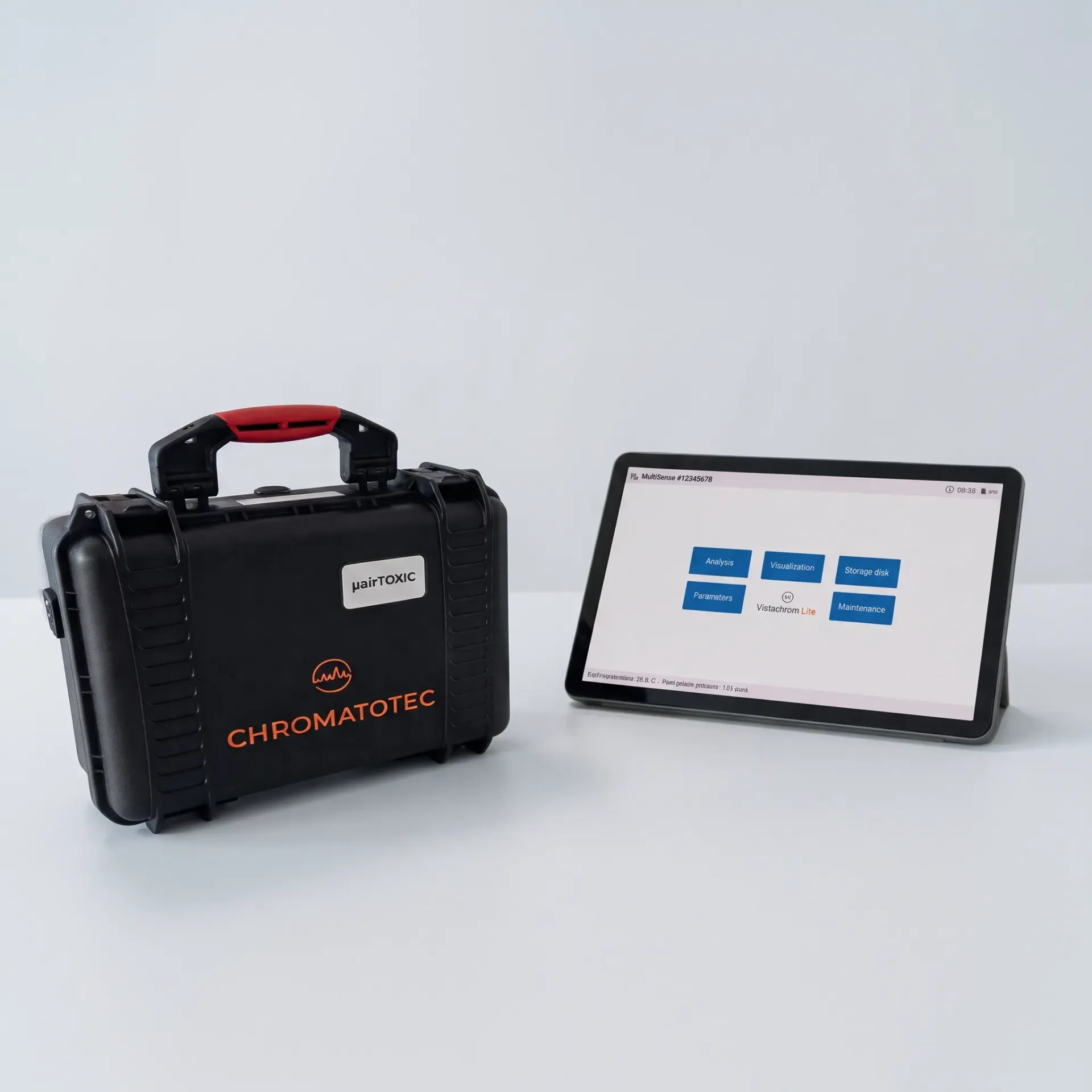
The µ-airTOXIC (often written micro-airTOXIC) is a gas chromatograph built into a carry case. It pre-concentrates an air sample on an adsorbent trap, separates the compounds on a capillary column and quantifies them with a heated photoionisation detector. Depending on the configuration, that means BTEX and 1,3-butadiene, or a library of up to 45 individual VOCs from benzene to n-decane, with a lower detection limit of ≤ 10 ppt in automatic mode (compound- and configuration-dependent).
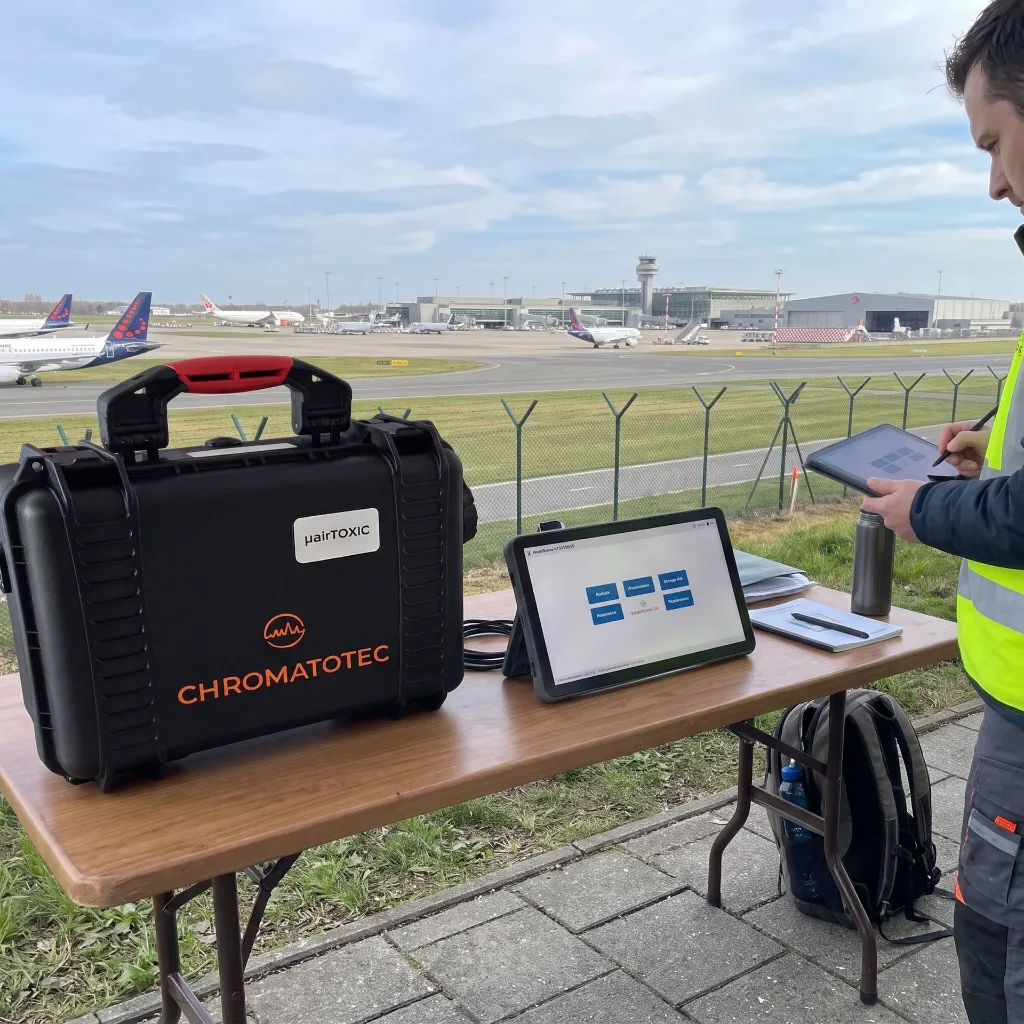
It runs on its own battery and carries its own nitrogen, so it is meant for the places where a fixed analyser does not go: short measurement campaigns, fenceline surveys, indoor-air investigations and occupational-exposure checks.
Replacing a microVOC or microBTEX? The µ-airTOXIC succeeds the Chromatotec microVOC and microBTEX portable analysers in the AAVOS range. If you currently operate one of these, contact us to discuss which µ-airTOXIC configuration matches your existing methods and calibration set-up.
A handheld PID gives one number: the total response of everything the lamp can ionise. That is useful for leak finding, but it cannot tell benzene from toluene, and benzene is usually the compound that matters. The µ-airTOXIC puts a chromatographic separation in front of the same type of detector. Each compound elutes at its own retention time and is quantified individually, which is what you need when results are compared against a limit value for a specific substance.
The pre-concentration step is what brings the detection limit down to trace level. Sample volume is programmable from 20 to 700 mL or more, so the trade-off between sensitivity and cycle time can be set per application.
Worth knowing: a 10.6 eV PID only responds to compounds with an ionisation energy below that value. Aromatics, alkenes and most of the C6–C12 range respond well; light alkanes such as methane and ethane do not. For biogenic measurements including isoprene, Chromatotec notes potential co-elution with C4 or C5 ozone-precursor VOCs, so method choice should follow the compounds you actually need to report.
Benzene measuring ranges of 0-10 ppb, 0-100 ppb or 0-1000 ppb are available. Cycle times are 10, 15, 20 or 30 minutes for the µ-A73022 and 30 minutes for the µ-A73022-B.
Sampling, analysis, data storage, battery and an internal nitrogen tank sit in one suitcase measuring 410 × 340 × 180 mm (H × W × D) and weighing 7 kg net. Chromatotec states the analyser is ready for operation in less than 5 minutes.
The specified operating temperature is 0 °C to 40 °C, which may vary with the method. For winter campaigns outdoors or unheated industrial sites, take this into account when planning the installation.
Urban air-quality campaigns. Temporary benzene and VOC measurements at locations without a permanent station, or to check the spatial representativeness of an existing site.
Refinery and chemical-site fencelines. Compound-specific data at the site boundary helps distinguish a process source from background traffic emissions – a distinction a total-VOC reading cannot make.
Indoor air and industrial hygiene. Investigating complaints, verifying workplace exposure to benzene or styrene, or checking indoor sources. With the 45-compound European configuration, terpenes from cleaning products or building materials are covered as well.
Beverage-grade CO₂. Chromatotec lists CO₂ for beverages among the applications, where trace aromatic impurities are a quality concern.
VOCs in water. With the optional purge module, VOCs are extracted from a water sample for online BTEX analysis.
Benzene is a regulated pollutant under the EU ambient air quality legislation, and EN 14662-3 describes automated pumped sampling with in situ gas chromatography for its measurement. According to Chromatotec's technical specification sheet (TSP), the µ-airTOXIC supports compliance with EN 14662-3:2015 for selected applications, and the TSP lists EN 15267-1, EN 15267-2 and QAL1. Applicability depends on the configuration and application.
The product page itself lists no certificate under standards, approvals and certifications. If your project calls for a certified analyser – a regulatory monitoring network or a tender requirement – ask us to confirm the certification status for your exact configuration before you specify it.
Calibration and maintenance intervals are not specified by the manufacturer; in practice they depend on the method and on how the analyser is used.
AAVOS distributes Chromatotec analysers in Belgium, the Netherlands and Luxembourg. We help you choose the configuration and carrier-gas set-up that fits your campaigns, commission the analyser, and train your team on Vistachrom LITE and calibration. After delivery, calibration, maintenance, repairs and service contracts are handled locally – useful for an instrument that travels from site to site.
Individual VOCs at trace level. The BTEX configuration covers benzene, cyclohexane, toluene, ethylbenzene, m-/p-xylenes, styrene and o-xylene; the C6-C12 configurations cover 33 (PAMS) or 45 (European) VOCs.
Yes. In the AAVOS range the µ-airTOXIC replaces the microVOC and microBTEX portable analysers. Contact us to match your existing application to the right configuration.
The manufacturer specifies an automatic-mode LDL of ≤ 10 ppt for benzene or other VOCs (µ-A76022). Actual performance depends on compound and configuration.
Battery autonomy is up to 8 hours and the internal nitrogen tank allows up to 22 hours of analysis at 15 bar, both depending on the method. Options such as an external nitrogen bottle (up to 20 days at 70 bar) and an additional battery extend this.
Chromatotec's TSP states support for compliance with EN 14662-3:2015 for selected applications and lists EN 15267-1, EN 15267-2 and QAL1. Applicability depends on configuration and application, so ask us to confirm the status for your set-up.
Nitrogen, from the internal tank (up to 15 barg), an optional high-pressure cylinder, an external bottle or a nitrogen generator.
Calibration is managed in Vistachrom LITE. For field calibration, a portable permeation oven with certified permeation tubes is available as an option.
Technical specification sheet – µ-airTOXIC (PDF, Chromatotec)
Planning a measurement campaign or replacing a microVOC or microBTEX? Contact AAVOS for advice on configuration, carrier gas and calibration, or for a quotation.
We use cookies to provide you a better user experience on this website. Cookie Policy