High-precision instruments for air quality monitoring, particle measurement, and environmental analysis – built for reliability, accuracy, and compliance.
Precision Real-Time Aerosol Monitoring with Gravimetric Validation
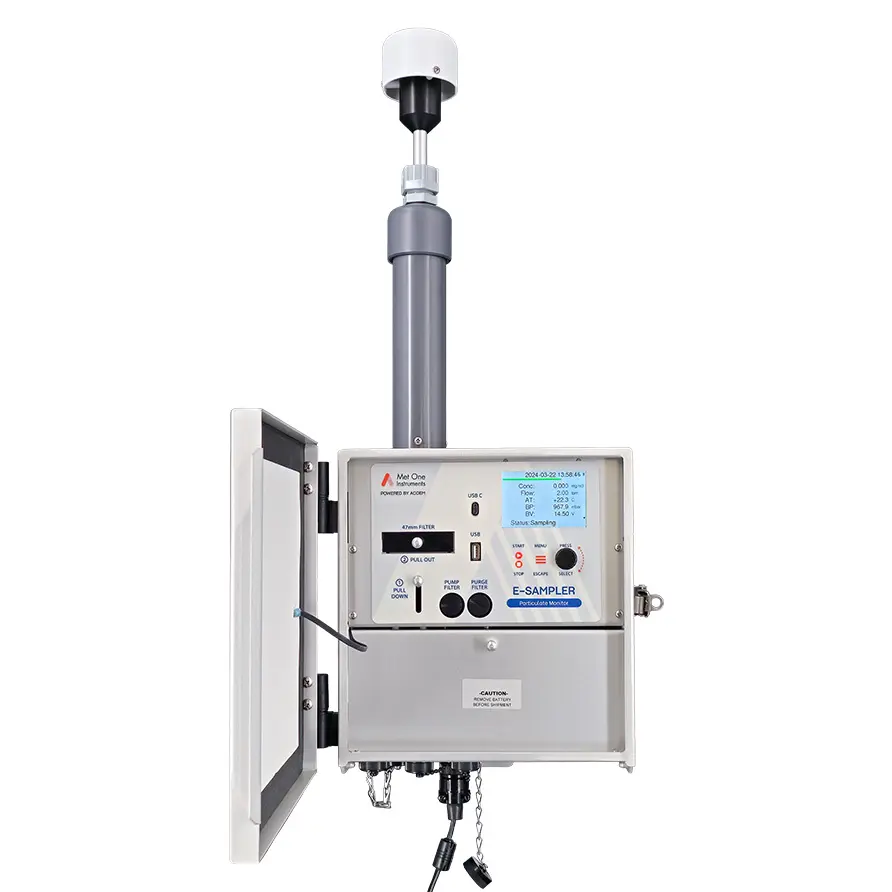
The Met One E-Sampler is a robust, dual-technology particulate monitor designed to bridge the gap between real-time data needs and regulatory gravimetric standards. By combining a laser-based light scattering nephelometer with an integral 47mm filter system, the E-Sampler allows users to obtain instantaneous particulate concentration data while simultaneously collecting a physical sample for laboratory analysis. This unique "two-in-one" capability makes it the ideal instrument for applications where data immediacy and trace-level chemical validation are both critical.
Engineered for field deployment in harsh environments, the E-Sampler features a weatherproof aluminum enclosure, automatic flow control, and programmable auto-zero functionality, ensuring long-term stability without frequent maintenance.
Dual-Analysis Capability: Delivers immediate, continuous particulate data via laser light scattering while collecting a gravimetric filter sample for mass validation or chemical speciation (metals, carbon, ions).
Operational Autonomy: Equipped with active flow control and intelligent auto-zero/auto-span routines, the instrument maintains calibration stability over extended periods, even in changing temperature and pressure conditions.
Rugged Field Design: The all-aluminum, RFI-shielded enclosure is built to withstand adverse weather, making it suitable for everything from mining sites to urban rooftops.
Versatile Power Options: Operates on AC power or internal batteries, facilitating rapid deployment in remote locations or emergency response scenarios where infrastructure is limited.
The E-Sampler employs a proprietary near-forward light scattering technique to measure airborne particulate concentration in real-time. An internal rotary vane pump draws ambient air at a precise rate of 2.0 LPM, passing it through a high-sensitivity laser sensing chamber. The scattered light intensity is detected by a PIN diode, digitized, and converted into mass concentration ($\mu g/m^3$) by the onboard CPU.
Gravimetric Integration:
Unlike standard nephelometers, the E-Sampler directs the sampled air stream onto a standard 47mm filter (accessible via a quick-change cartridge). This allows for:
In-Situ Calibration: Users can adjust the real-time optical "K-factor" based on the actual mass collected on the filter, aligning optical data with local aerosol characteristics.
Chemical Analysis: The collected filter can be sent to a laboratory to identify specific pollutants (e.g., silica, heavy metals), providing context to the raw mass data.
Optics Protection:
To prevent signal drift, the optical chamber is shielded by a purge-air system that uses filtered air to curtain the lenses, keeping them clean even in high-dust environments.
Fenceline & Remediation Monitoring: Tracking fugitive dust emissions at construction sites, waste dumps, or remediation zones to ensure compliance with community safety standards.
Mining & Quarrying: Monitoring respirable dust and total suspended particles (TSP) to protect worker health and minimize off-site impact.
Emergency Response: Rapid deployment during wildfires or industrial accidents to assess immediate air quality hazards for public safety.
Source Apportionment Studies: Using the physical filter sample to analyze the chemical composition of pollution events detected by the real-time optical sensor.
The Met One E-Sampler solves the common dilemma of "speed vs. accuracy" in aerosol monitoring. While optical monitors are fast but can drift, and reference samplers are accurate but slow, the E-Sampler offers the best of both worlds. Its ability to self-validate via the integral filter eliminates the uncertainty often associated with optical measurements. For environmental consultants and industrial EHS managers, this means defensible data that stands up to scrutiny, delivered in a package rugged enough to survive the real world.
Measured Components:
Particulate Matter (TSP, PM10, PM2.5, PM1 – depending on inlet selection).
Applications:
Fenceline monitoring, construction/demolition dust control, mining operations, ambient air quality studies, emergency response.
Certifications:
Factory calibrated to NIST-traceable standards; CE marked. (Note: While it uses reference-method principles for the filter, the E-Sampler itself is typically used as a "hybrid" or indicative monitor rather than a regulatory FRM/FEM compliance unit).
Measurement Principle:
Hybrid Technology: Near-forward Laser Light Scattering (Nephelometry) combined with concurrent Gravimetric Filter Sampling (47mm) for mass reference.
We use cookies to provide you a better user experience on this website. Cookie Policy