High-precision instruments for air quality monitoring, particle measurement, and environmental analysis – built for reliability, accuracy, and compliance.
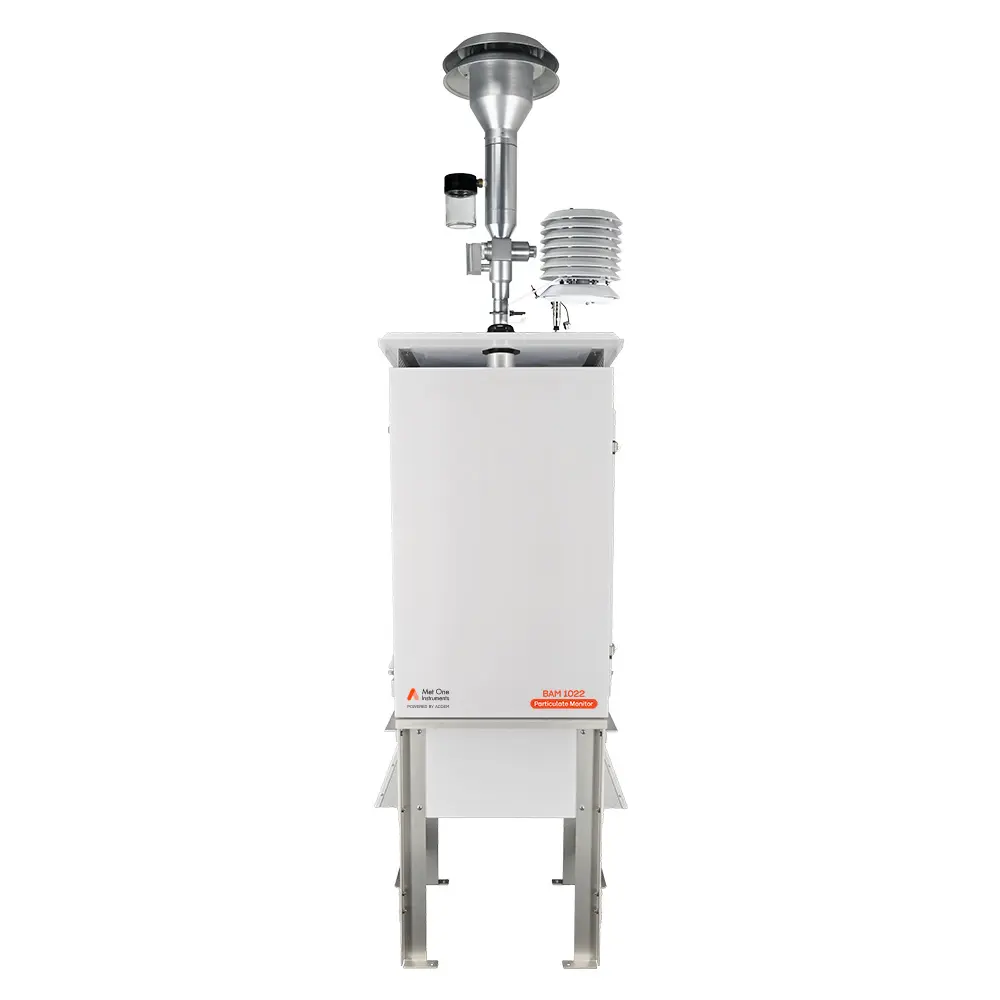
The Met One BAM-1022 redefines regulatory-grade particulate monitoring by combining the accuracy of Federal Equivalent Method (FEM) compliance with the agility of a portable system. Powered by Acoem, this instrument utilizes advanced in-line Beta Attenuation Mass (BAM) technology to deliver continuous, real-time PM2.5 measurements. Unlike traditional stationary monitors that require climate-controlled shelters and complex installation, the BAM-1022 is self-contained, weatherproof, and operational in under 10 minutes.
Engineered for both rapid deployment and long-term permanent networks, the BAM-1022 solves the critical challenge of maintaining data accuracy in high-humidity environments. Its patented in-situ sampling technique maintains the beta measurement at a fixed temperature above ambient levels, virtually eliminating moisture-induced measurement errors without the need for expensive, high-maintenance Nafion™ dryers.
Regulatory-Grade Accuracy Anywhere: Delivers US-EPA Class III FEM certified data (EQPM-1013-209) in a compact form factor, making it the only viable solution for "hotspot" monitoring that requires legal defensibility.
Zero-Infrastructure Deployment: The fully integrated, weatherproof shelter eliminates the need for air-conditioned cabins or walk-in enclosures. The system is lightweight (<18 kg per component) and separates into manageable modules for single-person transport.
Superior Reliability in Harsh Climates: By avoiding flow splitters and utilizing smart inlet heating, the system prevents the loss of semi-volatile compounds (SVCs) while ignoring water vapor interference, ensuring data integrity even during high-dew-point events.
Low Operational Costs: With a 2-month filter tape autonomy and no specialized consumable dryers to replace, the BAM-1022 significantly reduces site visit frequency and lifecycle maintenance costs compared to optical or oscillating microbalance systems.
The BAM-1022 employs a state-of-the-art In-Line Beta Attenuation principle. While legacy systems measure the filter tape after the sample is collected (requiring mechanical movement and dead time), the BAM-1022 measures the beta ray attenuation simultaneously as the dust is deposited. This allows for near-continuous sampling (virtually 60 minutes per hour) and superior time resolution (1-minute data updates).
System Design & Connectivity:
The unit features a ruggedized, vacuum-fluorescent touchscreen interface and a detachable pump box to isolate vibration. It supports modern telemetry standards, including USB, Ethernet, and RS-232, enabling seamless integration into cloud-based data acquisition systems (DAS) for remote diagnostics and firmware updates.
Measurement Capabilities:
Limit of Detection: < 1.0 µg/m³ (24-hour average).
Range: -15 µg/m³ to 10,000 µg/m³.
Flow Control: Active volumetric flow control (16.7 LPM) ensuring consistent particle size cuts.
Emergency Response & Wildfires: Rapidly deploying reference-grade monitors to assess public health risks during smoke events or chemical accidents.
Construction & Remediation: Fenceline monitoring to ensure compliance with dust control regulations at demolition or cleanup sites.
Urban "Hotspot" Analysis: Identifying pollution sources in street canyons or neighborhoods where building a permanent station is logistically impossible.
Background Network Filling: Supplementing existing national networks with lower-cost, high-accuracy nodes to improve spatial resolution.
The Met One BAM-1022 bridges the gap between low-cost sensors and expensive, stationary reference stations. It is the ideal choice for environmental agencies and industrial EHS managers who cannot compromise on data quality but require the flexibility to move assets as monitoring needs evolve. It offers the legal certainty of a Federal Equivalent Method without the six-figure infrastructure investment usually required to obtain it.
Measured Components:
PM2.5 (Fine Particulate Matter) as standard; configurable for PM10 or PM-Coarse depending on inlet selection.
Applications:
Regulatory compliance monitoring (US-EPA), emergency response, construction site compliance, near-roadside monitoring, academic research.
Certifications:
US-EPA Class III Federal Equivalent Method (FEM) for PM2.5 (Designation No. EQPM-1013-209); NRC; ISO 9001; RoHS.
Measurement Principle:
Continuous In-Line Beta Attenuation Mass (BAM) Monitor with In-Situ sampling geometry.
.
We use cookies to provide you a better user experience on this website. Cookie Policy