High-precision instruments for air quality monitoring, particle measurement, and environmental analysis – built for reliability, accuracy, and compliance.
Baghouse and cartridge filter systems rarely fail all at once. A torn bag or a cracked seal usually shows up first as a small, intermittent rise in dust carry-over — long before it becomes visible at the stack or shows up in a periodic compliance test. The U3600-QAL1 is built to catch that early signal continuously, using the same principle that has made triboelectric sensing a standard tool for particulate monitoring downstream of fabric and cartridge filters.
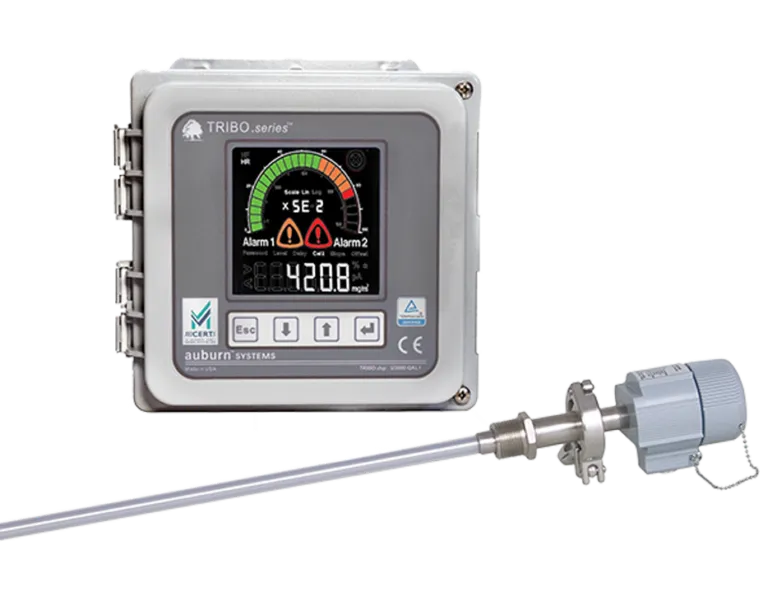
The U3600-QAL1 is a single-point, in-situ particulate monitor from Auburn, a Nederman company. It uses DynaCHARGE™ electrodynamic charge-transfer technology to detect particles passing a probe inserted into a stack or duct, converting the electrical charge generated by particle contact and proximity into a continuous output in picoamps (pA) or milligrams per cubic metre (mg/m³). It is certified by TÜV, listed under the UK MCERTS scheme, and certified under the CSIR-NPLI India (CPCB) scheme, which makes it usable across European, UK, US and Indian regulatory frameworks without swapping instrumentation between projects.
Charge-transfer sensors work by measuring the tiny electrical charge exchanged when particles strike or pass close to a charged probe. The signal is not itself a mass concentration; it is a current, expressed in picoamps, that correlates with dust loading. This is why the U3600-QAL1 reports both a raw pA signal and a derived mg/m³ value.
Out of the box, the instrument can be used qualitatively — as a trend and alarm device — without an iso-kinetic reference test, which is sufficient for applications such as European regulation EN15859 covering continuous filter monitoring. Where a quantitative, EN15267-2-compliant output is required, the controller allows a linear or curved calibration coefficient to be entered directly, correlating the pA signal to an iso-kinetic reference measurement. Auburn notes this direct pA readout and on-board coefficient setting is not typically available on other charge-transfer instruments, which usually require the manufacturer or a third party to programme the correlation externally.
Baghouse and cartridge filter leak detection — mounted directly downstream of the collector, where even a small increase in the pA signal indicates bag failure or seal degradation before it becomes a compliance issue.
Continuous stack particulate compliance monitoring — supporting EN14181, EN13284-2 and US MACT obligations on combustion, incineration and industrial process stacks.
Process control feedback — using the continuous pA trend as an early-warning input for maintenance planning rather than waiting for a scheduled stack test.
Auburn's published application material for this sensor covers aluminium production, asphalt plants, carbon black manufacturing, cement kilns, chemical processing and steel operations — industries where baghouse or cartridge dust collection is the primary particulate control method.
Environmental and compliance engineers responsible for continuous emission monitoring systems. Process and maintenance engineers monitoring baghouse or cartridge filter condition. Environmental consultants specifying monitoring solutions for permit compliance.
Combustion plant, waste incineration, metals and minerals processing, cement production, chemical manufacturing, and other industrial processes where fabric or cartridge filtration is used to control particulate emissions.
The sensor housing is rated IP66/NEMA 4X and can be specified in powder-coated aluminium, Teflon-coated, or 316 stainless steel construction, which matters when the probe sits in an abrasive or chemically aggressive gas stream. Flue gas temperature tolerance up to 500°C (932°F) covers most combustion and incineration stack conditions without additional gas cooling. The controller provides a 75 mm colour LCD display with on-board navigation for alarm status, scaling factor, linear or logarithmic scale selection, probe check status and unit selection (pA or mg/m³), which keeps commissioning and day-to-day diagnostics on-site rather than requiring a laptop connection.
Sensor Ambient temperature rating: -40° to +85°C (-40° to +185°F) Enclosure protection rating: IP66 / NEMA 4X Enclosure material: Aluminium (powder coated); Teflon-coated and 316 stainless steel options Probe lengths: 18″ (460 mm), 30″ (760 mm), 36″ (915 mm) — other lengths available Stack/duct fittings: 2″ ANSI flange, 1½″ BSP/NPT, quick-release tri-clamp — others on request Sensor cable length: up to 300 ft (100 m) Flue gas temperature rating: up to 932°F (500°C) Measurement range: 0.1 to 1,000 pA / 0.1 to 1,000 mg/m³
Controller Enclosure material: Polycarbonate Enclosure protection rating: NEMA 4X / IP66 Power supply: 85–260 VAC @ 5 A Ambient operating temperature: -20° to +50°C (-4° to +122°F) Number of sensors supported: 1 (single-point) Display: 3″ x 3″ (75 mm x 75 mm) colour LCD Outputs: 2 × alarm relay, 1 × 4–20 mA, 1 × Modbus TCP (optional) Certified measuring range (EN15267-3): 0–15 mg/m³ Reported measuring range: 0–1,000 mg/m³
Note: the manufacturer lists a certified range of 0–15 mg/m³ under EN15267-3 alongside a wider reported measuring range of up to 1,000 mg/m³. Both figures are reproduced as published; confirm which range applies to your specific certification requirement before specifying.
Application note: aluminium primary production (case study — emissions maintained below 1 mg/m³ on a 2.8M CFM process). Application notes: asphalt, carbon black, cement, chemical, minerals, steel. Manuals and product guides (access via manufacturer login or on request).
AAVOS supplies the U3600-QAL1 across Belgium, the Netherlands and Luxembourg with the support that a compliance-critical instrument needs in practice: help selecting the correct probe material and length for your process, installation and commissioning on site, and calibration support to establish the linear or curved coefficient your EN15267-2 reporting requires. If a sensor needs recalibration or a probe replacement after wear, our service team handles it locally rather than routing the instrument back to the manufacturer.
What does the U3600-QAL1 actually measure? It measures the electrical charge (in picoamps) generated when particulate matter contacts or passes close to the sensor probe, and converts that signal to an equivalent dust concentration in mg/m³.
Does it need an iso-kinetic reference test before use? Not for qualitative monitoring — the direct pA reading can be used as-is for trend and leak detection, for example under EN15859. A quantitative, EN15267-2-compliant mg/m³ output requires calibration against an iso-kinetic reference test, after which the correlation coefficient is entered into the controller.
Which standards and certifications does the U3600-QAL1 hold? It is certified by TÜV, listed under the UK MCERTS scheme, and certified under the CSIR-NPLI India (CPCB) scheme. It complies with EN14181, EN13284-2 and EN15267-3, and meets US MACT requirements.
Where is this monitor typically installed? Directly downstream of a baghouse or cartridge filter dust collector, so that any increase in particulate carry-over — for example from a torn bag — is detected as soon as it occurs.
What outputs are available for integration with a DCS or PLC? Two alarm relays, one 4–20 mA analogue output, and an optional Modbus TCP output.
Can the U3600-QAL1 be used on high-temperature stacks? The sensor is rated for flue gas temperatures up to 500°C (932°F), which covers most combustion and incineration applications without additional gas cooling.
What probe material should I choose? Standard powder-coated aluminium suits most general industrial applications. Teflon-coated or 316 stainless steel probes are available where the gas stream is abrasive or chemically aggressive — your AAVOS contact can advise based on process gas composition.
Contact AAVOS for a technical review of your stack or baghouse application and a proposal for the correct U3600-QAL1 configuration, including probe material, length and calibration approach for your compliance regime.
Auburn PM 100 / PM 100 PRO baghouse particulate monitors. Auburn B-PAC™ intelligent filter controls. Black carbon and PM ambient monitoring instruments.
We use cookies to provide you a better user experience on this website. Cookie Policy