High-precision instruments for air quality monitoring, particle measurement, and environmental analysis – built for reliability, accuracy, and compliance.
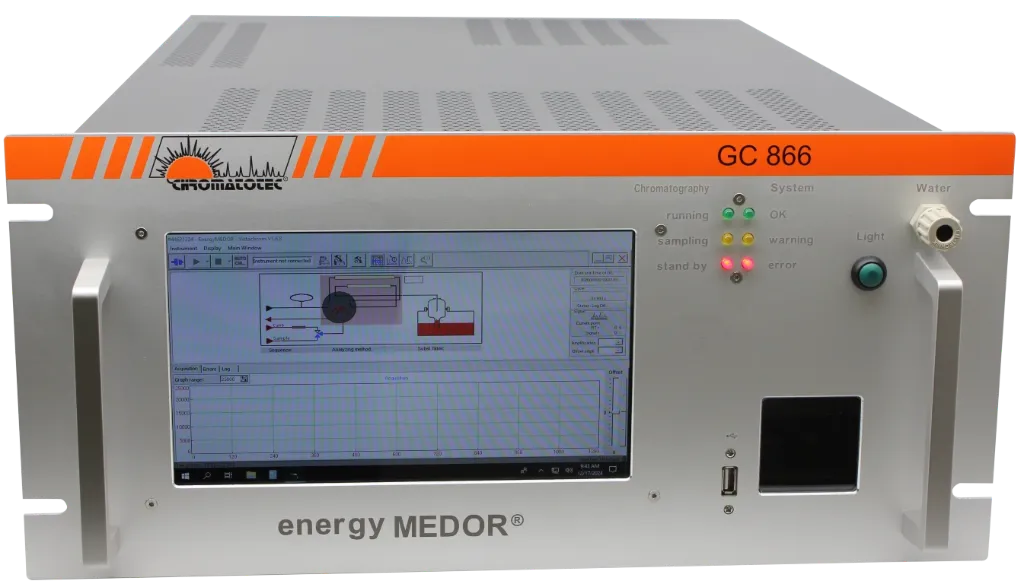
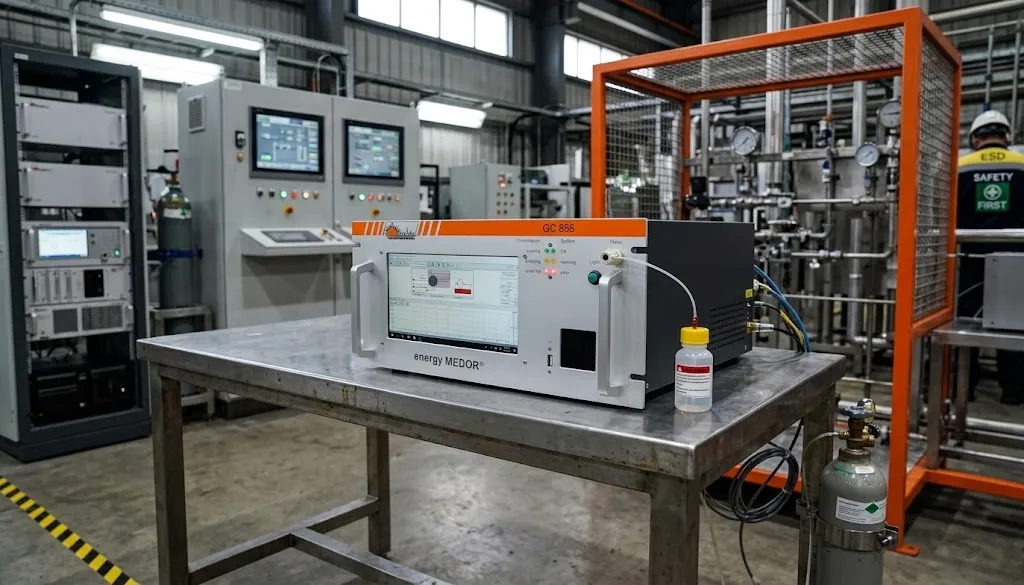
The energyMEDOR is an automatic, isothermal gas chromatograph built by Chromatotec for continuous, online analysis of sulfur compounds — hydrogen sulfide, mercaptans, tetrahydrothiophene (THT) and total sulfur — in natural gas, biogas and other industrial gas matrices. It is aimed at gas network operators and industrial sites that need to track odorant levels or sulfur content in real time rather than through periodic manual sampling.
Two versions cover different concentration ranges. The energyMEDOR ppm targets higher sulfur or odorant levels typical of odorisation dosing control, while the energyMEDOR ppb is intended for trace-level work such as deodorisation verification or pipeline quality checks. Both use the same underlying platform and detection principle; the difference is in calibration and detection range rather than instrument architecture.
How it measures
Sample is introduced through an automatic loop injection valve, and separation follows standard gas chromatography. Detection uses a gas-liquid reaction with a sulfur-specific detector, which Chromatotec states gives freedom from interference by non-sulfur compounds — a relevant point on natural gas, where hydrocarbon background could otherwise complicate sulfur measurement with less selective detectors. Chromatotec also states a detector service life in excess of ten years, which — if it holds in the field — has a direct bearing on long-term running costs, though AAVOS has not independently verified this figure.
Carrier gas is dry air or nitrogen at 3 bar, drawn at under 4 ml/min; nitrogen is required specifically when THT is present in the sample. Internal calibration uses 50 ml/min for the ppm range, sample inlet pressure is 1 bar, and the pneumatic valve uses 90 ml per commutation. These figures matter at the specification stage, since they determine what gas supply infrastructure a site needs to provide.
Detection performance
Cycle time depends on which compound set is being analysed — Chromatotec's published figures range from 300 seconds up to 1,200 seconds depending on configuration. The exact mapping between configuration code and cycle time is not clearly defined on the current manufacturer page (see Evidence Notes above), so this should be confirmed with Chromatotec or against the full TSP datasheet before being quoted to a customer.
Validation and data handling
Results are automatically validated against an internal permeation tube, which provides a built-in reference check without requiring a separate calibration gas cylinder for routine verification. Data is handled through an embedded Windows-based computer with an LCD display and 32 GB of SSD storage, and MODBUS communication is included as standard. Chromatotec's VISTACHROM® software adds remote monitoring and injection control, full on-board archiving for traceability, configurable high/low threshold alarms — relevant for odorisation dosing control — and data export via MODBUS, MGS1, 4-20 mA or 0-10 V, which covers most SCADA and DCS integration requirements without additional hardware.
Hazardous area suitability
The energyMEDOR is offered with ATEX/IECEx certification for Zone 1 and 2 installations, in two variants: II 2 G Ex pxb IIC T4 Gb, and a second rated IIB+H2 T4 Gb. It also carries GOST-R certification. Chromatotec references ASTM D7493-08 in connection with the instrument, though this is a standard for the analysis method rather than a certification the instrument itself holds — worth keeping that distinction clear on a technical page rather than implying regulatory approval that hasn't been separately confirmed.
What isn't specified
The manufacturer's public page does not give dimensions, weight, power consumption, operating temperature or humidity range, or a maintenance/calibration interval. The full TSP technical datasheets exist (linked below) but sit behind a download portal that currently blocks automated retrieval, so this information would need to come from AAVOS' own copy of the datasheet or a direct request to Chromatotec before it can be published.
Downloads
Related Chromatotec sulfur-compounds products: H2S MEDOR, H2S/TOS TS MEDOR, THT MEDOR, TRS MEDOR, chromaS, airmoMEDOR, airmoS. Each targets a different point on the sulfur-compound/odorant measurement spectrum — the differentiating details will need confirming from their respective source pages rather than assumed from this one.
Why AAVOS
(General technical-partner framing below — no AAVOS-specific service claims have been added beyond what's already standard in your Knowledge Base; insert your confirmed service list here once the KB is available.) AAVOS can support specification, installation, commissioning, calibration and ongoing technical support for gas chromatograph installations of this type across Belgium, the Netherlands and Luxembourg.
contact: Contact AAVOS for technical advice, configuration support or a quotation on the energyMEDOR.
What does the energyMEDOR measure?
Hydrogen sulfide (H₂S), mercaptans, tetrahydrothiophene (THT), sulphides and total sulfur in natural gas and similar gas matrices.
What's the difference between the ppm and ppb versions?
The ppm version is designed for higher sulfur or odorant concentrations, typically odorisation dosing control; the ppb version targets trace-level detection, such as deodorisation checks. Detection limits differ accordingly (0.1 ppm versus 5 ppb for H₂S and mercaptans).
Is the energyMEDOR suitable for hazardous areas?
Yes — it's available with ATEX/IECEx Zone 1 and 2 ratings (two certified variants) and GOST-R certification.
What carrier gas does it need?
Dry air or nitrogen at 3 bar. Nitrogen is required specifically when THT is present in the sample stream.
How is measurement accuracy validated?
Through an automatic internal permeation tube check, rather than requiring manual calibration-gas injection for every routine verification.
Can it integrate with a SCADA or DCS system?
Yes — MODBUS communication is included as standard, with MGS1, 4-20 mA and 0-10 V outputs available via the VISTACHROM® software.
What's the expected detector lifespan?
Chromatotec states a detector service life in excess of ten years; this figure comes from the manufacturer and hasn't been independently verified.
Where can I find full technical specifications (dimensions, power, operating conditions)?
Not published on the manufacturer's product page at present — request the full TSP datasheet directly, or contact AAVOS for the current documentation.
We use cookies to provide you a better user experience on this website. Cookie Policy