High-precision instruments for air quality monitoring, particle measurement, and environmental analysis – built for reliability, accuracy, and compliance.
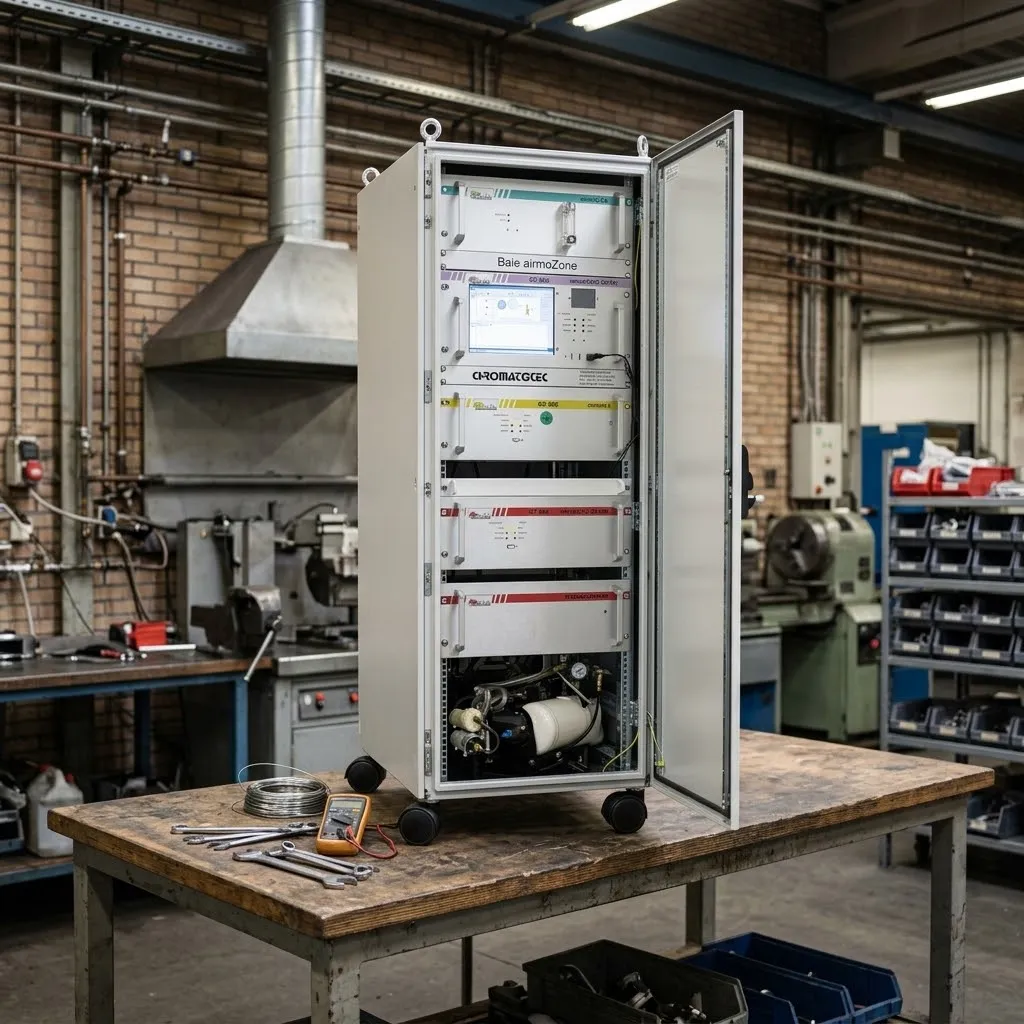
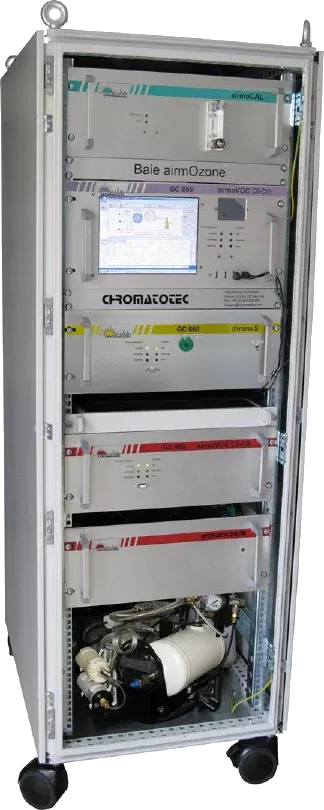
The airmOzone is an automated gas chromatograph built specifically to track the volatile organic compounds that drive ground-level ozone formation. It combines two autoGC-FID analytical modules – airmoVOC C2-C6 and airmoVOC C6-C12 – in a single cabinet, giving one system continuous coverage from light to heavier VOCs without operators having to run two separate instruments side by side.
Air-quality networks use this type of analyser where regulatory reporting requires VOC speciation rather than a single lumped VOC value: PAMS stations, EU directive compliance sites, and research programmes studying secondary organic aerosol formation.
VOCs react with nitrogen oxides in sunlight to form tropospheric ozone, and separately oxidise to form secondary organic aerosols. Regulators therefore don't just want a total VOC figure – they want individual compound concentrations, because different VOCs contribute very differently to ozone formation potential. The airmOzone's chromatographic separation is what makes that speciation possible, as opposed to broadband detectors that only return a sum value.
<p>Depending on which analytical modules are combined, the system can be configured to cover:</p>
This is an evolutive platform rather than a single fixed configuration: airmoVOC C2-C6, C6-C12, OVOC C1-C3 and modules extending up to C20 can be combined depending on which compound list a site needs to report against. Which combination is required is application-dependent and should be confirmed against the specific reporting obligation before ordering.
Each module is an automated gas chromatograph with flame ionisation detection (FID), using hydrogen as carrier gas. Compounds are separated on-column before reaching the detector, which is what allows the system to distinguish benzene from co-eluting compounds – the manufacturer states no interference from the ten compounds that can otherwise overlap with benzene, in line with EN 14662-3. Sensitivity is documented down to trace (ppt-level) concentrations, and the analyser is linear from 0 to 100 ppb (0–325 µg/m³).
The airmOzone is certified for benzene and twelve other VOCs from Annex X of Directive 2008/50/EC, tested to EN 15267-1:2009, EN 15267-2:2009 and EN 14662-3:2015, and holds QAL1 status. For sites where certified compliance monitoring for these specific compounds is the requirement, this certification is the relevant reference point – for PAMS or TO-14 scope beyond the certified compound list, treat that coverage as manufacturer-specified analytical capability rather than as an EN-certified measurement.
Zero and span calibration runs automatically through the built-in airmoCAL system, using certified permeation tubes at low ppb concentrations. The primary gas standard used carries ±2% certified accuracy with SI traceability. This removes the need for manual calibration gas cylinder changes as part of routine site operation, though permeation tube replacement and periodic verification remain part of the maintenance plan.
VISTACHROM controls the analyser and stores chromatogram data, with Peak Viewer for reviewing individual chromatograms. Data can be transferred to a data logger using MODBUS RTU, JBUS, or the manufacturer's stated "German protocol" interface – confirm with Chromatotec which specific protocol variant this refers to if it needs to match an existing SCADA or data-logging setup.
Dimensions, power draw, sample flow and environmental operating limits are not given on the manufacturer's web page and should be confirmed from the TSP datasheet before use in a tender specification.
The airmOzone is built from modules also sold individually: airmoVOC C2-C6, airmoOVOC C1-C3, airmoVOC C3-C10, airmoVOC C6-C12 and airmoVOC C6-C20. Choosing airmOzone over a single standalone module makes sense when a site's reporting obligation spans both light and heavier VOCs in one continuous dataset; a single airmoVOC module may be sufficient where the compound scope is narrower.
AAVOS can help determine which module combination matches your specific reporting obligation – EU directive Annex X, the CAFE recast Annex VII list, or PAMS/TO-14 – before you commit to a configuration. We also support installation, commissioning, calibration verification and ongoing maintenance of autoGC-FID systems in Belgium, the Netherlands and Luxembourg.
Contact AAVOS for technical advice, configuration support or a quotation.
We use cookies to provide you a better user experience on this website. Cookie Policy