High-precision instruments for air quality monitoring, particle measurement, and environmental analysis – built for reliability, accuracy, and compliance.
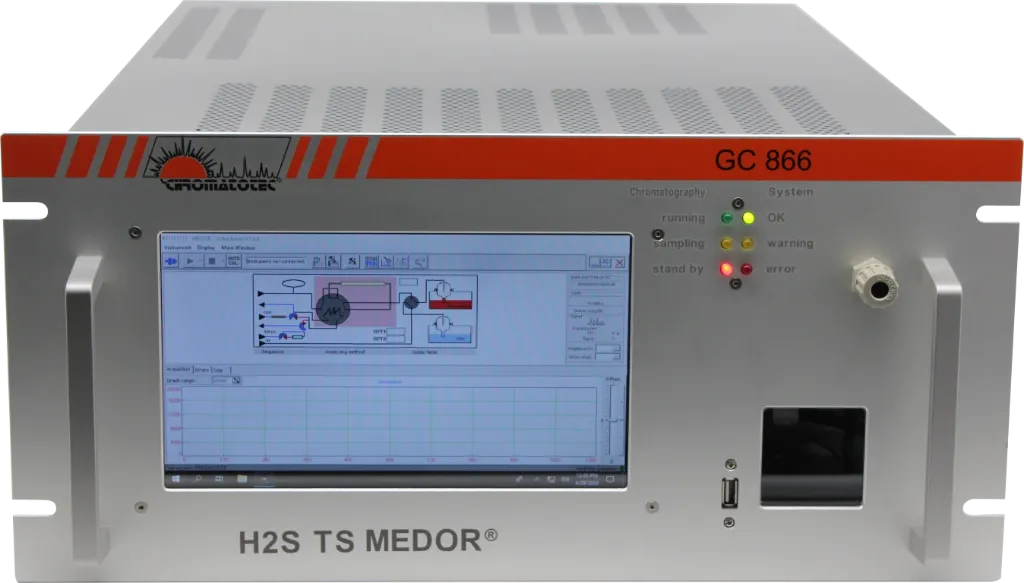
Hydrogen sulfide rarely travels alone. In natural gas, biogas and industrial wastewater it's usually accompanied by organic sulfur species that carry their own odour and corrosion risks, which is exactly where a monitor measuring H2S alone often falls short. The H2S/TOS TS MEDOR® measures hydrogen sulfide, total organic sulfur and total sulfur in the same automated cycle, using gas chromatography paired with an electrochemical sulfur-specific detector.
The analyser draws a sample automatically through a loop, injects it onto a metallic capillary column, and separates the sulfur-bearing compounds under isothermal gas chromatography conditions. Detection is handled by Chromatotec's MEDOR® wet-cell detector, an electrochemical Sulfur Specific Detector whose signal comes from the reaction between the wet-cell electrolyte and the sulfur compounds eluting from the column. Because the detection chemistry is sulfur-specific, the response is not distorted by hydrocarbons or other matrix components that would interfere with less selective detectors.
The H2S/TOS TS MEDOR® is available in a ppb configuration (0–1 ppm, detection limit 5 ppb H2S) and a ppm configuration (0–10, 0–50 or 0–100 ppm, detection limit 0.1 ppm H2S), with a low-percentage range available via an HC sampling valve. Cycle time is 2 minutes for the 0–3 ppm range and 5 minutes for higher ranges, so the choice of configuration should be driven by the expected concentration window at the sampling point rather than a general preference for the more sensitive unit.
Technical specifications
The combination of continuous operation and multi-species sulfur detection suits sites where sulfur levels need tracking over time rather than spot-checked: H2S and total sulfur monitoring in natural gas and biogas streams, odour and sulfur compound tracking at wastewater treatment plants and landfills, and process or CEMS-adjacent sulfur measurement in refining and petrochemical operations. Where the requirement is regulatory ambient air or odour-nuisance monitoring rather than process gas, the same detection principle applies but sampling arrangements will differ — worth confirming with AAVOS before specifying.
Chromatotec rates the MEDOR® wet-cell detector's electrolyte at up to 10 years of service life, which is unusually long for an electrochemical cell and is the main driver of the instrument's low running cost. Internal calibration via tube and gas generator options means no calibration cylinders need to be sourced, stored or replaced on a routine basis. Onboard storage retains more than 10 years of data, which is useful for long-term trend analysis or compliance record-keeping without relying solely on external data logging.
The analyser runs on Chromatotec's VISTACHROM software, which handles remote monitoring and injection control and archives results and chromatograms on board for full traceability. Alarm levels are tunable and interactive, allowing the system to flag excursions automatically rather than requiring an operator to review chromatograms manually.
The published specification does not state dimensions, weight, enclosure rating, power consumption, supply voltage, or operating temperature and humidity range. If any of these are a hard requirement for your installation — a cabinet, a hazardous-area classification, or a specific power supply — get in touch with AAVOS and we'll request the missing figures directly from Chromatotec before you commit to a layout.
Configuration
The H2S/TOS TS MEDOR® is stated by the manufacturer as fully compliant with ASTM D7493-14 (on-line measurement of sulfur compounds in natural gas and gaseous fuels by gas chromatography and electrochemical detection) and compliant with ASTM D5504-20 (determination of sulfur compounds in natural gas and gaseous fuels by gas chromatography and chemiluminescence, using an alternative detector). ATEX/IECEx and GOST certifications are referenced on the manufacturer's page but the supporting documents point to the Exp enclosure variant and a related airmoBTX model respectively — AAVOS is confirming with Chromatotec which certifications apply to the standard H2S/TOS TS MEDOR® configuration before these are published as product certifications.
AAVOS supports Chromatotec's sulfur compound analysers across Belgium, the Netherlands and Luxembourg with product selection, system configuration, installation, commissioning, calibration and ongoing technical support. If you're weighing the ppb against the ppm configuration, or need to confirm hazardous-area requirements for a specific installation, our team can work through the sizing with you before you order.
Contact AAVOS for technical advice, configuration support or a quotation on the H2S/TOS TS MEDOR®.
What does the H2S/TOS TS MEDOR® measure?
Hydrogen sulfide (H2S), total organic sulfur (TOS) and total sulfur (TS) in a single automated analysis cycle.
What's the difference between the ppb and ppm versions?
The ppb version covers 0–1 ppm with a detection limit of 5 ppb H2S; the ppm version covers 0–10, 0–50 or 0–100 ppm with a detection limit of 0.1 ppm H2S. Choice depends on the expected concentration at the sampling point.
How does the detector work?
It uses a MEDOR® electrochemical wet-cell Sulfur Specific Detector (SSD), which generates its signal from the reaction between the wet-cell electrolyte and sulfur compounds separated by the preceding gas chromatography step.
How often does the detector need to be replaced?
The manufacturer rates the wet-cell electrolyte for up to 10 years of service life.
Does it need calibration gas cylinders?
No — internal calibration is available via a tube and gas generator option, removing the need for external cylinders.
Which standards does it meet?
Full compliance is stated with ASTM D7493-14; compliance is stated with ASTM D5504-20 using an alternative detector.
Can it be integrated into an existing monitoring or SCADA system?
Yes — optional MODBUS and 4–20 mA outputs are available, alongside onboard result and chromatogram storage.
Is an explosion-proof version available?
Chromatotec offers Exd/Exp enclosure variants of the underlying GC 866 platform; confirm certification scope with AAVOS before specifying for a hazardous area.
We use cookies to provide you a better user experience on this website. Cookie Policy