High-precision instruments for air quality monitoring, particle measurement, and environmental analysis – built for reliability, accuracy, and compliance.
Stack and duct particulate monitoring has to keep working under conditions that would put most instruments out of service within weeks: high dust loading, vibration, heat, and long stretches without a technician on site. The PM Laser, built by Auburn FilterSense, a Nederman company, is designed around that reality. It measures dust concentration optically, across the full duct or stack, without anything touching the process gas.
Product Overview
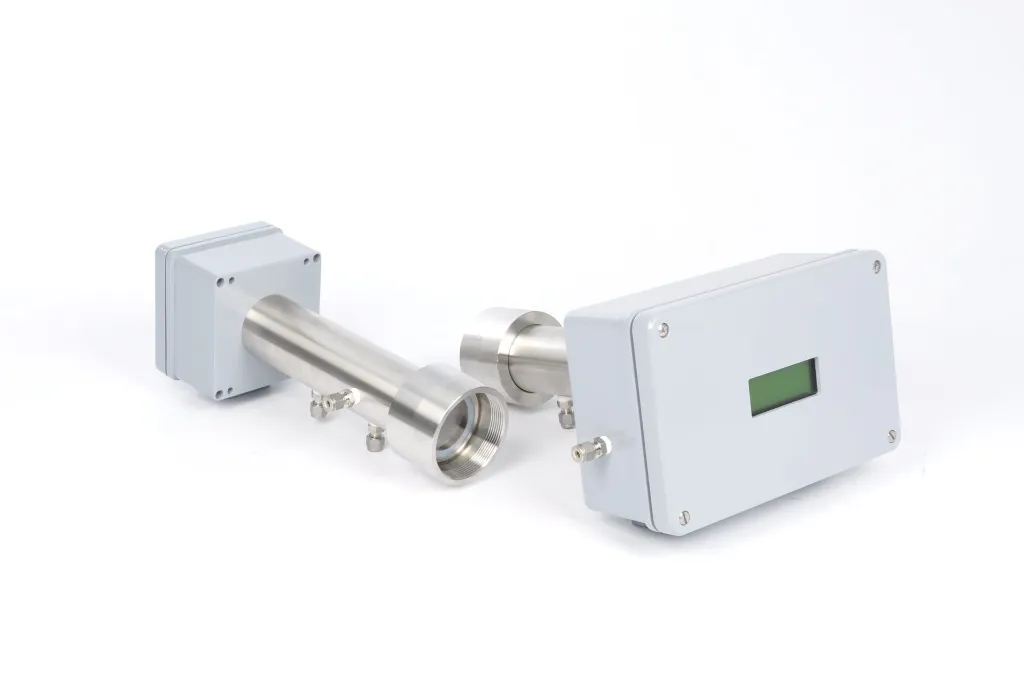
The PM Laser projects a laser beam across an industrial duct, stack or pipe and reads two things at the receiver: how much light has been absorbed on the way through, and how much has been scattered forward by particles in the gas stream. Combining transmission and forward-scattering measurement in one instrument means the PM Laser stays accurate whether the dust loading is very low or very high, which is where single-technique optical monitors often lose reliability. With no moving parts in the measurement path, the main maintenance requirement is a periodic visual check rather than scheduled part replacement.
Key Benefits
Measurement Principle
A laser diode sends a beam across the stack to a receiver on the opposite side. Two effects are measured simultaneously. The reduction in light intensity reaching the receiver — transmission, or extinction — gives a reliable reading at higher dust concentrations. The light scattered forward by individual particles gives much finer resolution at low concentrations, down to a detection limit below 0.5 mg/Nm³. Switching between, or combining, these two measurement modes is what allows one instrument to cover both a near-clean stack and a heavily loaded process line without needing two separate monitors.
Typical Applications
Typical Users
Environmental compliance engineers rely on the PM Laser to generate a defensible, continuous data record. Process engineers use the same live signal to judge whether a filter, cyclone or combustion adjustment is having the intended effect. Plant EHS teams use it as an early-warning tool for filter bag failure or process upsets, well before a manual stack test would pick up the same trend.
Industries
Auburn FilterSense instruments, including the PM Laser, are used across aluminium and steel production, cement kilns, foundries, incineration plants, mineral processing, power generation, wood processing, chemical manufacturing, food and dairy production, pharmaceutical manufacturing, battery production, and carbon black manufacturing.
Technical Highlights
Technical Specifications
Detection limit: < 0.5 mg/Nm³ (scattered mode) Measurement range: 0–15 mg/Nm³ (scattered mode, particle size >1 µm); 0–10,000 mg/Nm³ (transmission mode, particle size >1 µm) Resolution: 0.05 mg/Nm³ Response time: 1–2 sec (standard); 50 ms (pulse mode) Optical path length: MP: 0.5–3 m / LP: 3–6 m / XLP: 6–10 m Max. stack diameter: 10 m / 32.8 ft (XLP) Process temperature: Above dew point, up to 700 °C / 1292 °F Process pressure: 0.1–1.5 BarA Operating/storage temperature: -20 °C to +55 °C / -4 °F to +131 °F Protection classification: IP66 Laser class: Class IIIb (IEC 60825-1) Certifications: CE certified; EMC Directive 2014/30/EU conformant Hazardous area approval: ATEX/IECEx Zone 2 – II 3 GD T100 °C Ex nA nC II T5 (optional) Analogue output: 4–20 mA, 500 Ω max., isolated Digital outputs: Modbus TCP, Ethernet, RS-232 Relay outputs: High dust, Warning, Fault (normally closed) Analogue input: 4–20 mA for process temperature and pressure Power supply unit: Input: 100–240 VAC, 50/60 Hz; Output: 24 VDC, 900–1000 mA Transmitter power input: 18–36 VDC, max. 20 W Purge flow: 50–100 l/min (1.76–3.58 CFM), application dependent Flange sizes: MP: DN50/PN10; LP: DN80/PN10; XLP: DN150/PN10 (ANSI available on request) Alignment tolerance: Flanges parallel within 1.5° Transmitter unit weight: 6.2 kg (13.7 lbs) standard; 7.9 kg (17.4 lbs) Ex version
Accessories & Consumables
The PM Laser is supplied with an integrated purge air system to keep the optical windows clear of dust; a dry, oil-free compressed air or gas supply on site is required to run it. PC software for configuration, calibration and diagnostics is included. No routine consumables are needed under normal operation — Auburn specifies a visual inspection every 6–12 months and a calibration check against gravimetric analysis every 12 months, rather than parts replacement.
Downloads
Not specified by the manufacturer: full user manual, application notes, and declaration of conformity were not available on the source page at the time of writing — request these directly from AAVOS if needed for a specific project.
Why Choose AAVOS
Sizing a stack monitor correctly, choosing between the MP, LP and XLP optical path, and getting flange alignment right during installation all affect how well an instrument like the PM Laser performs once it's running. AAVOS supports customers in Belgium, the Netherlands and Luxembourg through the full lifecycle of the instrument: application review and path-length selection, installation and commissioning, calibration against gravimetric reference methods, and ongoing technical support and service contracts. Because AAVOS works with particulate and dust monitoring instruments across multiple industrial sectors in the region, questions about ATEX classification, purge air supply, or integration into an existing SCADA system can be answered by someone who has already handled that installation type before.
Frequently Asked Questions
What does the PM Laser actually measure? It measures particulate (dust) concentration in a gas stream, expressed in mg/Nm³, using two optical techniques: laser transmission and forward light scattering.
Why does the PM Laser use two measurement modes instead of one? Transmission (extinction) measurement is well suited to higher dust concentrations, while forward scattering gives finer resolution at low concentrations, down to below 0.5 mg/Nm³. Combining both extends the usable range of a single instrument rather than requiring separate monitors for clean and heavily loaded conditions.
What is the difference between the MP, LP and XLP versions? They differ in optical path length and the stack diameter they're designed for: MP covers 0.5–3 m, LP covers 3–6 m, and XLP covers 6–10 m. The correct choice depends on the physical diameter of the stack or duct being monitored.
Can the PM Laser be installed in a hazardous area? An ATEX/IECEx Zone 2 rated version is available (II 3 GD T100 °C Ex nA nC II T5), for installations where this classification applies.
How often does the PM Laser need calibration or maintenance? Auburn recommends a visual inspection every 6–12 months, with no consumables required for normal operation, and a calibration check against gravimetric analysis every 12 months. Zero and span can also be validated at any time using the instrument's built-in check, without interrupting the process.
What data outputs are available for integration with a DCS or SCADA system? The PM Laser provides a 4–20 mA analogue output, Modbus TCP and RS-232 digital communication, and relay outputs for high dust, warning and fault conditions.
Does the PM Laser need compressed air or another utility to operate? Yes. The integrated purge system requires a dry, oil-free compressed air or gas supply, at a flow rate of 50–100 l/min depending on the application, to keep the optics free of dust build-up.
What stack temperatures can the PM Laser handle? Process gas temperatures up to 700 °C (1292 °F) are supported, provided the gas stays above its dew point.
Get in Touch
For an application review, help selecting the correct optical path length, or a quotation for a specific stack or duct configuration, contact AAVOS International bv.
Related Products
We use cookies to provide you a better user experience on this website. Cookie Policy