Hoogprecisie-instrumenten voor luchtkwaliteitsmonitoring, deeltjesmeting en milieuanalyse – gebouwd voor betrouwbaarheid, nauwkeurigheid en naleving van de regelgeving.
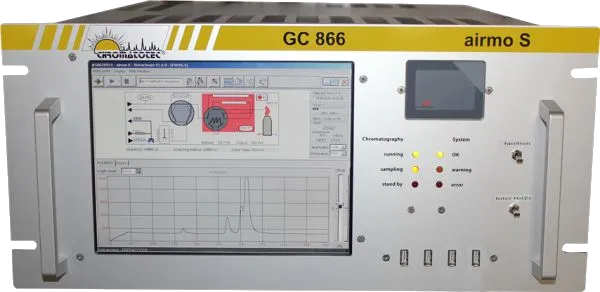
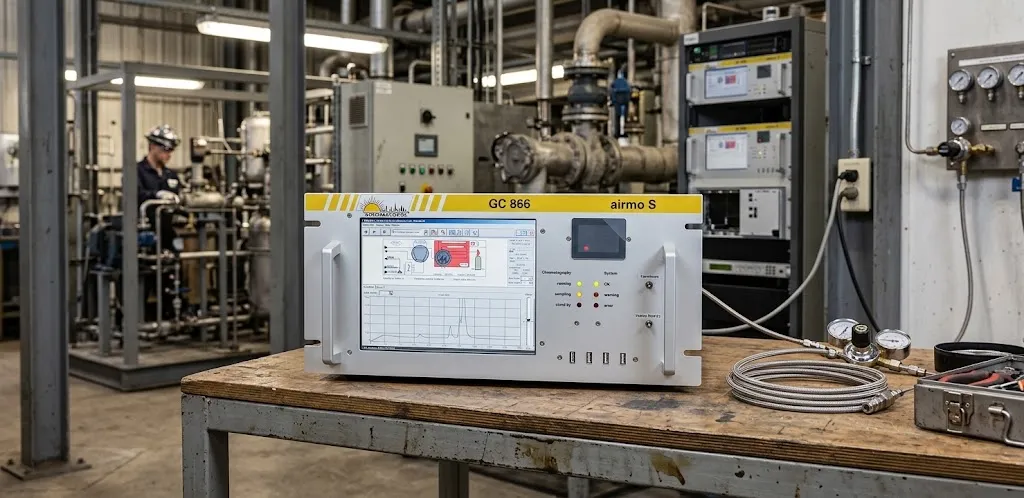
Sulfur odours rarely announce themselves at convenient concentrations. Mercaptans and sulphides are detectable by the human nose at levels well below what most gas analysers can resolve, which is exactly the gap the airmoS was built to close. Manufactured by Chromatotec, it is an automatic isothermal gas chromatograph fitted with a sulfur-specific photometric flame detector (FPD), designed for continuous unattended monitoring of trace sulfur compounds in ambient air.
airmoS draws a continuous ambient air sample and injects it into a temperature-controlled column oven via a single-trap valve system with metallic capillary columns. Separation happens isothermally — the oven runs at a fixed, application-optimised temperature rather than ramping, which keeps the analytical cycle short and repeatable. Detection is handled by a double flame photometric detector, a technique chosen specifically for its sensitivity to sulfur-containing compounds and its relative immunity to the hydrocarbon background typically present in ambient air.
A full measurement cycle takes 10 minutes in standard airmoS mode. An optional dual-mode configuration extends this to 30 minutes, running a 10-minute chromaS cycle alongside a 20-minute airmoS cycle on the same platform — useful where a site needs both instruments' compound coverage without doubling the hardware footprint.
Precision figures quoted by the manufacturer: relative standard deviation on standard concentration results (amplification 1) ≤ 5%; RSD on retention time across all compounds (amplification 1) ≤ 2%, with a standard deviation ≤ 2 seconds.
The choice between trap and loop configuration is not cosmetic. The trap delivers the sub-ppb sensitivity the instrument is named for; the loop option trades that sensitivity for a wider dynamic range and coverage of additional compounds including H₂S and SO₂. Which one suits a given site depends entirely on whether the concentrations expected sit closer to nuisance-odour trace levels or to higher process-adjacent levels — this is worth confirming before specification.
Every run is stored in full — both the numeric result and the underlying chromatogram — on an embedded Windows-based computer with a 10" TFT colour LCD display and 128 GB of SSD storage. Four USB ports and two RS-232 ports are available for data extraction or integration into a wider monitoring network.
These figures determine the gas supply infrastructure a site needs before installation — worth reviewing alongside any existing cylinder or generator setup already in place.
Application-dependent: which configuration and options a given deployment needs depends on the target compounds and expected concentration range at the monitoring location. Not specified by the manufacturer as a fixed requirement — this should be confirmed against the specific application.
airmoS is positioned for ambient air monitoring situations where sulfur compounds need to be resolved at genuinely trace levels — mercaptans and sulphides that are relevant at concentrations far below what a general-purpose VOC or H₂S monitor would typically resolve. The manufacturer does not specify particular industry sectors on this product page; broader context from Chromatotec's own solution pages groups sulfur and odour instrumentation under ambient air quality monitoring generally, which is useful background but not a confirmed sector list for this specific model.
Chromatotec's sulfur compounds range includes airmoS, chromaS, and the MEDOR series (H2S MEDOR, H2S/TOS TS MEDOR, THT MEDOR, TRS MEDOR, energyMEDOR). airmoS and chromaS share enough of a platform that they can run in dual mode on the same hardware; beyond that, the manufacturer's page does not detail how airmoS differs from chromaS or from the MEDOR instruments in terms of detection limits or intended application. This is a genuine content gap — a buyer comparing options within the range would benefit from that distinction, and AAVOS can help clarify which model fits a specific monitoring requirement on request.
In the interest of giving a complete picture rather than a polished one: the manufacturer's page does not state power supply requirements, physical dimensions, weight, warranty terms, or any certifications or regulatory approvals — the certifications field is explicitly marked "N/A." None of these have been assumed or estimated here.
AAVOS distributes Chromatotec instrumentation across Belgium, the Netherlands and Luxembourg, and can support product selection between the trap and loop configurations, installation and commissioning, and ongoing calibration and maintenance once the instrument is in service. Where the missing specification detail above (power, dimensions, certifications) affects a tender or installation plan, AAVOS can request the outstanding documentation directly from Chromatotec.
Contact AAVOS for technical advice, configuration support or a quotation.
What does the airmoS measure?
Trace-level sulfur compounds in ambient air — including mercaptans and sulphides such as DMDS, CS₂, MM and DMS with the standard trap configuration, or a wider list including H₂S and SO₂ with the optional loop.
What is the detection principle?
Isothermal gas chromatography with a single-trap sample valve and metallic capillary columns, paired with a sulfur-specific double flame photometric detector (FPD).
How long does one measurement cycle take?
10 minutes in standard airmoS mode, or 30 minutes in the optional dual mode (10 minutes chromaS plus 20 minutes airmoS).
Trap or loop — which should I choose?
The trap configuration gives sub-ppb sensitivity for double and single sulfur compounds. The loop option trades that sensitivity for a wider detection range and adds coverage of H₂S, SO₂ and related compounds. The right choice depends on expected site concentrations.
Is the airmoS certified to any standard?
The manufacturer states no certifications or approvals apply to this instrument (marked "N/A" on the official product page).
What gases does it require?
Nitrogen or air as carrier gas, hydrogen and air for the detector, and dry air for the sampling dryer — see the gas supply table above for exact pressures and flow rates.
Can it be combined with other Chromatotec analysers?
Yes — the dual mode option runs airmoS and chromaS cycles on the same platform.
What connectivity does it offer for data integration?
Four USB ports and two RS-232 ports, alongside 128 GB of onboard SSD storage for full data and chromatogram retention.
We gebruiken cookies om je een betere gebruikerservaring op deze website te bieden. Cookiebeleid