Hoogprecisie-instrumenten voor luchtkwaliteitsmonitoring, deeltjesmeting en milieuanalyse – gebouwd voor betrouwbaarheid, nauwkeurigheid en naleving van de regelgeving.
Monitoring networks and industrial operators increasingly need data on hydrocarbons that standard light-VOC analysers simply don't see. Compounds in the C10 to C40 range — heavier alkanes, gaseous PAHs, contaminants migrating from plastics and oils — sit outside the detection window of most BTEX or C2-C6 instruments, yet they carry real relevance for air quality assessment, source apportionment and industrial emissions work. The airmoVOC C10-C40 from Chromatotec is built specifically for this part of the spectrum.
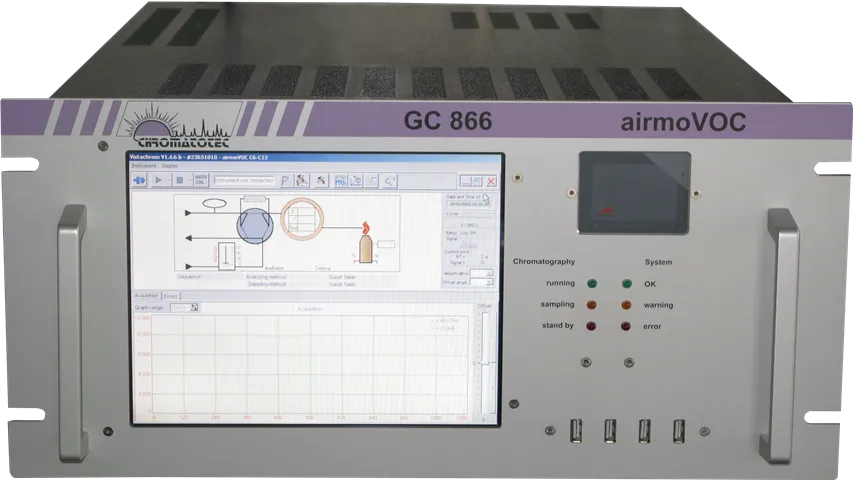
The airmoVOC C10-C40 is an automatic gas chromatograph (auto-GC) housed in a compact 19" rack, designed for continuous, unattended analysis of trace and ultra-trace concentrations of light and heavy semi-volatile organic compounds. Detection runs on a flame ionisation detector (FID), paired with a sample pre-concentration and thermo-desorption stage that lets the instrument pull usable signal out of very low ambient concentrations without manual sample prep.
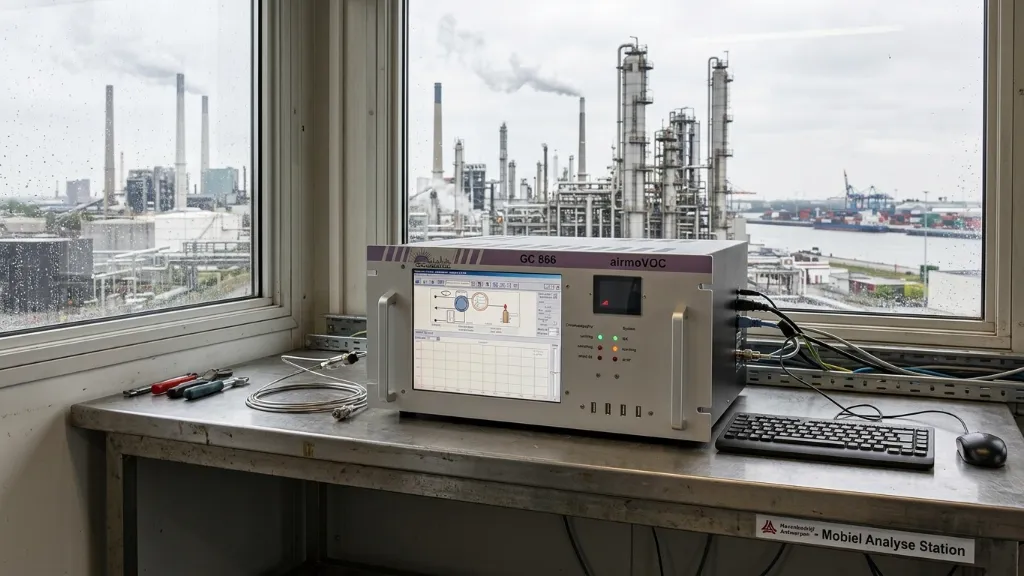
Because the sampling and desorption cycle is fully automated, the analyser is suited to fixed-site deployment where an operator cannot be present for every measurement — regulatory monitoring stations, industrial fence-line posts, or laboratory setups running long unattended campaigns.
Sample air is drawn continuously through an absorbent tube, where the target hydrocarbons — from linear alkanes to gaseous PAHs — accumulate through pre-concentration. The tube is then thermally desorbed using a programmable temperature gradient reaching up to 350°C, releasing the trapped compounds into the GC column for separation. The flame ionisation detector then quantifies each separated component as it elutes.
This pre-concentration step is what allows the airmoVOC C10-C40 to report detection limits in the low parts-per-trillion range. Direct injection without pre-concentration would not resolve concentrations this low, which is why thermo-desorption GC-FID has become a standard approach for trace-level SVOC monitoring rather than an optional refinement.
The instrument's carbon-range coverage makes it relevant across several monitoring contexts rather than a single niche:
Urban and non-urban air pollution control — long-term unattended monitoring of hydrocarbon load at fixed ambient stations.
Indoor and outdoor BTEX monitoring — where benzene and related aromatics need continuous tracking against exposure limits.
Plant and process emissions analysis — fence-line or near-source monitoring around facilities that emit heavier hydrocarbon fractions.
Contaminant extraction analysis — testing off-gassing or residual contamination from plastics, PET packaging and oils.
VOC analysis in water — using the purge module to extend the same GC-FID platform to aqueous samples.
Environmental agencies and monitoring network operators use instruments in this class to fill the gap left by lighter-range VOC analysers, particularly where regulatory reporting needs to cover a broader hydrocarbon spectrum. Research institutes and universities apply the same platform in source-apportionment and atmospheric chemistry studies, where the C10-C40 range often carries diagnostic value for identifying pollution sources.
On the industrial side, petrochemical sites, refineries, plastics and packaging manufacturers, and waste management operators are the more likely buyers — anywhere heavier hydrocarbon fractions are part of the process or the emissions profile. Laboratories running contract analysis for these sectors also use the airmoVOC C10-C40 where sample throughput and unattended operation matter more than portability.
A few characteristics are worth calling out specifically, rather than folding into the specification table:
The airmoVOC range carries an EN14662 QAL1 certificate and an EN14662 MCERTS certificate (2023), the two reference frameworks most commonly required when hydrocarbon monitoring data feeds into European regulatory reporting. For network operators who need to justify instrument choice against a quality assurance scheme, this certification history is usually the first thing a tender or audit will ask for.
AAVOS can provide the full manufacturer datasheet and certification documents on request — contact our technical team if you need these for a tender file or procurement dossier.
Buying the analyser is only the first step. AAVOS supports the airmoVOC C10-C40 with technical advice during product selection, installation and commissioning on site, and calibration once the instrument is running. For monitoring networks and industrial sites across Belgium, the Netherlands and Luxembourg, that means a local point of contact for maintenance and technical support rather than a purely transactional purchase from overseas. Where a project needs training for operating staff or an ongoing service contract, AAVOS can put that in place alongside the instrument itself.
What is the measuring principle of the airmoVOC C10-C40? It uses pre-concentration on an absorbent tube followed by thermo-desorption with a programmable temperature gradient up to 350°C, with detection by flame ionisation detector (FID).
Which standards does the airmoVOC C10-C40 comply with? The airmoVOC range holds an EN14662 QAL1 certificate and an EN14662 MCERTS certificate (2023).
How does the C10-C40 range differ from lighter VOC analysers? Standard BTEX or C2-C6 analysers do not cover heavier alkanes or gaseous PAHs. The airmoVOC C10-C40 extends detection up to N-Eicosane and through to benzo(a)pyrene, covering a hydrocarbon range that lighter-range instruments miss entirely.
Can this analyser monitor VOCs in water as well as air? Yes, with the optional purge module the same GC-FID platform can be used for VOC analysis in water samples.
How long does one measurement cycle take? Standard cycle time is 30 to 60 minutes. An extended 90 to 120 minute cycle is available as an option for applications that need it.
What gas supply does the instrument require? Hydrogen at 45 mL/min (4 bar inlet) and air at 450 mL/min (4 bar inlet), plus a vacuum pump on the 1/4" sample inlet.
Can the airmoVOC C10-C40 run without mains power? An optional 24 V battery input is available for sites without a stable mains supply.
What software controls the analyser? VISTACHROM®, which supports remote monitoring and data export via MODBUS, 4-20 mA or 0-10 V outputs.
For a quotation, technical consultation, or advice on whether the airmoVOC C10-C40 fits your monitoring requirement, contact the AAVOS technical team. We can also advise on integration into an existing monitoring network and on service and calibration arrangements once the instrument is installed.
We gebruiken cookies om je een betere gebruikerservaring op deze website te bieden. Cookiebeleid