Hoogprecisie-instrumenten voor luchtkwaliteitsmonitoring, deeltjesmeting en milieuanalyse – gebouwd voor betrouwbaarheid, nauwkeurigheid en naleving van de regelgeving.
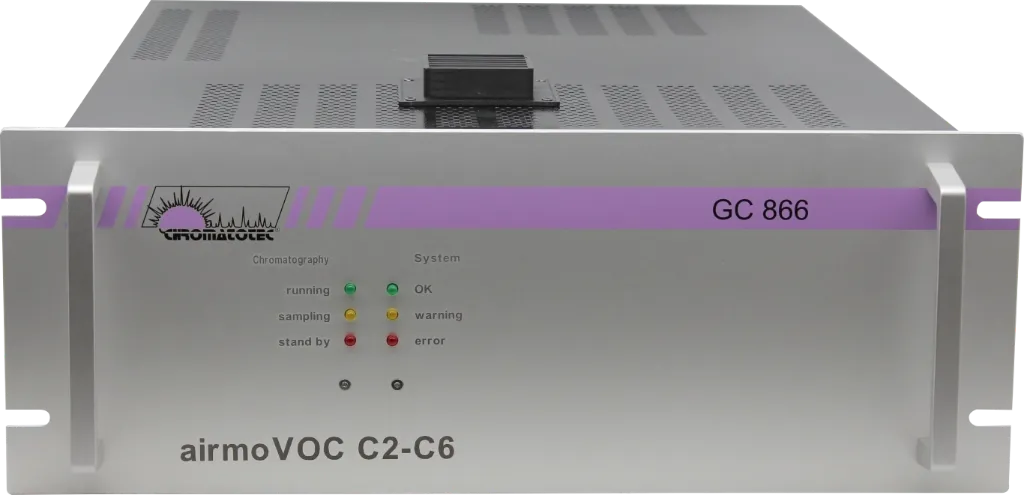
Light hydrocarbons such as 1,3-butadiene and butane sit at the centre of many ambient air quality programmes, partly because of their role as ozone precursors and partly because 1,3-butadiene itself is a compound of direct health concern. Measuring them reliably at trace level, hour after hour, without an operator present, is where gas chromatography earns its place over simpler broadband VOC instruments. The airmoVOC C2-C6 from Chromatotec is built specifically for that job: continuous, unattended speciation of C2 to C6 hydrocarbons using an integrated GC-FID system.
The airmoVOC C2-C6 combines a six-port valve, a single sorbent trap and a metallic capillary column with a flame ionisation detector, all housed in a 19-inch, 4U rack format. Sample air is drawn onto the sorbent trap, thermally desorbed, and separated on the column before quantification by the FID. A programmable temperature gradient oven controls the separation, and a thermoelectric cooling system stabilises the trap temperature — a detail that matters specifically for resolving ethane and other light, poorly retained compounds cleanly from the chromatogram.
Analysis cycles run at 30 minutes as standard, with a 60-minute cycle available where slower reporting is acceptable in exchange for other trade-offs in the method. Sample volume is programmable between 20 and 160 ml, with a sampling time of up to 40 minutes, which gives some flexibility in matching the method to compounds present at very low concentration. Up to 32 compounds can be resolved and quantified within a single analysis.
Flame ionisation detection responds to virtually all organic compounds containing carbon-hydrogen bonds, which makes it a natural match for hydrocarbon monitoring. On its own, however, an FID cannot distinguish one hydrocarbon from another — it simply reports total carbon response. Gas chromatography solves that limitation by physically separating the sample on a column before it reaches the detector, so each compound elutes at its own retention time and is quantified individually. That is the combination the airmoVOC C2-C6 relies on: thermal desorption to concentrate the sample, chromatographic separation on a metallic capillary column, and FID quantification of each resolved peak.
This is the same principle behind reference-method ambient air hydrocarbon monitoring across European networks, which is why GC-FID instruments of this type are specified where individual compound data — not just a total VOC figure — is required for regulatory reporting or source apportionment work.
A detection limit of 15 parts per trillion for 1,3-butadiene is low enough to characterise background urban and industrial concentrations well below regulatory guideline levels, which is precisely the range where broadband VOC sensors typically lose reliability. The sub-2% concentration repeatability over 48 hours is a reasonable indicator of how stable the method remains between calibrations, which matters for any station intended to run unattended between site visits.
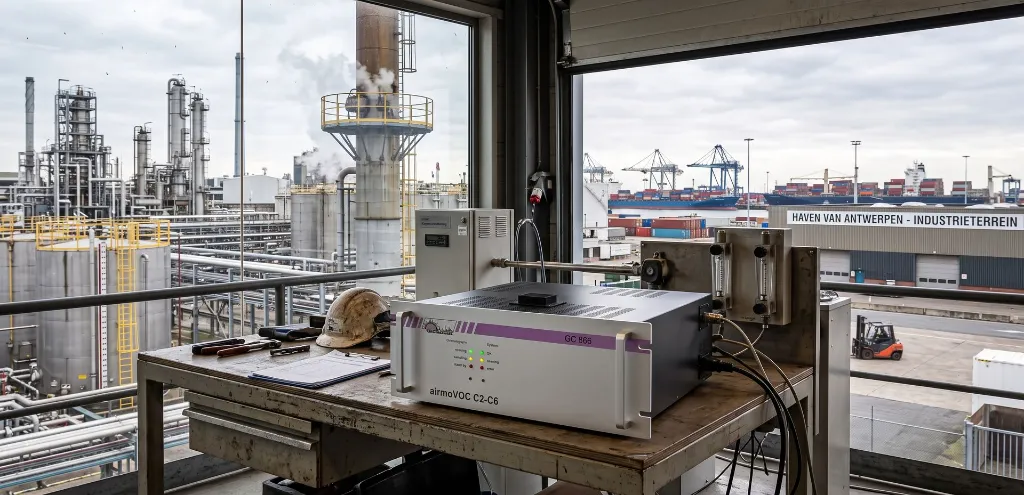
The airmoVOC C2-C6 is certified to EN14662, the European reference method for ambient air benzene measurement, with MCERTS certification confirmed in 2023 and a US EPA reference report also available. In practice, this positions the instrument for fixed ambient air quality monitoring stations that need individually speciated hydrocarbon data rather than an aggregate VOC signal — for example where 1,3-butadiene, butane or other C2-C6 compounds need to be reported separately to satisfy monitoring network or regulatory requirements. Compound-resolved hydrocarbon data of this kind is also used in source apportionment studies, where distinguishing between traffic, industrial and biogenic hydrocarbon signatures depends on having individual compound concentrations rather than a single combined figure.
The manufacturer's product page does not itemise specific industrial sectors or installation contexts beyond this certification basis; where an application is not explicitly confirmed by Chromatotec, it is flagged as such in the attribute table above rather than assumed.
The Xpert configuration adds a second sample dryer, a higher-temperature oven column and a wider-range mass flow controller. In practice this extends the instrument's usable range toward drier sample conditioning and gives more headroom for separating compounds that need a hotter final oven ramp — relevant where the C2-C6 range needs to be resolved cleanly at the upper end without compromising the lighter compounds.
Chromatogram handling runs through Chromatotec's Vistachrom software, which covers data analysis, storage, recalculation, calibration configuration and export, including retention time, peak area and concentration profiling. For a station running unattended cycles every 30 minutes, having recalculation and calibration management built into the same software as data export reduces the manual handling normally needed to reprocess historical chromatograms after a calibration change.
Consumable intervals and calibration gas requirements are not detailed on the manufacturer's product page. AAVOS can confirm exact replacement schedules and recommend a suitable calibration gas or dilution setup once the intended monitoring network and reporting requirement are known.
AAVOS International supplies, installs and calibrates environmental and process monitoring instruments across Belgium, the Netherlands and Luxembourg. For a GC-FID instrument such as the airmoVOC C2-C6, that support typically covers initial method setup and calibration gas selection, on-site commissioning, and the preventive maintenance a chromatograph needs to keep retention times and peak resolution stable over months of unattended operation. Where a monitoring network already runs other analysers, AAVOS can also advise on integrating the airmoVOC's MODBUS/JBUS output or 4-20 mA signal into existing data acquisition systems.
Buying through AAVOS also means a Benelux-based point of contact for service, spare sorbent traps and columns, and technical questions during day-to-day operation — rather than routing every query back to the manufacturer directly.
What is the measuring principle of the airmoVOC C2-C6?
It uses gas chromatography with flame ionisation detection (GC-FID). Sample air is concentrated on a sorbent trap, thermally desorbed, separated on a metallic capillary column, and the resolved compounds are quantified by the FID.
Which compounds can it measure?
It resolves C2-C6 hydrocarbons, including 1,3-butadiene and butane, and can quantify up to 32 compounds in a single analysis. The manufacturer's page does not publish the full 32-compound list; AAVOS can request this directly from Chromatotec.
What is the detection limit for 1,3-butadiene?
15 parts per trillion (equivalent to 33 ng/m³), according to the manufacturer's specification.
Which standards does this analyser comply with?
It holds QAL1 certification to EN14662, the European reference method for ambient air benzene measurement, with an MCERTS certificate dated 2023. A US EPA reference report is also available.
How long does one analysis cycle take?
30 minutes as standard, with a 60-minute cycle available as an option.
Can it be integrated into an existing air quality monitoring network?
Yes. It supports an optional 4-20 mA analogue output and an optional MODBUS/JBUS or MGS1 digital communication protocol, and results can be exported from the Vistachrom software.
Is the airmoVOC C2-C6 suitable for unattended operation?
It is designed for continuous, automatic online operation with integrated data storage, which is consistent with unattended fixed-station use. The manufacturer's page does not state a specific maintenance interval or calibration frequency for unattended deployment; AAVOS can advise on a service schedule once the installation context is known.
What is the difference between the standard and Xpert configuration?
The Xpert configuration adds a second sample dryer, a high-temperature oven column and a wider-range (0-200 ml/min) mass flow controller, extending the instrument's operating range for sample conditioning and separation.
For a detailed quotation, method advice for your specific monitoring network, or to discuss calibration gas and integration requirements for the airmoVOC C2-C6, contact AAVOS International. Our technical team can advise on site-specific configuration, installation and long-term service across Belgium, the Netherlands and Luxembourg.
We gebruiken cookies om je een betere gebruikerservaring op deze website te bieden. Cookiebeleid