Hoogprecisie-instrumenten voor luchtkwaliteitsmonitoring, deeltjesmeting en milieuanalyse – gebouwd voor betrouwbaarheid, nauwkeurigheid en naleving van de regelgeving.
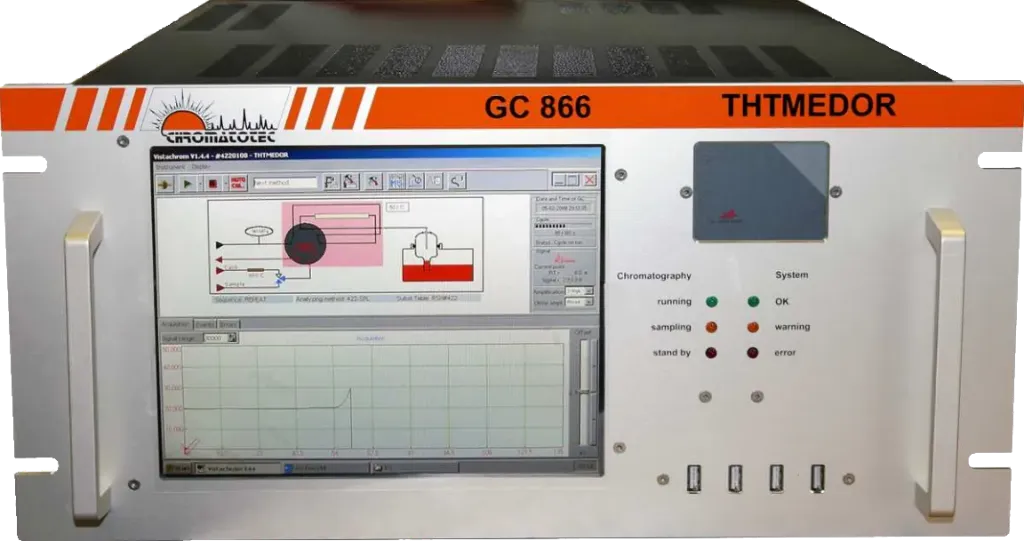
Gas distribution networks add odorants such as THT (tetrahydrothiophene) to naturally odourless gas so leaks can be detected by smell. Keeping that odorant concentration inside a narrow band is a regulatory and safety requirement, not a formality — too little and a leak goes unnoticed, too much and the gas becomes unpleasant to handle. The THT MEDOR from Chromatotec is built specifically for that job: continuous, unattended monitoring of THT (and TBM) concentration directly on the gas line.
THT MEDOR is a dedicated online gas chromatograph. Sample gas is drawn in through an automatic sample loop injection valve, separated on the column, and detected using a sulphur-specific electrochemical cell rather than a general-purpose detector. That specificity is the reason the instrument is not disturbed by the other hydrocarbon compounds present in natural gas, biogas or LPG streams. Internal pressure and temperature are monitored continuously, and the system validates its own results automatically using an internal permeation tube rather than relying solely on scheduled external calibration.
Two versions cover the two ranges that odorization applications typically need:
Ranges are adjustable depending on the application, per Chromatotec's specification.
THT MEDOR runs on Chromatotec's VISTACHROM® platform, which handles remote monitoring and injection control, full traceability through on-board archiving of results, and configuration of QC checks and threshold alarms. Data can be exported over MODBUS, MGS1, 4–20 mA or 0–10 V, which covers most SCADA and DCS integration scenarios used on gas network sites. Alarm thresholds (high/low) are user-modifiable, which matters for sites running different odorization targets across seasons or gas qualities.
The instrument is intended for continuous odorization or deodorization control on natural gas, biogas and LPG networks — the point where operators need to know, in real time and without manual sampling, whether the odorant level in the gas stream is within specification. It is not a general ambient air or industrial process VOC analyser; its detector is purpose-built for sulphur-based odorant compounds.
Chromatotec publishes separate technical documentation for Exd and Exp variants of the GC 866 platform that THT MEDOR is built on, alongside an ATEX and IECEx Zone 1, Group IIC, T4 certificate. Where an installation requires a certified enclosure for a classified zone, confirm with AAVOS which variant applies to the specific site classification before ordering — this is not automatically included on the standard unit.
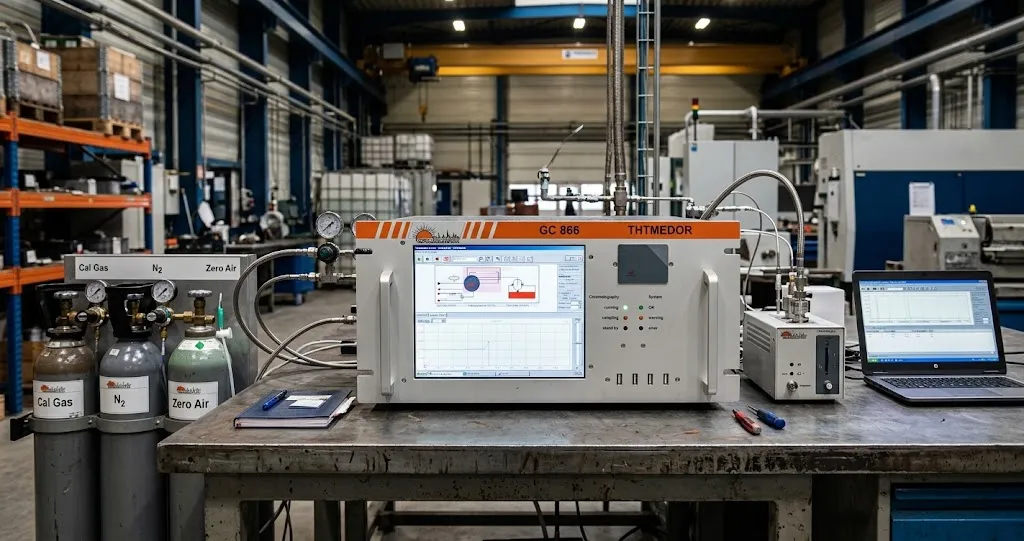
Required: carrier gas supply (N₂), sample line connection to the process
Optional: internal calibration module (adds 50 ml/min flow requirement)
Application-dependent: multi-stream sampling configuration, hazardous-area enclosure (Exd/Exp), SCADA/DCS integration hardware for the chosen output protocol
AAVOS supports THT MEDOR installations across Belgium, the Netherlands and Luxembourg with product selection and configuration advice, installation and commissioning support, calibration, and ongoing technical support. Where a project needs a specific hazardous-area variant or a particular SCADA output protocol, AAVOS can help confirm the right configuration before the order is placed rather than after installation.
What does the THT MEDOR analyser measure?
THT (tetrahydrothiophene), the odorant most commonly added to natural gas, and TBM, using a sulphur-specific electrochemical detection cell.
What's the difference between the ppm and ppb model?
The ppm model covers a detection range of 1–50 mg/m³ with a 1 mg/m³ detection limit; the ppb model covers 0.3–3.0 mg/m³ with a 0.3 mg/m³ detection limit. Both ranges are adjustable to the application.
How does the detection principle avoid interference from other gas components?
The instrument uses a sulphur-specific electrochemical cell rather than a general hydrocarbon detector, so other compounds present in the gas stream do not interfere with the THT/TBM measurement.
How long does one measurement cycle take?
180 seconds for a single-stream configuration; 240–300 seconds when configured for multiple sample streams.
Is the THT MEDOR available for hazardous (Ex) areas?
Yes. Chromatotec offers Exd and Exp variants of the underlying GC 866 platform, certified ATEX and IECEx Zone 1, Group IIC, T4. Confirm the required variant with AAVOS based on your site's zone classification.
How is measurement accuracy validated over time?
The system performs automatic validation using an internal permeation tube, in addition to the optional internal calibration module.
Which data protocols does the analyser support?
MODBUS, MGS1, 4–20 mA and 0–10 V, via the VISTACHROM® software platform.
What maintenance does the instrument require?
Chromatotec describes it as a low-maintenance instrument, with an estimated detector service life of up to 10 years. Specific maintenance intervals are not stated in the manufacturer documentation available to us — confirm with AAVOS for a maintenance plan.
Contact AAVOS for technical advice, configuration support or a quotation on the THT MEDOR.
We gebruiken cookies om je een betere gebruikerservaring op deze website te bieden. Cookiebeleid