Hoogprecisie-instrumenten voor luchtkwaliteitsmonitoring, deeltjesmeting en milieuanalyse – gebouwd voor betrouwbaarheid, nauwkeurigheid en naleving van de regelgeving.
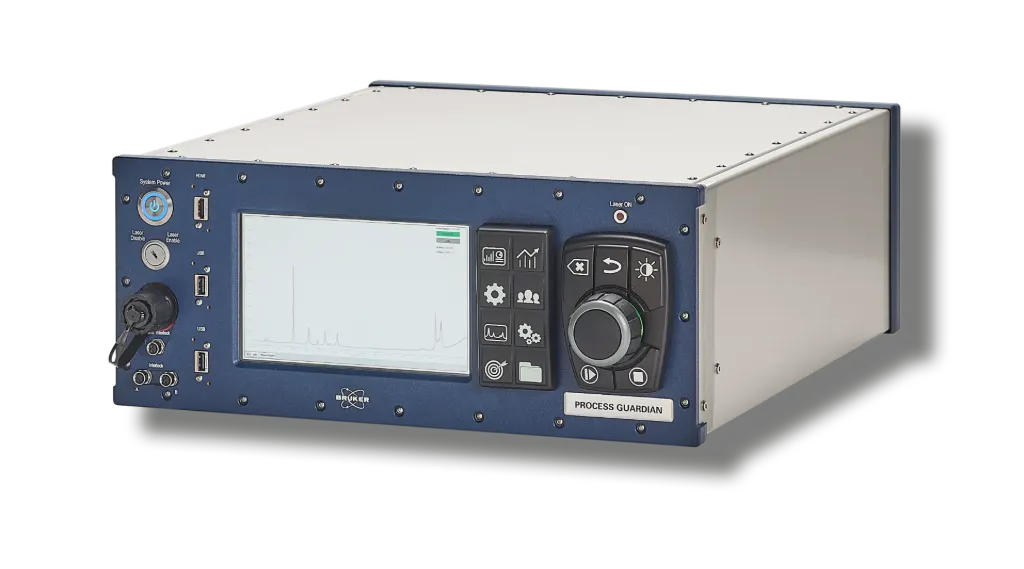
The Process Guardian™ is a standalone process Raman spectrometer that runs a full measurement without a connected PC — processor, software and display all sit inside the instrument. It is aimed at process engineers, PAT specialists and QC teams who need real-time molecular data from a reactor, pipeline or production line and don't want an external computer in the loop. Bruker builds it around its patented High Throughput Virtual Slit (HTVS™) optics, which is where the sensitivity advantage comes from.
Conventional slit-based Raman spectrometers throw away photons at the entrance slit. That's tolerable in a bright benchtop sample, limiting when you're measuring low-concentration analytes or fighting fluorescence background in a real process stream. HTVS™ removes the slit and, according to Bruker, raises signal intensity by 10× to 30× without giving up spectral resolution. In practice that means shorter acquisition times, better signal-to-noise and lower detection limits — the three things that usually decide whether a Raman method survives the move from lab to process.
HTVS™ virtual-slit optics — 10×–30× higher signal than slit-based instruments; faster measurements and lower detection limits.
Fully embedded architecture — integrated processor, software and 8.7" display. No external PC, no IT maintenance.
Field-replaceable 785 nm stabilised laser — the laser can be swapped on site rather than returning the unit.
4- or 8-channel fibre multiplexer (optional) — one analyser monitors several process points, cutting cost per measurement point.
Dual LAN, OPC UA and Modbus TCP/IP — direct integration into DCS/SCADA and remote 24/7 data access.
Rotary dial and glove-friendly buttons — operable in the field without removing PPE.
21 CFR Part 11 compliant — suitable for regulated pharmaceutical and biopharma environments.
ATEX-certified configurations — deployment in hazardous (Ex) zones; intrinsically safe measurement with the OPIS 35™ laser accessory.
The instrument is a rugged, rack-mountable unit intended to sit in a process environment rather than a clean lab. Because everything runs on the embedded processor, commissioning is largely a matter of mounting it, connecting the probe fibre and putting it on the network. Laser safety interlocks, integrated health monitoring and fault detection are built in, so the unit reports its own condition instead of relying on an operator to notice drift.
For chemical, petrochemical and pharmaceutical plants with classified zones, Process Guardian™ is available in Ex configurations. Paired with the OPIS 35™ ATEX/IECEx-certified laser accessory, it supports intrinsically safe Raman measurement — which is what allows the probe to sit directly on a process line in an explosive atmosphere rather than inside a purged enclosure.
Raman gives you molecule-specific information, so the same analyser covers a wide span of process problems. Bruker documents six main areas:
With the optional 4- or 8-channel fibre multiplexer, a single Process Guardian™ sequences through several probes on one process line. For plants where measurement points are spread across a skid or a reactor train, that changes the economics — you scale coverage by adding probes and fibre rather than adding analysers, and you get a more complete picture of the process from one calibrated instrument.
A 785 nm laser illuminates the sample through a fibre-coupled probe. Scattered light returns to the spectrometer, where HTVS™ optics replace the conventional entrance slit to pass far more of the collected photons onto the detector. The embedded processor applies the chemometric model and outputs concentrations or property values in real time, pushing them to the control system over OPC UA or Modbus TCP/IP. No external PC sits in the measurement chain.
(The Bruker source does not confirm a public manual, brochure or Declaration of Conformity — request through AAVOS.)
Can the Process Guardian™ run without a connected computer?
Yes. The processor, software and 8.7" display are built into the instrument, so it measures, applies the model and outputs results independently. That removes the external PC and its IT maintenance from the loop.
Is it suitable for an ATEX-classified area?
The instrument is available in Ex configurations, and with the OPIS 35™ ATEX/IECEx-certified laser accessory it supports intrinsically safe Raman measurement in hazardous zones. Confirm the exact zone rating and gas group needed for your installation with AAVOS.
How does HTVS™ improve on a standard Raman spectrometer?
By replacing the optical entrance slit, HTVS™ passes more collected photons to the detector — Bruker states 10×–30× higher signal intensity at unchanged resolution. The practical benefit is faster measurement, better signal-to-noise and lower detection limits, which matters most for dilute analytes and fluorescent samples.
Can one analyser monitor several process points?
Yes, with the optional 4- or 8-channel fibre multiplexer. One instrument sequences through multiple probes, so you scale measurement coverage without buying additional analysers.
Does it integrate with our control system?
It provides dual LAN interfaces with OPC UA and Modbus TCP/IP, so results feed directly into DCS/SCADA environments, and remote users can access data over standard industrial protocols.
Is it appropriate for GMP pharmaceutical manufacturing?
The instrument is 21 CFR Part 11 compliant, which supports its use in regulated small-molecule and biologics manufacturing. AAVOS can advise on validation support for your specific application.
What does it cost and how quickly can it be delivered?
Configuration — probe type, multiplexing, Ex options — drives both price and lead time. Contact AAVOS for a quotation matched to your process.
AAVOS is the Benelux distributor for Bruker process spectroscopy, covering Belgium, the Netherlands and Luxembourg. A process Raman method rarely succeeds on hardware alone — probe selection, installation on the line, chemometric model building and ongoing calibration all decide whether the numbers can be trusted. Rather than dealing with an overseas manufacturer, you get a local point of contact for advice, installation, commissioning, calibration, maintenance and technical support, from people who work with this class of instrument across the region.
Contact our specialists (https://www.aavos.be/contactus) to discuss probe configuration, hazardous-area options and integration for your process. Existing customers can submit a support request via our helpdesk (https://www.aavos.be/helpdesk).
We gebruiken cookies om je een betere gebruikerservaring op deze website te bieden. Cookiebeleid