Hoogprecisie-instrumenten voor luchtkwaliteitsmonitoring, deeltjesmeting en milieuanalyse – gebouwd voor betrouwbaarheid, nauwkeurigheid en naleving van de regelgeving.
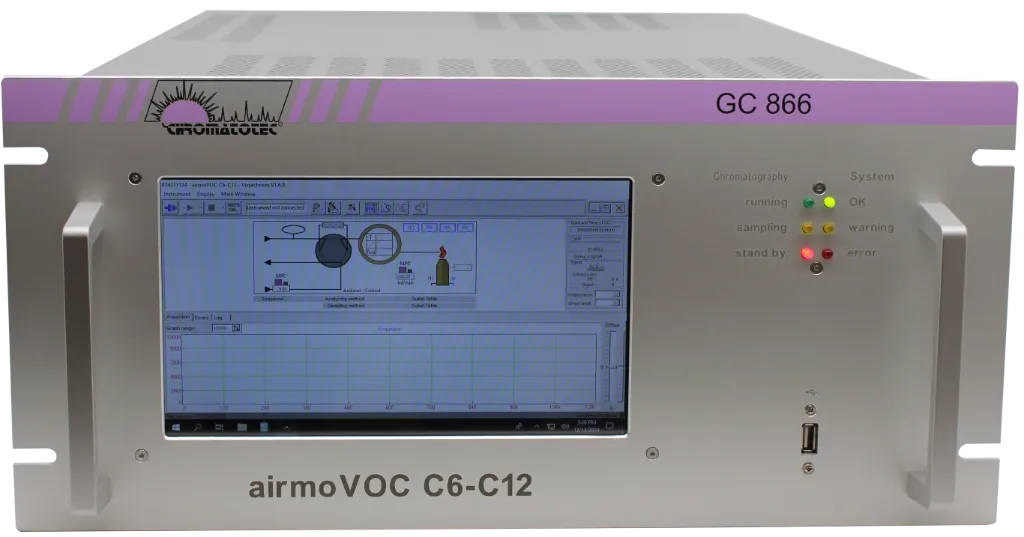
Benzene toxicity is not the only reason refineries, petrochemical sites and air-toxics networks watch the C6-C12 hydrocarbon range closely. Aromatics and halogenated species in this window carry most of the health-relevant risk in a VOC profile, yet they sit at concentrations that push ordinary gas chromatographs to their limits. The airmoVOC C6-C12 from Chromatotec was built around that problem: continuous, unattended speciation of hydrocarbons from C6 to C12, including PAMS target compounds, BTEX, and halogenated volatiles reported under the TO14 method.
AAVOS supplies this analyser to environmental agencies running fixed ambient air stations, to refineries and chemical plants monitoring fence-line or source emissions, and to laboratories and consultancies carrying out air-toxics or source-apportionment studies where individual benzene, toluene and heavier aromatic concentrations matter more than a lumped total-hydrocarbon figure.
Chromatotec's airmoVOC platform splits hydrocarbon monitoring by molecular weight for a practical reason: light and heavy VOCs behave differently on a column and mean different things to a regulator. The airmoVOC C2-C6 targets the lighter alkanes and alkenes associated with traffic emissions and ozone precursor monitoring. The C6-C12 instrument covers the heavier end — aromatics, halogenated compounds and the PAMS/BTEX/TO14 groups most relevant to air-toxics compliance, refinery source testing and benzene-specific regulatory reporting. Both share the same core chromatographic platform, but they are calibrated, certified and applied for different purposes; treat them as complementary rather than interchangeable.
The airmoVOC C6-C12 uses gas chromatography with flame ionisation detection (GC-FID), a well-established reference technique for hydrocarbon speciation because it responds proportionally to carbon content and separates individual compounds rather than reporting a bulk total. Sample air is drawn through a six-port valve onto a single sorbent trap, which pre-concentrates the target compounds before they are thermally desorbed onto a metallic capillary column. The column sits inside a programmable temperature gradient oven, and carrier gas flow is controlled by a piezo valve rather than a mechanical flow controller — a detail that matters for retention-time stability over long unattended runs, since piezo control responds faster to small pressure changes than conventional needle valves.
Sample volume is programmable between 30 and 700 ml, with a sampling time of up to 40 minutes, which lets an operator trade sensitivity against cycle time depending on whether the priority is trace-level detection or faster reporting.
The instrument analyses up to 53 compounds from C6 to C12, including the PAMS (Photochemical Assessment Monitoring Stations) target list and BTEX (benzene, toluene, ethylbenzene, xylenes). It also identifies halogenated volatile compounds reported under the TO14 method — the manufacturer's designation for the compound group associated with US EPA Method TO-14, commonly used to characterise chlorinated and brominated air toxics. This combination makes the airmoVOC C6-C12 relevant wherever a monitoring programme needs individual aromatic and halogenated concentrations rather than a total hydrocarbon figure, which a non-speciating detector cannot provide.
The two detection ranges reflect a switchable amplification setting on the FID electronics. Amplification 3 gives the finer 0.05–45 µg/m³ window needed for trace ambient measurements; switching to amplification 2 extends coverage to 0.5–400 µg/m³, which keeps higher-concentration episodes — closer to a fence-line or source scenario — within range without diluting the sample.
The airmoVOC C6-C12 is MCERTS certified for benzene measurement to EN 14662-3, the European reference method for automatic, pumped ambient air sampling with in-situ gas chromatography. For network operators reporting under EU ambient air quality legislation, that certification is what allows benzene data from this analyser to be used as compliance-grade evidence rather than indicative monitoring. It is a benzene-specific certification, worth noting for anyone assuming a blanket approval across the full 53-compound list.
Vistachrom, Chromatotec's chromatography software, handles visualisation, calibration and data export. It calculates retention time, peak area, mass and concentration profiles for each run, which is what turns a raw chromatogram into a reportable compound-by-compound result without manual peak integration on every cycle.
Environmental agencies and government monitoring authorities operate the airmoVOC C6-C12 in fixed ambient stations. Refineries, chemical manufacturers and other industrial operators use it for fence-line and process-boundary monitoring. Environmental consultancies deploy it for compliance and air-toxics assessments, and universities or research institutes use it where speciated, low-level hydrocarbon data supports atmospheric chemistry research.
AAVOS supplies, installs and calibrates the airmoVOC C6-C12 across Belgium, the Netherlands and Luxembourg. That includes helping select the right cycle time and amplification configuration for a given monitoring objective, on-site commissioning, and the preventive maintenance a trace-level gas chromatograph needs to keep retention times and peak resolution stable over months of unattended operation. Because AAVOS already supports the wider airmoVOC range, including the C2-C6, sites running both instruments get one point of contact for calibration gas, consumables and service scheduling instead of managing two separate supplier relationships.
What is the measuring principle of the airmoVOC C6-C12?
Gas chromatography with flame ionisation detection (GC-FID). Sample air is pre-concentrated on a single sorbent trap, desorbed onto a metallic capillary column inside a programmable temperature gradient oven, and separated compounds are detected by FID.
Which compounds does it measure?
Up to 53 compounds in the C6 to C12 range, including PAMS target compounds and BTEX, plus halogenated volatile compounds identified under the TO14 method.
What is the detection limit for benzene?
10 ppt in the standard configuration, improving to 1 ppt with the airmoVOC Expert configuration.
Is the airmoVOC C6-C12 certified for regulatory ambient air monitoring?
Yes, for benzene. It holds MCERTS certification for benzene measurement to EN 14662-3, the European reference method for automatic pumped sampling with in-situ gas chromatography.
How long does one measurement cycle take?
30 minutes as standard, with a 60-minute cycle available as an option.
Can it be integrated into an existing monitoring network?
Yes. The analyser supports a 4-20 mA current output and MODBUS/JBUS or MGS1 communication protocols as options, alongside internal data storage.
What is the difference between the airmoVOC C6-C12 and the airmoVOC C2-C6?
The C2-C6 targets lighter hydrocarbons associated with traffic-related and ozone-precursor monitoring. The C6-C12 covers heavier aromatics, BTEX and halogenated compounds, with MCERTS certification specifically for benzene under EN 14662-3.
Is the analyser suitable for unattended, continuous operation?
It is designed for continuous automatic operation with internal data storage and a documented retention-time stability of under 0.3% RSD over 48 hours. Maintenance intervals and consumable replacement schedules should be confirmed with AAVOS for a specific monitoring programme.
For a quotation, help selecting the right cycle time and amplification setting for your monitoring objective, or advice on calibration gas and network integration for the airmoVOC C6-C12, contact AAVOS International.
We gebruiken cookies om je een betere gebruikerservaring op deze website te bieden. Cookiebeleid