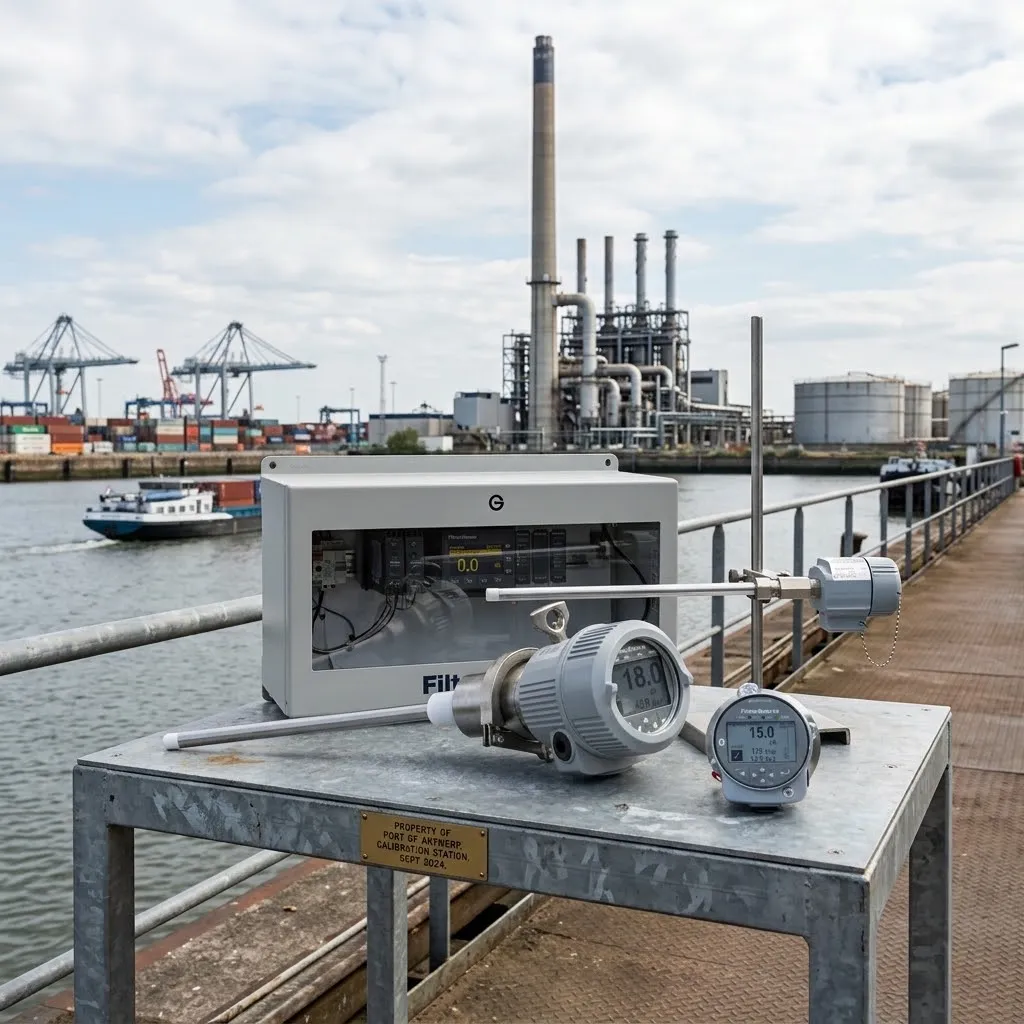
Hoogprecisie-instrumenten voor luchtkwaliteitsmonitoring, deeltjesmeting en milieuanalyse – gebouwd voor betrouwbaarheid, nauwkeurigheid en naleving van de regelgeving.
Filter bag failure rarely announces itself. A single torn bag in a baghouse with several hundred filter elements can leak particulate for days before it shows up in a stack test or an annual compliance report, and by then the damage to equipment downstream and to the compliance record is already done. The PM 1 PRO from Auburn, a Nederman company, is built specifically to close that gap: it monitors particulate concentration continuously, in situ, using charge induction sensing, so that a leak is flagged in minutes rather than discovered during the next scheduled inspection.
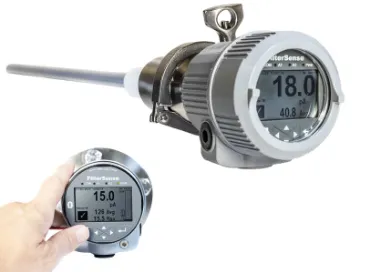
The PM 1 PRO belongs to Auburn's DynaCHARGE™ range and is designed for continuous, low-level particulate monitoring in stacks, ducts and pipes downstream of baghouses and dust collectors. Rather than relying on optical or beta-attenuation methods, the instrument uses electrodynamic (charge induction) sensing: particulate passing the probe induces a measurable electrical charge, which the electronics convert into a continuous output correlated to dust loading. Because the sensing element sits directly in the gas stream, response to a developing leak is immediate rather than delayed by sampling or averaging cycles.
The sensor is available as a transmitter-only version or combined with local alarm relays, and electronics can be mounted integrally on the probe or remotely where access or ambient conditions make that preferable.
Charge induction (electrodynamic) sensing works by exposing a probe electrode to the flowing gas stream. Particulate carried in the flow induces a small, measurable electrical charge on the electrode as it passes; the resulting signal, expressed in picoamps, is proportional to the mass and velocity of particulate present. This differs from optical scattering or beta-attenuation methods in that it requires no light source, no sample extraction and no filter media to maintain — the trade-off is that the output correlates with particulate loading rather than providing an absolute gravimetric reading, so site-specific correlation against a reference method is typically required where the output is used for regulatory reporting rather than leak alarm purposes alone.
Environmental and process engineers responsible for baghouse performance, compliance officers tracking particulate emission obligations, and maintenance teams who need an early warning before a filter failure escalates into an unplanned shutdown or an emissions exceedance.
Auburn positions the PM 1 PRO across dust-intensive process industries, including aluminium, battery manufacturing, carbon black, cement, chemical processing, food and dairy, foundries, incineration, minerals processing, pharmaceuticals, power generation, steel and wood processing — anywhere a baghouse or dust collector is a critical piece of environmental control equipment.
Three configurations cover different control-loop requirements: a transmitter-only version for straightforward 4-20 mA integration, an alarm-only version with relay outputs for standalone leak alarming, and a combined alarm-and-transmitter version for sites that want both a hard alarm contact and a continuous analogue signal. Communication is not limited to the analogue loop — Modbus RTU over RS-485, USB and Bluetooth® are all available, with HART offered as an option, which gives instrumentation teams a route to pull diagnostic and trend data without rewiring the loop.
Accuracy/repeatability figures, dimensions, weight, ingress protection rating, specific certification numbers and country of manufacture are not specified on the manufacturer's product page and should be confirmed from the datasheet before publication.
Not specified by the manufacturer on this page. Auburn's PM sensor comparison chart and application review form are available for sizing and probe selection support; consult these before specifying accessories.
AAVOS supplies particulate monitoring instrumentation across Belgium, the Netherlands and Luxembourg with the technical advice, commissioning and calibration support that a probe like the PM 1 PRO needs to perform reliably from day one. Correct probe placement and correlation against a reference method are the two most common sources of poor performance in charge-induction monitoring, and AAVOS' engineers can support both during installation as well as through ongoing maintenance and service contracts.
What does the PM 1 PRO actually measure?It measures a signal proportional to particulate concentration in the gas stream, using charge induction rather than optical or gravimetric methods. The output is typically used for trending and leak detection rather than as an absolute gravimetric reading.Can it be used for EPA compliance reporting?Auburn positions the PM 1 PRO to support EPA MACT, NESHAP and Title V/CAM monitoring requirements. Whether it satisfies a specific reporting obligation depends on the applicable regulation and any required site-specific correlation testing.Is the PM 1 PRO suitable for hazardous areas?Yes. It carries a Class I Division I (Zone 0/20) rating, which covers most explosive-atmosphere process applications.What is the difference between the PM 1 PRO-T, -A and -AT models?The -T is a transmitter-only version with a 4-20 mA loop output. The -A is an alarm-only version with relay contacts. The -AT combines both a 4-20 mA transmitter output and alarm relays in one unit.Does it need a separate power supply?The transmitter version can run loop-powered on 2-wire 4-20 mA. The alarm and alarm/transmitter versions require a line power connection to operate the relay outputs.How is the sensor mounted?Electronics can be integral to the probe or mounted remotely, which is useful where ambient temperature or accessibility at the process connection makes integral mounting impractical.What communication protocols does it support?USB, Bluetooth® and Modbus RTU over RS-485 are standard; HART is available as an option.Can AAVOS support installation and calibration in the Benelux?Yes. AAVOS provides technical advice, installation support, commissioning and service contracts for particulate monitoring instrumentation across Belgium, the Netherlands and Luxembourg.
For advice on specifying a PM 1 PRO for a specific baghouse or duct application, contact AAVOS' technical team for support with probe selection, installation and calibration.
We gebruiken cookies om je een betere gebruikerservaring op deze website te bieden. Cookiebeleid