Hoogprecisie-instrumenten voor luchtkwaliteitsmonitoring, deeltjesmeting en milieuanalyse – gebouwd voor betrouwbaarheid, nauwkeurigheid en naleving van de regelgeving.
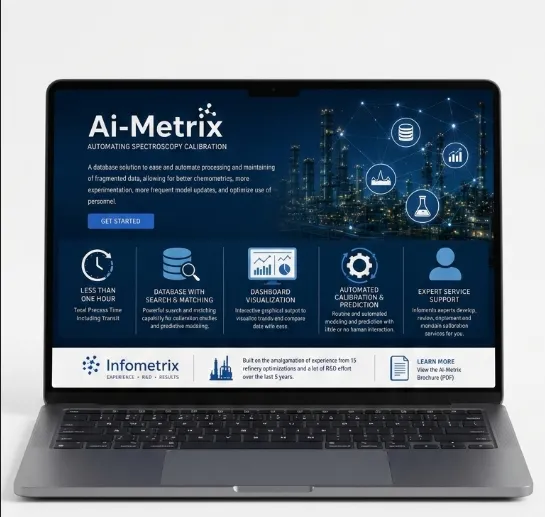
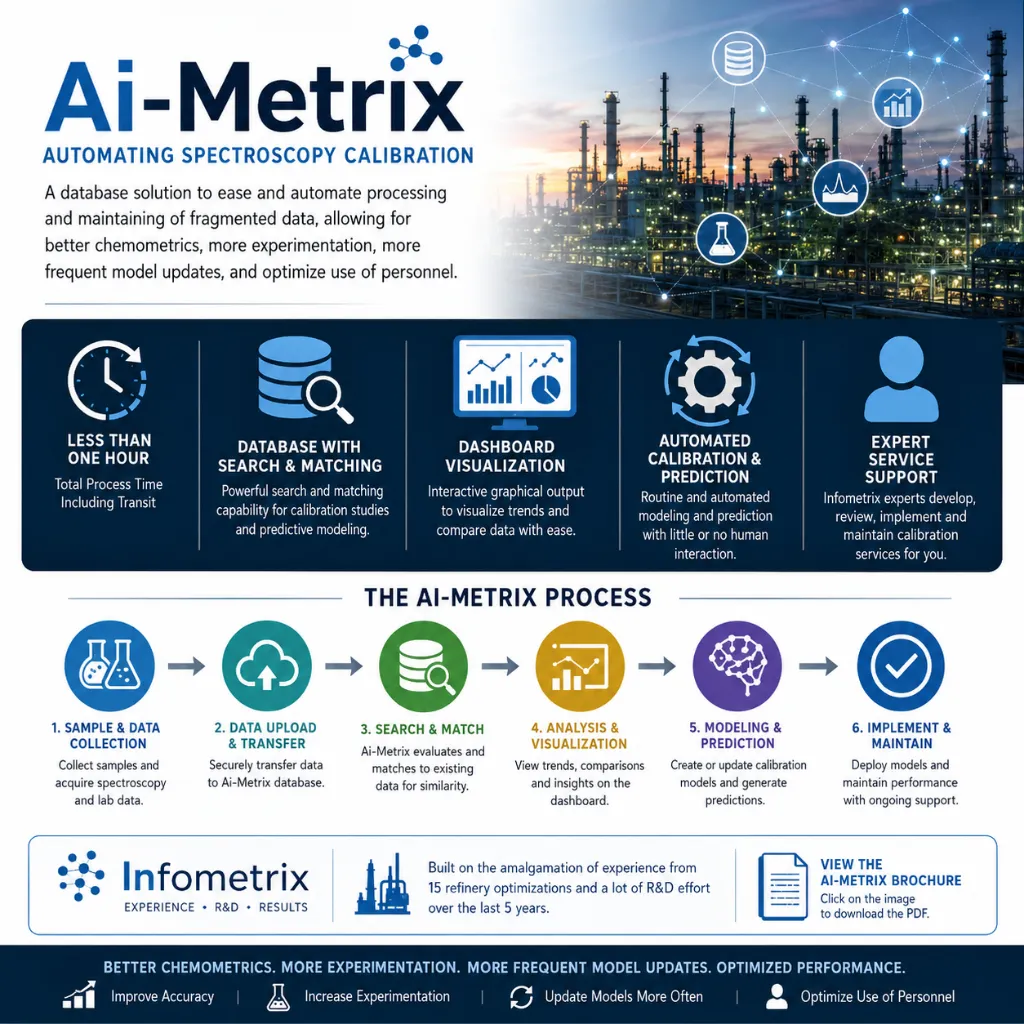
Ai-Metrix is a database and automation layer that sits on top of the spectrometers already running in your lab or process unit. It matches every new spectrum to its reference value, builds and maintains PLS calibration models without manual intervention, and tracks model quality on a live dashboard. Infometrix, the developer behind Ai-Metrix, built the system on lessons learned across fifteen refinery calibration projects and several years of dedicated R&D, and AAVOS supplies and supports it across Belgium, the Netherlands and Luxembourg.
The workflow starts on the customer's own desktop. Lab data and spectra are dropped into a shared folder, and a SQL Server database — the core of Ai-Metrix — watches that folder and matches spectra to reference values automatically, without the file needing to be cleaned up first. Unmatched data is held until its partner arrives; matched pairs are sorted into calibration or validation sets. Within minutes, the result is visible on a browser-based Tableau dashboard, showing which spectra are waiting on a reference value and which reference values have no spectrum yet.
Model requests go through a pre-built Excel workbook populated with the customer's own properties, sample categories and date ranges. Submitting it triggers the modelling engine: a three-step robust statistical routine removes samples that would degrade the model, followed by a two-step PLS run that sets the optimal number of factors. This five-step sequence runs separately for every property being modelled. Processing time ranges from a few minutes to several hours depending on how much data is in the database and how many properties are requested — Infometrix positions the full turnaround, including transit time for new data, at under an hour for a routine update.
Infometrix built Ai-Metrix from established, swappable components rather than a proprietary black box: Microsoft SQL Server for the database core, Adobe PDF for reports, Tableau Online for the dashboards, and Infometrix's own Pirouette software to verify model quality. Because the components are modular, a better-performing technology can replace one of them later without disturbing the rest of the system, and if a customer's existing modelling software already handles a given application, Ai-Metrix can be configured to reproduce that process rather than replace it outright. Infometrix scientists review each spectrometer's calibration history during setup so the automated process starts from the customer's own established practice, not a generic default — and those settings remain open for review at any time.
Every model request returns a PDF report documenting the distribution of lab values, the number of inliers and outliers identified at each of the five processing steps, and the number of factors selected — more than seventy diagnostics feed into that assessment. New incoming data is checked against the standard error of prediction from the most recent model, so a replacement model is only triggered when it would genuinely improve on the one in service, and the resulting model history builds into a performance-over-time view on the dashboard. Where a report needs to follow a specific ASTM procedure — D6708, for example, which checks whether a reference method and a spectral method agree — Infometrix adds it at no extra charge. Bespoke, organisation-specific reports can also be built into the database output for a one-off development charge, after which they run automatically alongside the standard reporting.
Each model request produces both a Pirouette file (the outlier-free data set with the model built and its complexity set) and, where Pirouette is used for routine processing, a ready-to-use Pirouette model. For customers running other chemometrics packages, Ai-Metrix can instead deliver the inlier sample set and the chosen factor count directly, so the model can be built in whatever software the customer already has installed.
Ai-Metrix was developed inside the refining and petrochemical sector — the two confirmed brochures cover general use and refinery-specific deployments, with the refinery brochure also available in Japanese and Spanish — and it fits naturally wherever spectroscopic calibration models support process or blending decisions: crude oil and gasoline property prediction, fuel and gasoline blending optimisation, MON/RON prediction, and broader hydrocarbon processing and reaction monitoring work. Because the system is not tied to any spectrometer manufacturer or existing chemometrics platform, it also suits research groups and multi-site operators who need one calibration workflow across a mixed instrument fleet.
Refinery and petrochemical process laboratories running routine NIR or other spectroscopic analysers for blending and quality control; process engineers responsible for keeping calibration models current across multiple instruments or sites; laboratory managers who need calibration work to survive staff turnover; and chemometricians who want an audit trail of every model built rather than a folder of loose files.
AAVOS quotes base fees, setup costs and any site-specific configuration directly, get in touch for a proposal against your instrument count and property list.
Does Ai-Metrix only work with Infometrix instruments?
No. Ai-Metrix is designed to be independent of spectrometer manufacturer and can be configured to support legacy chemometrics software already in use, so it works across a mixed instrument fleet rather than locking you into one brand.
How long does it take to get a new or updated calibration model?
Once data is submitted, processing typically takes a few minutes to a few hours depending on the size of the database and the number of properties requested. Infometrix positions the full routine turnaround, including data transit, at under an hour.
Do we need Pirouette to use the models Ai-Metrix builds?
No. Pirouette files and models are included as standard, but if your site runs a different chemometrics package, Ai-Metrix can deliver the outlier-free sample set and optimal factor count for use in that software instead, for an additional setup fee plus $100/month per spectrometer.
How many properties can be modelled per instrument?
The base service covers up to 20 properties per prediction per spectrometer, with no limit on the total number of models the system maintains over time.
How does Ai-Metrix know when a calibration needs updating?
Every new data point is checked against the standard error of prediction from the most recent model. A replacement model is only generated when the system expects a genuine improvement, which keeps you from rebuilding models that don't need it.
What comes with each model report?
A PDF report showing the distribution of lab values, the inliers and outliers found at each of the five processing steps, and the number of factors selected, backed by more than seventy quality diagnostics. ASTM-format reports such as D6708 are added on request at no extra charge.
Where is our lab data stored and how is it secured?
The source material doesn't specify hosting location, data residency or a security certification for the SQL Server/Tableau Online components — for EU-based labs this is worth confirming directly with AAVOS before rollout, particularly around GDPR compliance.
What does it cost and how do we get started?
Ai-Metrix runs on a one-time setup cost plus a monthly fee, scaled to your instrument count and property list. Contact AAVOS for a quotation and a walkthrough of the process against your own data.
AAVOS is the Benelux distributor for Ai-Metrix and the wider Infometrix range, providing advice, installation support, commissioning and ongoing technical support from a local base in Belgium rather than routing every question through a supplier on the US West Coast. For a system that lives on your own network and touches your calibration data daily, having a Benelux point of contact for configuration questions, training and troubleshooting shortens the distance between a problem and a fix.
Want to see how Ai-Metrix would handle your own spectrometer fleet? Contact our specialists for a walkthrough of the process and a quotation based on your instrument count and properties. Existing Ai-Metrix users can submit a support request through the AAVOS helpdesk.
We gebruiken cookies om je een betere gebruikerservaring op deze website te bieden. Cookiebeleid