Hoogprecisie-instrumenten voor luchtkwaliteitsmonitoring, deeltjesmeting en milieuanalyse – gebouwd voor betrouwbaarheid, nauwkeurigheid en naleving van de regelgeving.
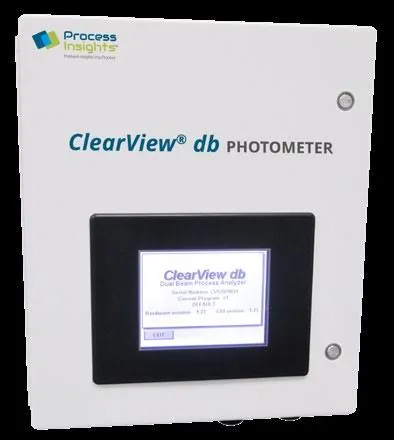
ClearView db is a VIS-NIR dual-beam photometer for continuous colour, concentration and turbidity measurement on liquid and gas process streams. Guided Wave positions it as the first commercially available true dual-beam filter photometer — rather than measuring a single beam against a fixed reference, it compares sample and reference beams continuously, which is what keeps a filter photometer accurate over months of lamp ageing and optical drift rather than just at commissioning.
Key Benefits
True dual-beam optics compensate for lamp ageing and optical contamination as they happen, instead of requiring a fresh reference measurement each time. A tungsten-halogen lamp rated at over 4,000 hours typical life, combined with the dual-beam design, stretches the interval between probe cleanings and lamp changes. Six filter positions support multi-parameter analysis from one unit, and an optional second sample channel brings the cost per sample point down further. Three enclosure options — general purpose, Class I Division 2, and Class I Division 1 explosion-proof — cover everything from a utility room to a classified hazardous area without changing analyser platform. Fibre optic cables carry light up to 100 metres between the photometer and the sample interface, so the electronics can sit somewhere accessible while the measurement point stays wherever the process actually is. It works with both flow cells and insertion probes, so the sample interface can be chosen to fit the installation rather than the other way round.
Applications
Guided Wave names five specific measurements: ASTM or Saybolt colour in fuels, hydroxyl (OH) number to catch a polymer reaction end point, water content in solvents, haze in diesel fuel using the turbidity option, and NaOH concentration in water. That range reflects the industries it's actually sold into: chemical production, petrochemicals, refining, biofuels, pharmaceutical manufacturing, food and beverage production, polymer production, and environmental monitoring and testing.
Typical Users
Process engineers in refining or petrochemical plants tracking fuel colour or haze specification in real time; polymer producers who need an in-line signal for reaction end point rather than a lab sample turnaround; and QC teams in pharmaceutical, food and beverage, or environmental labs running continuous concentration or turbidity checks rather than periodic grab-sample testing.
How It Works
Measurement follows the Beer-Lambert law: light passes through the sample at wavelengths selected by the filters fitted for a given application, and the degree of absorption at each wavelength correlates to the concentration or property being tracked. The complete system has three parts — the photometer itself, fibre optic cables, and the sample interface — with the fibre link allowing the sample point to sit up to 100 metres from the photometer electronics. Each application is defined by its own calibration, built from absorption data tied to known analytical values, so the filter set and calibration together determine what the instrument is actually measuring on a given installation.
Technical Highlights
Detector options cover silicon (450–1,050 nm), InGaAs (800–1,650 nm) and thermo-electrically cooled extended InGaAs (1,000–2,150 nm, maximum three fitted) — 2 to 6 detector/filter positions total, any combination except more than three xInGaAs units. Response time is user-settable down to a minimum of one second. Standard communications run over Ethernet using TCP Modbus; analogue and discrete outputs scale from up to 6 on a single-channel unit to up to 4 per channel on a two-channel unit. Local operation is via a colour QVGA LCD touchscreen.
Technical Specifications
Design: fibre optic dual-beam photometer. Channels: 1 sample channel standard, optional 2nd sample channel, optional turbidity monitoring on channel 1 only. Detectors/filters: 2–6, any combination of detector types except more than 3× xInGaAs. Filters: per customer requirements, maximum 6 individual filters. Detector types: Si (450–1,050 nm); InGaAs (800–1,650 nm); xInGaAs (1,000–2,150 nm, TE-cooled, max. 3). Light source: tungsten-halogen, >4,000 hours typical. Spectral range: 450–2,150 nm. Photometric noise: <50 µAU, 450–2,100 nm, 1-minute RMS. Photometric drift: <500 µAU RMS/°C. Wavelength drift: property of the filter fitted. Response time: 1 second minimum, user-settable. Fibre size: 400, 500 or 600 µm diameter, single strand. Fibre type: fused silica, ultra-low-OH (optimum range 450–2,150 nm). Fibre connectors: SMA 905. Analogue outputs: up to 6 (1-channel unit) or up to 4 per channel (2-channel unit); 4–20 mA, customer powered. Discrete outputs: up to 6 (1-channel unit) or up to 4 per channel (2-channel unit); contact closures. Analogue inputs: 4 (optional), 4–20 mA, isolated grounds. Local display: colour QVGA LCD touchscreen. Communications: Ethernet (TCP Modbus), standard. Power: 24 VDC, 3 A. Environmental rating: 0–45°C, 0–90% RH, sun and rain sheltered.
Enclosure Options
General purpose: NEMA 4, 14" × 12" × 6" (36 × 31 × 15 cm). Class I Division 2: Z-Purge, NEMA 4X, 16" × 20" × 6" (41 × 51 × 15 cm). Class I Division 1 (explosion-proof): IECEx, ATEX, 16" × 17" × 10" (41 × 43 × 26 cm).
Downloads
Datasheet. NIR/UV-VIS Application Questionnaire.
Frequently Asked Questions
Can one ClearView db monitor more than one parameter at once? Yes — up to six filter positions support multi-parameter analysis, and an optional second sample channel lets one unit cover two sample points.
Is it suitable for hazardous-area installation? Yes — beyond the general-purpose NEMA 4 enclosure, Class I Division 2 (Z-Purge, NEMA 4X) and Class I Division 1 explosion-proof (IECEx, ATEX) versions are both available, each in its own enclosure size.
How far can the sample point be from the analyser electronics? Up to 100 metres, using optical-grade fibre cable to carry light between the photometer and the sample interface.
What's the difference between this and a single-beam photometer? A single-beam design measures one light path and is vulnerable to drift as the lamp ages or optics get dirty. ClearView db compares a sample beam against a reference beam continuously, which Guided Wave states significantly reduces that drift and improves long-term repeatability.
Does it work with flow cells, insertion probes, or both? Both — it's compatible with a wide range of flow cells and insertion probes, so the sample interface can be matched to the installation.
How does it communicate with our DCS or SCADA system? Ethernet using TCP Modbus is standard, alongside configurable analogue (4–20 mA) and discrete (contact closure) inputs and outputs.
How do we get pricing and lead time? Contact our specialists with your target measurement, sample interface and area classification for a proposal.
Why AAVOS?
AAVOS distributes the Process Insights and Guided Wave range across Belgium, the Netherlands and Luxembourg, handling advice, installation, commissioning, calibration and technical support locally rather than through Process Insights' EMEA office in Frankfurt. Choosing the right filter set, detector combination and enclosure rating for a specific measurement is a calibration conversation worth having before ordering, and that's exactly the kind of pre-purchase support a local distributor is positioned to give.
Contact our specialists with details of your process stream and target measurement to discuss configuration, or submit a support request if you're already running a ClearView db installation.
We gebruiken cookies om je een betere gebruikerservaring op deze website te bieden. Cookiebeleid